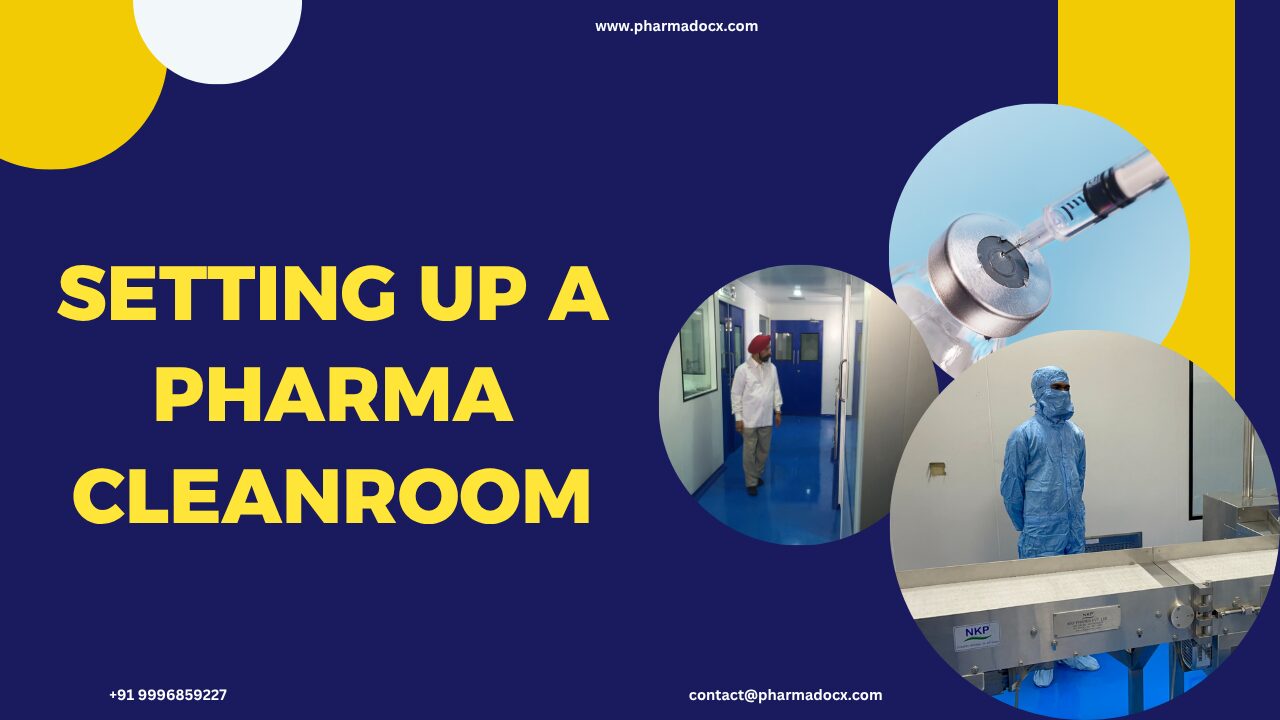
A pharmaceutical cleanroom is a highly controlled environment designed to minimize contamination during drug manufacturing. Airborne particles, temperature, humidity, and pressure are strictly regulated in a clean room. Setting up a pharma cleanroom requires a structured and regulatory-driven process. It is important to clearly define the product and process requirements before setting up a pharmaceutical cleanroom. The clean room should maintain compliance with GMP standards.
What is a pharma cleanroom?
A pharma cleanroom is a specialized, controlled environment used in drug manufacturing where air quality, temperature, humidity, and pressure are tightly regulated to prevent contamination. It is designed with smooth, non-shedding surfaces, HEPA-filtered air systems, and strict zoning to minimize the presence of particles and microbes. Moreover, personnel must follow rigorous gowning and hygiene protocols. Additionally, continuous monitoring ensures compliance with international standards, such as ISO 14644 and GMP guidelines. Thus, a pharma cleanroom safeguards product integrity and patient safety by ensuring sterile, contamination-free production conditions.
Key features
- Air quality control: Uses HEPA or ULPA filters to remove particles and microbes.
- Environmental regulation: Maintains precise temperature, humidity, and pressure differentials.
- Surface design: Smooth, non-shedding materials for walls, floors, and ceilings to reduce particle accumulation.
- Personnel protocols: Strict gowning procedures (coveralls, gloves, masks, shoe covers) to limit human contamination.
- Monitoring systems: Continuous particle counts, microbial sampling, and pressure checks to ensure compliance.
10-step guide to setting up a pharma cleanroom
Setting up a pharma cleanroom involves a structured process. Each step requires detailed planning and execution to meet GMP and ISO 14644 standards. We have prepared a detailed guide to help you set up a pharmaceutical cleanroom per industry standards.
1. Define the purpose and classification
The first step is to understand the cleanroom’s intended use, such as sterile manufacturing, non-sterile production, or microbiological testing before setting up a pharma cleanroom. Cleanroom classification depends on airborne particle concentration. Classification determines gowning requirements, air cleanliness levels, and monitoring procedures. Early definition ensures design consistency across HVAC, materials, and personnel protocols. This step aligns the facility with FDA, EU, and CDSCO regulatory expectations.
2. Determine the cleanroom mechanism and flow
Layout design directly impacts contamination control and operational efficiency. Poor design can cause cross-contamination, backflow of unfiltered air, and personnel errors. Personnel and materials must follow unidirectional flows, separated by airlocks. Pressure differentials (10–15 Pa) help distinguish rooms of varying cleanliness. Material flow should follow the following pathway: entry, processing, packaging, and waste removal. A logical layout supports GMP compliance and minimizes contamination risks.
3. Select construction materials carefully
Surfaces must be smooth, non-porous, and resistant to disinfectants. Recommended materials include epoxy-coated panels or stainless steel for walls/ceilings. Floors should be seamless and made with epoxy or polyurethane. Doors, windows, and lighting fixtures must be flush-mounted to prevent particle accumulation. Materials like wood or gypsum are prohibited due to particle shedding. All joints should be sealed with silicone to prevent microbial growth and air infiltration.
4. HVAC system design
Heating, Ventilation, and Air Conditioning (HVAC) systems maintain air cleanliness, temperature, humidity, and pressure. High-Efficiency Particulate Air (HEPA) filters remove ≥99.97% of particles ≥0.3 µm. Air changes per hour range from 20 (low-class) to 600 (high-class cleanrooms). Positive pressure prevents contaminated air ingress. Target conditions are 20–22 °C and 40–60% relative humidity. Preventive maintenance and filter integrity testing are essential.
5. Create zoning and pressure cascade
Cleanrooms use pressure cascades to maintain cleanliness gradients. The cleanest areas (Grade A) have the highest pressure, decreasing outward. Airlocks and gowning areas require defined pressure control. Differential gauges must be installed at transitions. This system prevents contaminated air from entering critical zones.
6. Define personnel and material flow procedures
Personnel are the largest source of contamination, requiring strict protocols. Entry should involve removing street clothes, washing hands, and donning sterile garments. Garments should include coveralls, gloves, masks, and shoe covers. Personnel should enter controlled areas via airlocks. Material airlocks must have interlocking doors and disinfected surfaces. Unidirectional flow ensures no backtracking of materials or personnel.
7. Test and install cleanroom utilities and equipment
Equipment must be corrosion-resistant and low in particle generation. Utilities include purified water, clean steam, compressed air, and nitrogen. They must meet ISO microbial/chemical quality standards. Sloped drains avoid water pooling and microbial growth. Validation ensures utilities consistently meet pharmaceutical-grade specifications.
8. Perform qualification and validation
Qualification occurs in four stages: DQ, IQ, OQ, PQ. DQ verifies design compliance with regulatory requirements. IQ confirms proper installation of systems and equipment. OQ tests operational performance (airflow, HEPA integrity, pressure, temperature). PQ ensures consistent performance under real working conditions. Requalification is required every 6–12 months or after major changes.
9. Implement environmental monitoring and cleaning programs
Continuous monitoring ensures cleanroom compliance during operations. Parameters to be assessed include particle counts, viable air/surface sampling, temperature, humidity, and pressure. Cleaning effectiveness must be validated and documented. Disinfectant rotation (e.g., alcohol and sporicidals) prevents microbial resistance. Settle plates and swabs track microbial contamination trends. Documentation supports audit readiness and regulatory compliance.
10. Train personnel and maintain compliance
Training personnel is an important step in setting up a pharma cleanroom. Training covers GMP basics, sanitation, and cleanroom behavior. Personnel must learn proper gowning, entry, and contamination control techniques. Cleaning methods and record-keeping should be emphasized. Internal audits verify compliance and identify deviations. Regular refresher training ensures ongoing competence. Compliance is sustained through documentation, audits, and corrective actions.
Setting up a pharma cleanroom: Pitfalls and how to mitigate them
We have listed some of the common pitfalls encountered while setting up a pharma cleanroom and provided tips on how to mitigate them.
- Design flaws: Poor layout, inadequate zoning, or incorrect HVAC design can lead to cross-contamination. Engage GMP-experienced architects and engineers early, use regulatory guidelines (ISO 14644) as design baselines, and conduct design qualification (DQ) before construction.
- HVAC imbalance: Incorrect air changes per hour, pressure differentials, or HEPA filter failures compromise sterility. Implement continuous calibration, install differential pressure gauges, and perform routine filter integrity testing (DOP/PAO).
- Human error: Personnel are the largest contamination source due to improper gowning, poor hygiene, or incorrect material handling. Establish strict SOPs, provide recurrent training, enforce unidirectional flow, and conduct mock audits to reinforce compliance.
- Material and equipment contamination: Non-compliant materials (wood, gypsum, porous surfaces) or unvalidated equipment introduce particulates and microbes. Use stainless steel or epoxy-coated materials, validate utilities (water, steam, compressed air), and ensure equipment is GMP-compliant and low-shedding.
- Regulatory gaps: Misalignment with global standards (FDA, EU GMP, CDSCO) can lead to audit failures and product rejection. Develop a harmonized compliance checklist, conduct gap analyses, and maintain audit readiness through documentation and CAPA systems.
- Environmental monitoring failures: Inadequate particle/microbial monitoring or poor cleaning validation allows contamination to go undetected. Implement continuous monitoring systems, rotate disinfectants to prevent microbial resistance, and validate cleaning procedures with trend analysis.
- Operational drift over time: Cleanrooms degrade due to wear, improper maintenance, or complacency in SOP adherence. Schedule preventive maintenance, enforce requalification every 6–12 months, and conduct internal audits to catch deviations early.
Pharmadocx Consultants: We will help set up a pharma cleanroom in a hassle-free manner
Setting up a pharma cleanroom is not simply a construction project. It is the creation of a highly regulated ecosystem where every detail safeguards product quality and patient safety. Success depends on aligning design, materials, HVAC systems, and personnel protocols with international standards, such as ISO 14644 and GMP guidelines. Each stage, from zoning and pressure cascades to qualification and environmental monitoring, must be executed with precision and documented for audit readiness. We offer comprehensive pharma cleanroom setup service. Our years of experience have made us a pioneer in pharma cleanroom setup. To hire our experts, email at [email protected] or call/Whatsapp on 9996859227.