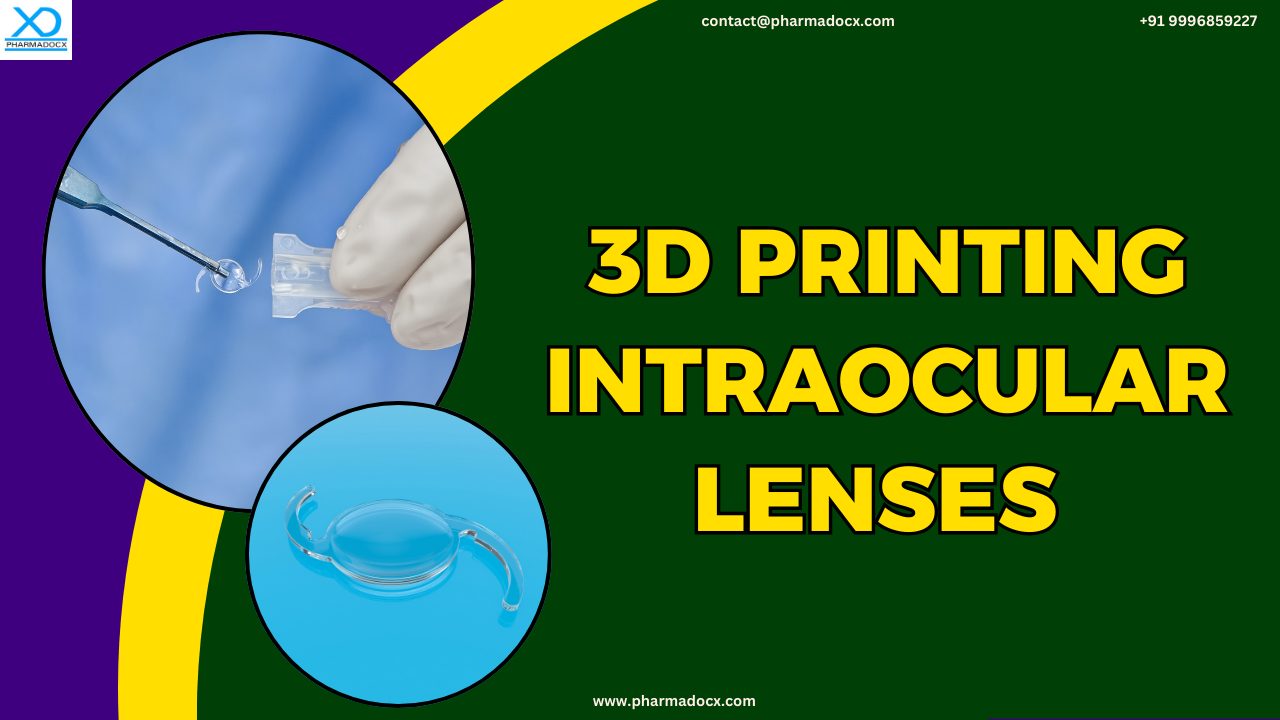

Intraocular lenses (IOLs) are artificial lens used to replace the natural lens that has been removed during cataract surgery. Traditionally, these lenses are produced using cast molding and lathe-cutting methods. However, these approaches restrict design flexibility. The advent of 3D printing is transforming the way IOLs are manufactured. By leveraging 3D printing, manufacturers can now design patient-specific lenses, incorporate intricate optical geometries, and rapidly prototype with exceptional precision. This breakthrough will not only improve visual outcomes for patients but also accelerate innovation. Additionally, it will ensure adherence to international medical device regulations. In this blog, we have discussed what is 3D printing intraocular lenses along with its advantages and disadvantages.
What is an intraocular lens?
An intraocular lens (IOL) is a small, clear, artificial lens implanted inside the eye to replace the natural lens that has been removed during cataract surgery. They can also correct refractive errors like nearsightedness (myopia), farsightedness (hyperopia), and astigmatism. IOL restores the eye’s ability to focus light onto the retina, allowing clear vision. Just like the natural crystalline lens, an IOL refracts light rays so that they focus properly on the retina, enabling sharp vision. IOLs are typically made of biocompatible plastic or acrylic. They have a central optic (the clear lens) and side struts called haptics that hold it securely in place inside the eye. The benefits of IOLs are clearer vision, reduced dependency on glasses or contact lenses, and long-term stability.
Types of IOLs:
- Monofocal IOLs: Focus at one distance (usually far). Glasses may still be needed for near vision.
- Multifocal IOLs: Provide vision at multiple distances (near, intermediate, far), reducing dependence on glasses.
- Toric IOLs: Correct astigmatism by compensating for irregular corneal curvature.
- Phakic IOLs: Implanted without removing the natural lens, often used for high refractive errors.
Hence, choice of IOL depends on lifestyle, vision needs, and eye health. Notably, some premium IOLs (like multifocal or toric) may cost more but offer greater convenience.
3D printing intraocular lenses
3D printing intraocular lenses (IOLs) is an emerging technology that uses additive manufacturing to create customized artificial lenses for implantation in the eye, primarily after cataract surgery. Unlike traditional methods, such as cast molding or lathe-cutting, 3D printing enables patient-specific designs, complex optical geometries, and rapid prototyping with exceptional precision. Thus, 3D printing intraocular lenses is a paradigm shift towards personalized ophthalmology.
What makes 3D printing IOLs different?
Traditional IOL manufacturing has limitations. Conventional IOLs are mass-produced using molds and cutting techniques, which restrict design flexibility and hinder innovation. However, 3D printing builds lenses layer by layer using specialized resins or polymers, allowing intricate designs that were previously impossible. Notably, each eye has unique anatomical and biometric characteristics. 3D printing allows tailoring of lens shape, thickness, and optical power to match individual patient needs.
Materials required for 3D printing intraocular lenses
The key materials required for 3D printing intraocular lenses (IOLs) are specialized biocompatible, optically clear resins and polymers designed to meet strict medical device standards. These materials must combine transparency, durability, and safety for long-term implantation in the eye.
Photocurable resins and acrylic polymers are commonly used. These materials provide superior optical clarity, smooth optical surfaces, flexibility, and biocompatibility. Transparency, refractive index stability, smooth surfaces, and long-term durability are critical while choosing IOL 3D printing materials. Hydrogels are being explored for their ability to mimic natural lens properties and potential for adjustable optics and drug-eluting designs. However, they require further validation for long-term implantation.
Biocompatibility of IOL 3D printing materials is vital and they should pass ISO 10993 for ocular implants. Additionally, they should be resistant to UV exposure, mechanical stress, and long-term degradation inside the eye. Moreover, the materials must withstand sterilization processes (e.g., autoclave, ethylene oxide, gamma radiation) without losing optical properties.
3 IOL 3D Printing techniques
We presented some techniques for 3D printing intraocular lenses.
- Stereolithography (SLA): Uses UV-curable resins to achieve ultra-high resolution and smooth optical surfaces.
- Two-photon polymerization (TPP): Enables nanoscale precision, ideal for complex optical geometries.
- Inkjet-based bioprinting: Being explored for layering biocompatible hydrogels with optical clarity.
Design capabilities of 3D printed IOLs
- Patient-specific customization: Lens curvature, thickness, and optical zones can be tailored to biometric data.
- Advanced optics: Multifocal, extended depth-of-focus (EDOF), and toric geometries can be directly printed.
- Rapid prototyping: Iterative design cycles allow faster innovation compared to mold-based methods.
Clinical implications of 3D printed IOLs
- Enhanced outcomes: Custom optics reduce residual refractive error post-surgery. 3D printed IOLs have the potential to minimize dependence on spectacles for near/far vision.
- Challenges: Achieving consistent optical clarity across batches can be challenging. Long-term stability of printed polymers in vivo can be a hassle. Surgeon adoption will require training and confidence in new lens designs.
Regulatory and quality considerations
- Validation needs: ISO 13485 QMS integration is required for additive manufacturing workflows. ISO 14971 risk management is applicable to new material/process risks (e.g., polymer leachables, surface roughness). Biocompatibility testing as per ISO 10993 guidelines has to be performed for ocular implants.
- Global regulatory pathways: The regulatory pathway for FDA will likely be via PMA or 510(k) with special controls, requiring demonstration of optical performance equivalence. With respect to EU MDR scrutiny will focus on manufacturing process validation and clinical evidence. CDSCO will require risk-based device-specific licensing with detailed technical dossiers and GMP compliance. Health Canada will demand MDL/MDEL submissions with additive manufacturing process documentation.
- Audit readiness: Traceability of digital design files and print parameters is necessary. CAPA systems adapted for additive manufacturing deviations will also be required. Supplier of raw materials will have to be monitored per regulatory requirements.
7 Benefits of 3D printing intraocular lenses
3D printing intraocular lenses (IOLs) has a wide range of benefits over traditional manufacturing methods, such as cast molding or lathe-cutting.
- Patient-specific customization: Lenses can be tailored to each patient’s unique eye anatomy and biometric data. This reduces residual refractive errors and dependence on glasses after cataract surgery.
- Complex optical designs: Enables creation of advanced geometries, such as multifocal, extended depth-of-focus (EDOF), and toric lenses. Supports innovative designs that were previously impossible with conventional techniques.
- Rapid prototyping and innovation: Accelerates design cycles by allowing quick iteration and testing of new lens concepts. Shortens time-to-market for novel IOL technologies.
- Precision and accuracy: High-resolution printing methods, such as stereolithography or two-photon polymerization, achieve exceptional optical clarity and surface smoothness. Improves consistency in lens performance.
- Regulatory and manufacturing efficiency: Digital workflows enhance traceability and quality assurance. Easier integration into modern quality management systems (QMS) with digital records of design and production parameters.
- Potential cost reduction: On-demand production reduces inventory needs. Hospital-based or regional labs could print lenses locally, lowering logistics costs.
- Future-ready innovations: 3D printing intraocular lenses opens pathways for smart lenses (light-adjustable, drug-eluting, or nanocomposite designs).It supports integration with digital health and personalized medicine.
Challenges and considerations
- Surface quality: Achieving the ultra-smooth finish required for optical clarity remains a technical hurdle with layer-by-layer printing. Even microscopic irregularities can scatter light and reduce vision quality.
- Material biocompatibility: Resins must be safe, durable, and transparent for long-term implantation.
- Regulatory pathways: Since 3D printing introduces new processes, regulators require robust validation and risk assessments.
- Scalability: Moving from lab-scale prototypes to mass production is still under development.
- Patient safety: Any defect in optical clarity or mechanical stability directly impacts vision, making risk tolerance extremely low.
- Consistency and reproducibility: Ensuring every printed lens has identical optical properties is harder than with traditional molding. Variability in print parameters can affect performance.
- Sterilization and handling: Printed lenses must withstand sterilization without losing optical or mechanical properties.
3D printing intraocular lenses (IOLs) enables manufacturing patient-specific designs and complex optical geometries. It has the potential to significantly improve visual outcomes and expand access to advanced eye care. The technology is steadily paving the way towards a future where customized, on-demand lenses become the standard of care. Planning to venture into 3D printed IOL manufacturing business? Our team of experts will provide all the regulatory support you need. Simply email at [email protected] or call/Whatsapp on 9996859227.