
Medical device single audit program (MDSAP) is a comprehensive audit framework designed to meet regulatory requirements of multiple participating countries. MDSAP post‑market surveillance requires manufacturers to maintain a harmonized, risk‑based system for monitoring device performance and safety across five jurisdictions. In this blog, we will focus on post-market surveillance requirements under MDSAP.
MDSAP: An overview
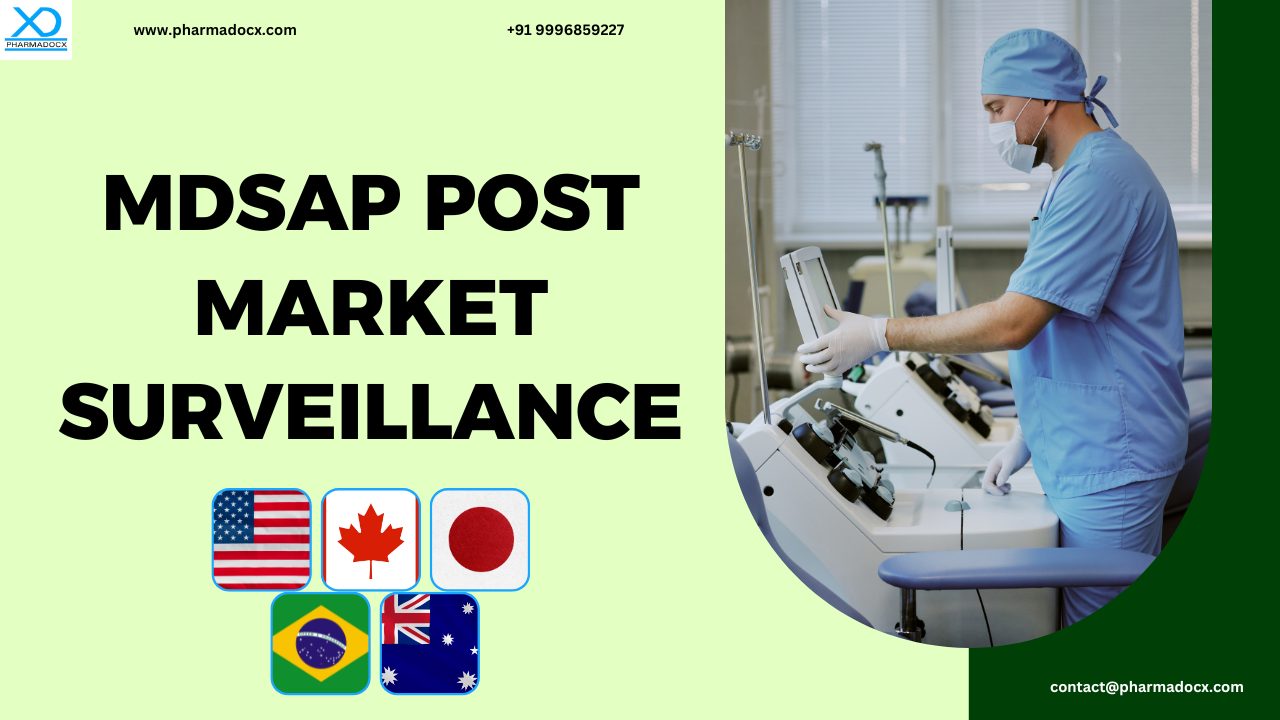
Medical device single audit program (MDSAP) is a single audit framework aimed to meet the regulatory requirements of multiple participating countries, namely the US, Canada, Japan, Brazil, and Australia.
This single audit ensures compliance of the QMS with ISO 13485 as well as country-specific regulations. Notably, MDSAP necessitates rigorous post-market surveillance (PMS). Hence, stringent MDSAP post market surveillance requirements are in place. Moreover, third-party auditors evaluate the manufacturer’s compliance using a single audit process. Hence, it is a globally recognized framework that simplifies regulatory audits for medical device manufacturers planning to launch their products in the MDSAP participating country.
MDSAP reduces the number of audits required while ensuring compliance with each participating country’s laws, thereby saving time and costs. Notably, MDSAP is mandatory in Canada for Class II, III, and IV medical devices. However, it is optional in the other participating countries. Nevertheless, by opting for MDSAP you can have a streamlined regulatory journey in all the participating countries. International medical device regulators forum (IMDRF) has developed and oversees the medical device single audit program (MDSAP).
MDSAP participating countries
- Australia: Therapeutic Goods Administration of Australia (TGA)
- Brazil: Agência Nacional de Vigilância Sanitária(ANVISA)
- Canada: Health Canada
- Japan: Japan’s Ministry of Health, Labour and Welfare (MHLW) and the Japanese Pharmaceuticals and Medical Devices Agency
- USA: Food and Drug Administration (FDA)
Key benefits of MDSAP
- Single audit process: A single audit process will help meet regulatory expectations across major markets, namely USA, Canada, Brazil, Japan, and Australia.
- Cost-effectiveness: MDSAP helps reduce costs by consolidating multiple audits into a single audit. This will help reduce the cost associated with conducting multiple audits for different countries.
- ISO 13485 compliance: A single audit process will help attain full compliance with ISO 13485 guidelines and country-specific regulations.
- Streamlined operations: Fewer audit inspections and predictable audit timelines will minimize production disruptions, thereby streamline operations.
- Improved market access: MDSAP certification will ease out access to multiple global markets and ensure quick launch of these products in the market.
- Transparency: Structured evaluations that are part of MDSAP will demonstrate compliance of your QMS and regulatory processes with globally accepted guidelines.
- Resource optimization: By avoiding the costs associated with multiple audits, time and resources can be allocated to other activities.
Before delving into MDSAP post market surveillance requirements, let us understand what is post market surveillance.
What is post market surveillance?
Post market surveillance (PMS) is the ongoing process of monitoring medical devices after they are placed in the market to ensure they remain safe, effective, and compliant with regulations. It is a legal requirement under frameworks, such as the EU MDR, FDA, MDSAP, etc.
Post market surveillance is a systematic set of activities conducted by manufacturers to collect, analyze, and act on data about device performance and safety once the product is in real-world use. It ensures that benefits continue to outweigh risks and that corrective actions are taken if issues arise.
Core components of PMS
- PMS plan: A documented strategy outlining how data will be collected and assessed.
- Data collection: Sources include complaints, adverse event reports, registries, scientific literature, and user feedback.
- Data analysis: Identifying trends, risks, or performance issues.
- Corrective actions: Labeling updates, design changes, recalls, or field safety notices.
- Reporting: Submission of PMS findings to regulators (e.g., FDA, EU, etc.).
Benefits of post market surveillance
- Enhanced patient safety: Post market surveillance plays a vital role in detecting rare or long-term adverse events not evident in pre-market trials.
- Regulatory compliance: Avoids penalties and ensures audit readiness.
- Market confidence: Builds trust among healthcare providers and patients.
- Continuous improvement: Provides insights for product upgrades, innovation, and improvement.
MDSAP post market surveillance
MDSAP requires manufacturers to maintain a robust post-market surveillance (PMS) system. The PMS system should align with the regulatory expectations of five major jurisdictions: the United States (FDA), Canada (Health Canada), Brazil (ANVISA), Japan (MHLW/PMDA), and Australia (TGA). Its goal is to ensure continuous monitoring of device safety and performance after commercialization, with harmonized reporting and corrective action obligations.
9 MDSAP post market surveillance requirements
- Establishing a PMS system: Manufacturers must have a documented PMS plan integrated into their Quality Management System (QMS).The plan should define data sources (complaints, adverse events, literature, registries, user feedback), methods for collection and analysis, and escalation pathways for corrective actions. A robust PMS system is a major MDSAP post market surveillance requirement.
- Data collection and vigilance: Data sources include complaints, adverse event reports, literature, registries, and feedback from healthcare providers. Vigilance reporting requires timely notification of adverse events, incidents, and recalls to relevant authorities in each participating country.
- Complaint handling: A formal complaint handling process must exist, ensuring all complaints are recorded, evaluated, and investigated. Additionally, whether the complaint has to be reported under vigilance requirements has to be determined. Moreover, the need to link to CAPA, if systemic issues are identified, has to be checked.
- Adverse event and vigilance reporting: Each participating jurisdiction has specific vigilance requirements. For FDA (U.S.), medical device reporting (MDR) is necessary within 30 days of awareness and 5-day reports are required for serious threats. Health Canada requires mandatory incident reporting within 10–30 days depending on severity. ANVISA (Brazil) requires immediate reporting of serious adverse events and periodic vigilance reports. PMDA/MHLW (Japan) requires prompt reporting of adverse events and malfunctions and periodic safety updates. For TGA (Australia), incident reporting has to be done within 10 days (serious) or 30 days (non-serious).
- Trend analysis: Manufacturers must conduct systematic trend analysis of PMS data. This will help detect increases in frequency or severity of incidents that may indicate emerging risks. It must be linked to ISO 14971 risk management for reassessment of benefit-risk balance.
- Corrective and Preventive Actions (CAPA): PMS findings must feed into CAPA systems. Actions may include design modifications, labeling updates, and field safety corrective actions (FSCA) or recalls. CAPA effectiveness must be verified and documented. CAPA forms a core MDSAP post market surveillance requirement.
- Periodic safety updates: Some jurisdictions (e.g., EU MDR, Health Canada) require periodic safety update reports (PSURs) or annual summaries. MDSAP audits check that manufacturers maintain these reports consistently across jurisdictions.
- Integration with risk management: PMS data must be continuously fed into the risk management file. Manufacturers must demonstrate that PMS outcomes influence ongoing risk assessments and product lifecycle decisions.
- Audit readiness: During MDSAP audits, regulators expect evidence of a functioning PMS system, records of complaint handling, vigilance reports, CAPA, and trend analyses. Additionally, proof that PMS activities are proportionate to device risk class has to be provided.
MDSAP post market surveillance: Key takeaways for manufacturers
- Harmonization: MDSAP audits check whether PMS systems meet all five jurisdictions’ requirements simultaneously.
- Audit readiness: PMS documentation, vigilance reports, and CAPA records must be readily available for auditors.
- Continuous improvement: PMS is not just reactive. It must proactively identify opportunities for product and process improvement.
- Global compliance: A single PMS framework must be flexible enough to satisfy varying timelines and reporting formats.
Therefore, MDSAP post‑market surveillance requirements serve as a harmonized framework for manufacturers to maintain vigilant, proactive, and risk‑based monitoring of their devices across multiple jurisdictions. By integrating complaint handling, adverse event reporting, trend analysis, and CAPA into a unified quality system, companies can meet the diverse regulatory expectations of the FDA, Health Canada, ANVISA, PMDA/MHLW, and TGA. Additionally, they can also strengthen patient safety and product reliability worldwide. Thus, effective PMS under MDSAP will help with continuous improvement and global audit readiness. To avail our comprehensive MDSAP certification service, drop an email at [email protected] or call/Whatsapp on 9996859227.