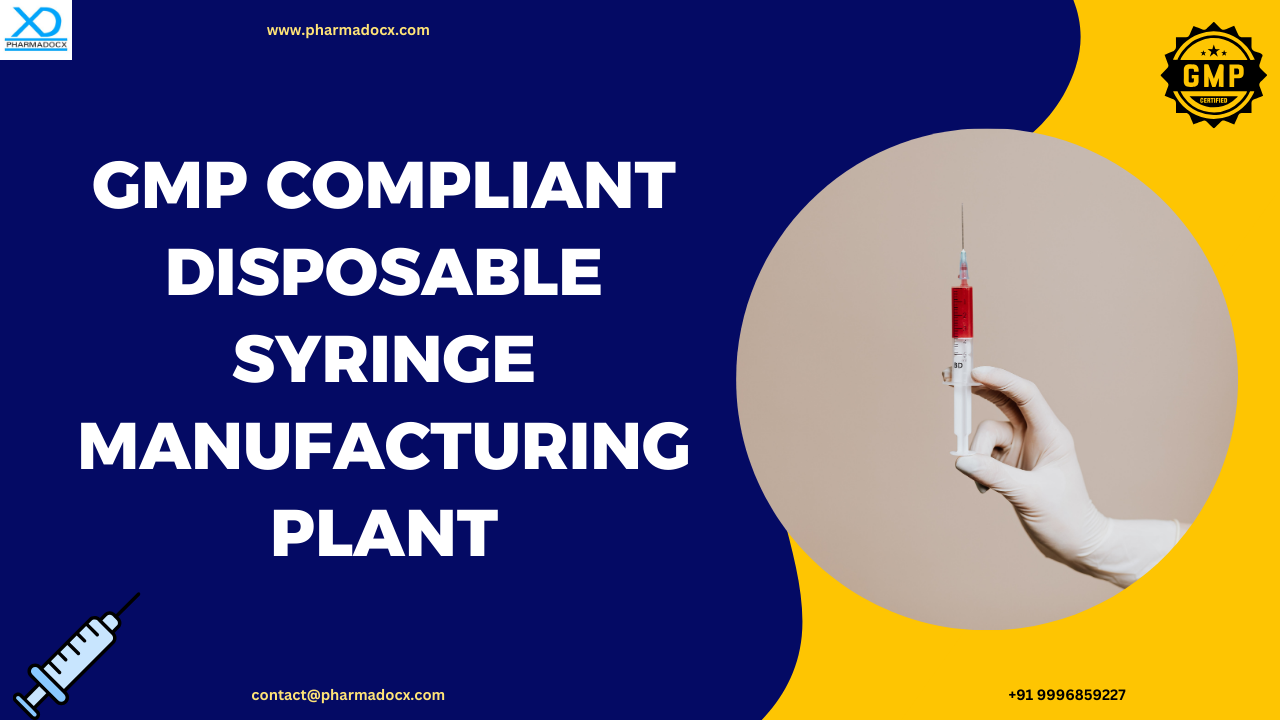
A disposable syringe is a single-use medical device typically made of medical-grade plastic. It is pre-sterilized and intended to be discarded immediately after a single use to prevent cross-contamination. A disposable syringe manufacturing plant is a specialized industrial facility designed for the mass production of sterile, single-use syringes. These plants use automated production lines to transform raw medical-grade materials into finished products that meet stringent global healthcare standards. It is important to establish the manufacturing facility per GMP guidelines to ensure compliance with regulatory guidelines. In this blog, we have prepared a guide on how to establish a GMP compliant disposable syringe manufacturing plant.
The first step of establishing a GMP compliant disposable syringe manufacturing plant is to have a well-designed plant layout. A well-designed plant layout will form the backbone of a GMP compliant, audit ready, regulatory compliant, and scalable production facility. Avail our comprehensive medical factory layout design service to have a regulatory compliant, sustainable, scalable, audit ready, efficient, and future ready plant. We will tailor our service per your requirements.
What are the core components of disposable syringe manufacturing plant?
A disposable syringe manufacturing plant is a highly structured facility that integrates precision engineering, sterile production, and regulatory compliance. It is a specialized industrial plant designed for the mass production of sterile, single-use syringes. These plants have highly automated production lines to manufacture finished, packaged products from raw medical-grade materials. We have presented the core components of a disposable syringe manufacturing facility.
- Raw material handling and preparation unit: Polypropylene (PP) resin storage and drying units. Syringes are primarily made from medical-grade PP, which must be dried to remove moisture before molding. Additives and colorants handling units will be required for graduations, markings, or specialized syringe types.
- Injection molding section: Injection molding machines are used to produce syringe barrels, plungers, and needle hubs with high precision. Custom-designed molds for different syringe sizes (1 ml, 2 ml, 5 ml, 10 ml, etc.). Cooling systems are required to maintain dimensional accuracy and prevent warping.
- Needle manufacturing and assembly unit: Stainless steel tubing preparation are required to cut, straighten, and sharpen needles. Electro-polishing and cleaning units are required to smoothen sterile needle surfaces. Needle hub assembly machines are required to attach needles securely to hubs.
- Printing and marking: Graduation printing machines are required for volume markings on syringe barrels. Ink curing systems for permanent, non-toxic markings on syringe barrels.
- Assembly line: Automated assembly machines are required to integrate barrel, plunger, gasket, and needle. Lubrication units to apply silicone oil for smooth plunger movement. Quality inspection stations are required to check for dimensional accuracy, leakage, and smooth operation.
- Sterilization section: ETO (Ethylene Oxide) sterilizers are commonly used for disposable syringes. Gamma irradiation units are used as alternative sterilization units. Sterility validation labs ensure compliance with ISO and regulatory standards.
- Packaging and labelling: Blister packing machines are used to manufacture individual sterile packs. Cartoning machines are used to group syringes into bulk packs. Labeling systems are used to label batch numbers, expiry dates, and regulatory markings.
- Quality control and testing labs: Mechanical testing units are used to test plunger force, leakage, breakage resistance.Chemical testing units are used to test residual ETO levels, biocompatibility.Microbiological testing units are used to evaluate sterility assurance.
- Utilities and support infrastructure: Cleanrooms (ISO Class 7 or 8) are essential for sterile production, assembly, and production. HVAC systems with HEPA filters are required to maintain controlled environment. Water treatment systems are used to purify water for cleaning and sterilization.
- Regulatory and documentation systems: QMS (Quality Management System) are essential for ISO 13485 compliance. Traceability systems are required to maintain batch records and audit trails. Regulatory approval systems will be required to keep track of regulatory guidelines, such as CDSCO (India), FDA (US), CE marking (EU).
Key GMP requirements for establishing a disposable syringe manufacturing plant
A disposable syringe manufacturing plant must operate under strict Good Manufacturing Practice (GMP) requirements to ensure product safety, sterility, and regulatory compliance. GMP requirements for syringe plants revolve around facility design, environmental control, validated processes, documentation, quality testing, and regulatory compliance. These ensure that every syringe is sterile, safe, and traceable from raw material to patient use. We have highlighted the key GMP requirements for disposable syringe manufacturing plant.
1. Facility design and layout
- Segregated areas: Separate zones for raw material storage, molding, assembly, sterilization, and packaging to prevent cross-contamination.
- Controlled material flow: Unidirectional movement of materials and personnel to minimize contamination risks.
- Cleanroom classification: ISO Class 7 or 8 cleanrooms for molding and assembly. ISO Class 5 for critical operations, like needle attachment.
- Air handling systems (HVAC): HEPA-filtered air, positive pressure differentials, and controlled temperature/humidity.
2. Environmental controls
- Air quality monitoring: Regular particle count and microbial monitoring.
- Water quality systems: Purified water (PW) or Water for Injection (WFI) for cleaning and sterilization.
- Surface sanitation: Routine cleaning with validated disinfectants.
- Personnel hygiene: Gowning procedures, restricted access, and training in aseptic practices.
3. Equipment and process validation
- Injection molding machines: Must be qualified and validated for consistency.
- Sterilization validation: Ethylene oxide (ETO) or gamma irradiation cycles must be validated for sterility assurance level.
- Calibration programs: Regular calibration of critical instruments (temperature, pressure, flow meters).
- Preventive maintenance: Documented schedules for all equipment.
4. Documentation and records
- Standard Operating Procedures (SOPs): SOPs should be in place for every process step (molding, assembly, sterilization, packaging).
- Batch manufacturing records (BMRs): BMRs are required for traceability of raw materials, process parameters, and operators.
- Deviation and CAPA system: Handling of non-conformances with corrective and preventive actions.
5. Quality control and testing
- Incoming material testing: Verification of medical-grade polypropylene, stainless steel, and packaging materials.
- In-process checks: Barrel dimensions, plunger smoothness, needle sharpness, leakage tests.
- Finished product testing: Sterility, biocompatibility, residual ETO levels, mechanical strength.
- Microbiological monitoring: Routine sterility testing of batches.
6. Personnel training and competence
- GMP training programs: Mandatory for all staff, covering hygiene, documentation, and contamination control.
- Role-specific training: Specialized training for operators in molding, sterilization, and QC labs.
- Continuous education: Refresher courses and updates on regulatory changes.
7. Regulatory compliance
- Licensing and approvals: CDSCO (India), FDA (US), CE marking (EU), ISO 13485 certification are necessary to operate the disposable syringe manufacturing plant.
- Audit readiness: Facilities must be prepared for inspections by regulatory authorities.
- Risk management: ISO 14971-compliant risk assessments for product safety.
- Traceability systems: Serialization, batch coding, and recall procedures are a part of robust traceability system.
8. Packaging and labeling controls
- Sterile barrier systems: Blister packs or peel-open pouches validated for integrity.
- Label accuracy: Product type, size, batch number, expiry date, and regulatory markings.
- Tamper-evident features: To ensure product authenticity and safety.
Establishing a disposable syringe manufacturing plant per GMP requirements guarantees patient safety and regulatory compliance. By following GMP guidelines, a carefully designed infrastructure can be established with segregated cleanroom, validated equipment, and robust environmental controls; all supported by meticulous documentation and quality systems. By embedding GMP into every stage from raw material handling to sterilization and packaging, the plant ensures that each syringe meets global standards for sterility, precision, and traceability. This plant will imbibe a culture of regulatory excellence.
Why should you opt for our disposable syringe manufacturing plant layout design service?
We at Pharmadocx Consultants will ensure your disposable syringe manufacturing facility will achieve the following parameters:
- Regulatory compliance
- GMP and other industry standard compliance
- Operational efficiency
- Controlled material and personnel flow
- Segregation of clean and non-clean areas
- Prevention of mix-ups and cross-contamination
- Traceability and audit readiness
- Quality control of manufactured disposable syringes
- Consistent manufacture of safe, effective, high-quality disposable syringe
- Sustainability and scalability
- Optimum utilization of space
To have your disposable syringe manufacturing plant designed by experts,email at [email protected] or call/Whatsapp on 9996859227.