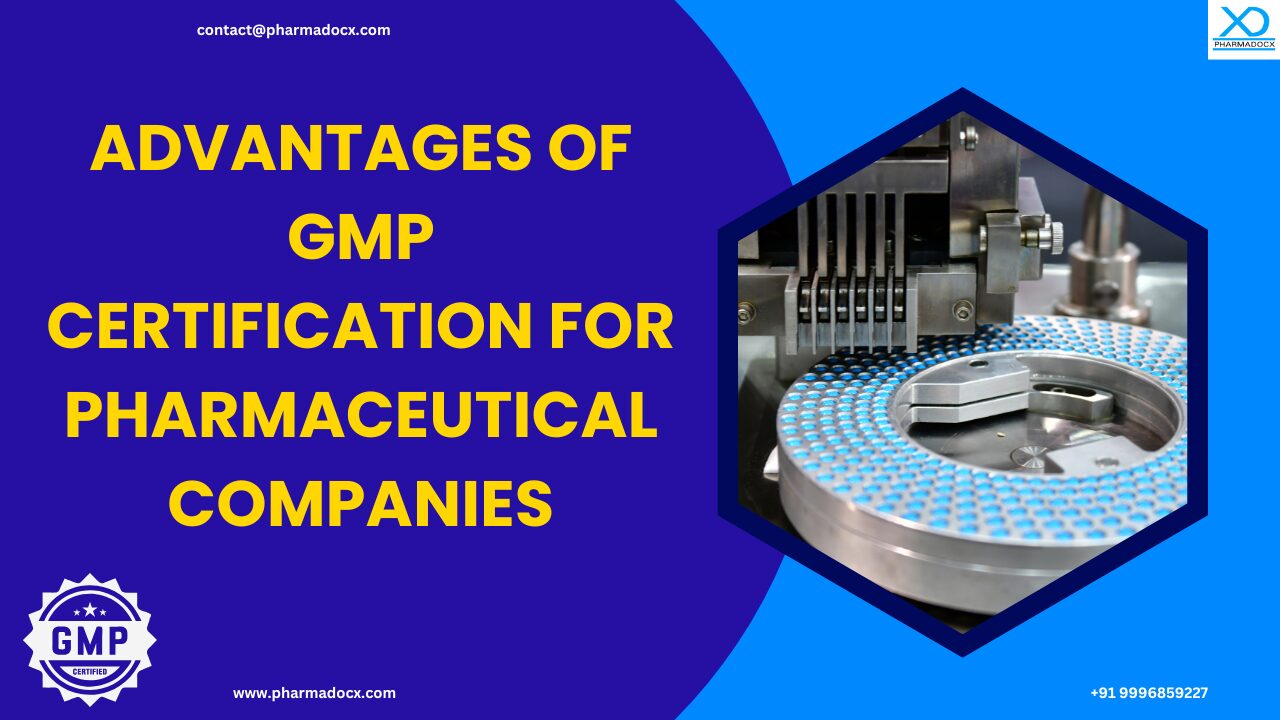
In this blog, we have discussed the advantages of having GMP certification for pharmaceutical companies. Additionally, we have presented the GMP certification mistakes to avoid and the challenges of maintaining certification.
What is good manufacturing practices (GMP)?
Good manufacturing practices (GMP) is a system that sets guidelines for consistently manufacturing products as per defined quality benchmarks. GMP covers every aspect of the manufacturing process to prevent cross-contamination, adulteration, and mislabelling. Pharma GMP guidelines are aimed at protecting patients from health hazards by regulating the quality, efficacy, and safety of pharmaceuticals.
GMP guidelines are developed to minimize pharmaceutical production associated risks that cannot be eliminated only by testing the finished product. Some of the risks in pharmaceutical production are as follows: unexpected cross-contamination or adulteration of drugs, incorrect labelling of containers, and addition of insufficient or too much of active ingredients. Good manufacturing practices provide detailed written guidelines for each step in the drug production process that could affect the quality of the final product.
Implementing GMP in your production process can help reduce losses and waste. Additionally, you can avoid product recalls, fines, and legal action for manufacturing substandard products. Thus, good manufacturing practices in pharma industry protects both patients and the company.
GMP certification for pharmaceutical companies is an official recognition that a pharmaceutical company follows strict quality standards in the production of medicines. For companies, GMP certification is often mandatory to sell products in regulated markets and is critical for international trade and export approvals.
Aspects covered by good manufacturing practices in pharma industry
GMP guidelines regulate all aspects of production that will impact the safety and quality of manufactured drugs. Aspects of production regulated are as follows:
- Manufacturing building, environment, and facilities
- Manufacturing equipment and instrument
- Raw materials
- Personnel
- Quality management
- Staff sanitation and hygiene
- Inspections and quality audits
- Product complaints
- Documentation and recordkeeping
- Validation and qualification
What is GMP certification for pharmaceutical companies?
GMP certification ensures that pharmaceutical companies consistently produce medicines that are safe, high-quality, and compliant with international standards. GMP certification for pharmaceutical companies is a globally recognized benchmark, often required for exporting drugs and gaining trust from regulators and healthcare providers. It ensures that every step of manufacturing from raw material sourcing to packaging is controlled and documented to prevent contamination, errors, or inconsistencies. Regulatory authorities like the WHO, FDA, and CDSCO require GMP compliance to safeguard patient health and maintain product reliability. Companies with GMP certification gain credibility in both domestic and international markets, as it is often a prerequisite for exporting drugs.
10 Advantages of having GMP certification for pharmaceutical companies
1. Regulatory compliance
GMP certification ensures that companies meet national and international regulatory requirements. This reduces the risk of penalties, product recalls, or shutdowns due to non-compliance. It also positions the company as a trusted partner for regulators and healthcare providers.
2. Product quality assurance
By following GMP standards, companies guarantee consistent product quality. Every batch of medicine meets safety, purity, and efficacy requirements. This builds confidence among doctors, pharmacists, and patients.
3. Market access and export opportunities
Many countries require GMP certification for imported pharmaceuticals. Without it, companies are barred from entering lucrative international markets. Certification thus opens doors to global trade and expansion.
4. Competitive advantage
GMP-certified companies stand out in a crowded marketplace. Certification signals reliability and professionalism to clients and partners. This often leads to stronger business relationships and higher sales.
5. Risk reduction
GMP guidelines minimize risks of contamination, mix-ups, and manufacturing errors. This protects patients from harmful products and shields companies from liability. Reduced risk also lowers insurance costs and operational disruptions.
6. Operational efficiency
Implementing GMP requires structured processes and documentation. This streamlines production, reduces waste, and improves resource utilization. Over time, efficiency translates into cost savings and higher profitability.
7. Brand reputation
Certification enhances a company’s reputation in the pharmaceutical industry. Customers and stakeholders view GMP-certified firms as trustworthy and ethical. A strong reputation helps attract investors and long-term partnerships.
8. Employee competence
GMP emphasizes staff training and accountability. Employees become more skilled in handling equipment, documentation, and hygiene practices. This boosts workforce confidence and reduces human error.
9. Audit readiness
GMP-certified companies are better prepared for regulatory inspections and client audits. Documentation and processes are already aligned with compliance standards. This reduces stress during audits and increases approval success rates.
10. Patient safety and trust
Finally, GMP certification ensures that medicines are safe for patients. Trust in the company grows when patients know products are manufactured under strict quality controls. This trust is the foundation of sustainable business growth.
10 GMP certification mistakes to avoid
- Ignoring gap analysis: Skipping a thorough pre‑audit assessment leaves hidden compliance risks.
- Poor staff training: Untrained staff often make errors during inspections.
- Incomplete documentation: Failing to prepare WHO GMP‑aligned SOPs, manuals, and records is the top reason for audit failures.
- Weak quality management systems (QMS): Outdated QMS usually fails regulatory scrutiny.
- Delayed corrective actions: Slow responses to audit findings can derail certification timelines.
- Overlooking supplier compliance: Non‑compliant suppliers can jeopardize your certification.
- Misinterpreting GMP guidelines: Many firms confuse WHO GMP with local GMP requirements.
- Underestimating timelines: Unrealistic planning underestimates timelines and deadlines.
- Weak communication with regulators: Poor communication with regulatory officials can stall approvals.
- Not taking help from industry experts: Attempting GMP certification without expert consultation often results in costly delays and rejections.
Challenges of maintaining GMP certification for pharmaceutical companies
GMP certification for pharmaceutical companies is not a one-time achievement but an ongoing challenge for pharmaceutical companies.
- Regulatory updates: GMP standards evolve frequently across regions (FDA, EMA, CDSCO, WHO). Companies must continuously monitor changes and adapt processes. Staying current requires dedicated regulatory intelligence and resources.
- Documentation discipline: Every activity, production, testing, cleaning, must be recorded in detail. Even minor lapses in documentation can lead to non‑compliance. Maintaining this discipline is resource‑intensive and error‑prone.
- Employee training: Staff must be regularly trained on GMP practices and updates. Inadequate training can create compliance gaps.
- Cost pressures: GMP compliance demands investment in infrastructure, equipment, and audits. Smaller firms often struggle with these financial burdens. Long‑term maintenance requires significant budget allocation.
- Audit readiness: Regulators and clients may conduct surprise inspections. Companies must always be prepared with clean facilities, updated records, and compliant processes. This constant state of readiness adds operational stress.
- Supplier and raw material control: GMP requires strict oversight of suppliers and raw materials. Ensuring that external vendors meet standards is complex and often outside direct control. Weak supplier governance can jeopardize certification.
- Technology and equipment validation: All equipment and systems must be validated and maintained per GMP. Breakdowns or outdated technology can cause compliance failures. Continuous investment in upgrades is necessary.
- Cross‑functional coordination: GMP compliance spans production, quality, regulatory, and supply chain teams. Misalignment between departments can lead to gaps. Strong communication and collaboration are essential.
Avail our service to easily secure GMP certification for pharmaceutical companies
We provide end-to-end GMP certification services tailored to your pharma facility. With our support, securing the GMP certification for pharmaceutical companies is a cakewalk.
- Gap analysis and mock audits: We will help you identify compliance gaps before regulators do.
- Documentation preparation and compilation: We will prepare and compile necessary supporting documents as per industry guidelines.
- Training and competency building: We provide the necessary GMP training for pharma staff and QA teams to prepare them for the audit.
- Regulatory communication: Our team will ensure smooth communication with auditors and regulatory authorities.
- Certification process management: We will handle every step of the GMP certification process from application to approval.
Email at [email protected] or call/Whatsapp on 9996859227 to easily secure the GMP certification for pharmaceutical companies.