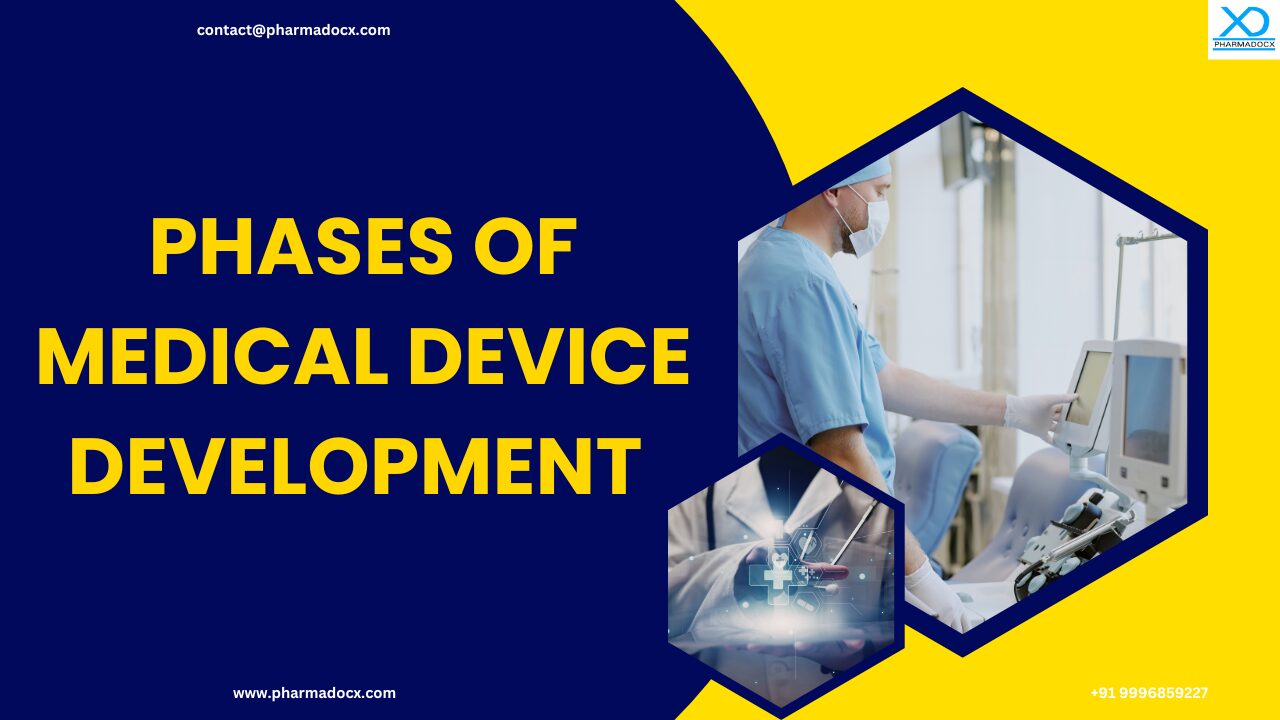
Medical device development is a structured and highly regulated process. It takes a product from concept through design, testing, regulatory approval, and post-market monitoring to ensure safety, effectiveness, and compliance. It involves multiple phases, each with specific deliverables, documentation, and regulatory checkpoints. Thus, medical device development is a step-by-step, compliance-driven journey from idea to patient use. It requires strong QMS, regulatory navigation, and continuous monitoring.
What is medical device development?
Medical device development is the structured process of turning an idea into a safe, effective, and compliant product for patient use. It begins with concept and feasibility studies, followed by detailed design and prototyping, where user needs and regulatory requirements are translated into specifications. The process then moves through verification (ensuring outputs meet inputs) and validation (confirming the device works as intended in real-world conditions), often including clinical investigations for higher-risk devices. Once validated, the design is transferred into manufacturing under a Quality Management System (ISO 13485). Regulatory submissions are made to concerned authorities. After approval and market launch, ongoing post-market surveillance ensures continued safety, performance, and compliance. Thus, it is a lifecycle that embeds quality, risk management, and regulatory discipline at every stage to protect patients and ensure device success.
Phases of medical device development
1. Initiation and planning
The medical device development process begins with identifying a medical need or problem that the device will solve. Market research and competitive analysis help determine the potential demand and positioning. Regulatory pathways are mapped early to understand requirements. A preliminary risk assessment is conducted to evaluate technical, financial, and compliance challenges. Funding strategies and intellectual property protection are also established at this stage. Finally, a Quality Management System (QMS), often ISO 13485, is initiated to ensure compliance from the outset.
2. Concept and feasibility
This phase focuses on translating the idea into a tangible concept or prototype. Technical feasibility studies are conducted to confirm that the device can function as intended. Risk management activities, guided by ISO 14971, are performed to identify hazards and mitigate them. Usability and human factors are analyzed to ensure the device is practical for end-users. Early prototypes are tested to validate core functionality and safety. The outcome of this phase determines whether the project should move forward into full development.
3. Design and development
Detailed design inputs are documented, covering user needs, regulatory standards, and performance requirements. Design outputs, such as specifications, drawings, and production instructions, are created. Iterative prototyping allows teams to refine the design and address issues early. Design reviews are conducted regularly to ensure alignment with requirements and risk controls. Verification activities confirm that design outputs meet the defined inputs. This phase of medical device development builds the foundation for regulatory submissions and manufacturing readiness.
4. Validation and regulatory submission
Medical device development validation ensures the device performs as intended under real-world conditions. Clinical investigations may be required for higher-risk devices to demonstrate safety and effectiveness. Documentation is compiled into a Design History File (DHF) or Technical File for regulatory review. Submissions are prepared for authorities, such as the FDA (510(k), PMA), EU MDR (CE marking), or CDSCO.
5. Manufacturing and launch
Design transfer moves the product into manufacturing, thereby ensuring processes are validated and reproducible. Supply chain management and vendor qualification are established to maintain quality. Pilot production runs confirm scalability and compliance with regulatory standards. Manufacturing facilities must operate under Good Manufacturing Practices (GMP) and ISO 13485. Regulatory clearance is obtained before the product can be marketed.
6. Post-market surveillance
After launch, continuous monitoring ensures the medical device remains safe and effective. Vigilance systems track adverse events, complaints, and field performance. Corrective and Preventive Actions (CAPA) are implemented to address issues quickly. Periodic audits and regulatory inspections verify ongoing compliance. Feedback from users and healthcare providers informs product improvements. This phase ensures long-term success and patient safety through proactive risk management.
Importance of having an effective medical device development process in place
- Patient safety: Medical device development ensures that products are designed, tested, and validated to protect patients from harm. Rigorous risk management and regulatory compliance reduce the chances of malfunction or adverse events. Without structured development, unsafe devices could reach the market and compromise patient lives.
- Regulatory compliance: The process aligns devices with global standards, such as FDA, EU MDR, and CDSCO requirements. Compliance guarantees that devices meet strict safety, quality, and performance benchmarks. This not only enables market approval but also builds trust among healthcare providers and patients.
- Innovation and advancement: Structured development fosters innovation by translating new ideas into usable medical technologies. It allows integration of advanced materials, AI, and digital health solutions into safe devices. This drives progress in healthcare, improving diagnosis, treatment, and patient outcomes.
- Market access and growth: Medical device development is essential for securing approvals that open access to domestic and international markets. A well-developed device can attract investors, partnerships, and commercial opportunities. This contributes to business growth and strengthens the healthcare ecosystem.
- Quality and reliability: Development embeds quality systems, like ISO 13485, to ensure consistency in design and manufacturing. Devices undergo verification and validation to confirm they perform reliably under real-world conditions. High-quality devices reduce recalls, improve reputation, and sustain long-term success.
- Post-market improvement: Medical device development does not end at product launch. Ongoing surveillance ensures devices remain safe and effective. Feedback from users and healthcare providers informs updates and improvements. This continuous cycle enhances patient care and keeps medical devices aligned with evolving medical needs.
Best practices for medical device development
- Implement quality management early: Establish a QMS (ISO 13485) at the start to ensure traceability and compliance. This embeds quality into every stage of development rather than treating it as an afterthought. Moreover, early adoption reduces audit risks and accelerates regulatory approvals.
- Integrate risk management throughout: Apply ISO 14971 principles continuously, not just at the design stage. Identifying hazards early helps prevent costly redesigns later. Continuous risk assessment ensures patient safety and regulatory alignment.
- Maintain strong documentation discipline: Keep design inputs, outputs, reviews, and changes well-documented in the Design History File (DHF). Clear records support regulatory submissions and audits. Furthermore, documentation also enables knowledge transfer across teams and future product iterations.
- Adopt iterative prototyping: Build and test prototypes in cycles to identify usability and safety issues early. Iteration reduces the risk of late-stage failures. Moreover, it also allows feedback from clinicians and users to be incorporated into design improvements.
- Ensure cross-functional collaboration: Bring together engineering, clinical, regulatory, and marketing teams from the outset. Collaboration ensures that technical feasibility, compliance, and market needs align. This holistic approach reduces silos and accelerates development.
- Plan for post-market surveillance: Develop vigilance systems to monitor device performance after launch. Additionally, collect feedback from healthcare providers and patients to identify issues quickly. Continuous improvement strengthens safety, compliance, and brand reputation.
Medical device development helps achieve regulatory compliance
Thus, medical device development plays a crucial role in achieving regulatory compliance because it embeds quality, safety, and risk management into every stage of the product lifecycle. By following structured processes, such as design controls, documentation discipline, and continuous risk assessment, manufacturers can demonstrate adherence to standards, like ISO 13485 and ISO 14971. This systematic approach ensures that submissions to authorities, such as the FDA, EU MDR bodies, or CDSCO, are complete, transparent, and audit-ready. For any regulatory compliance queries, email at [email protected] or call/Whatsapp on 9996859227.