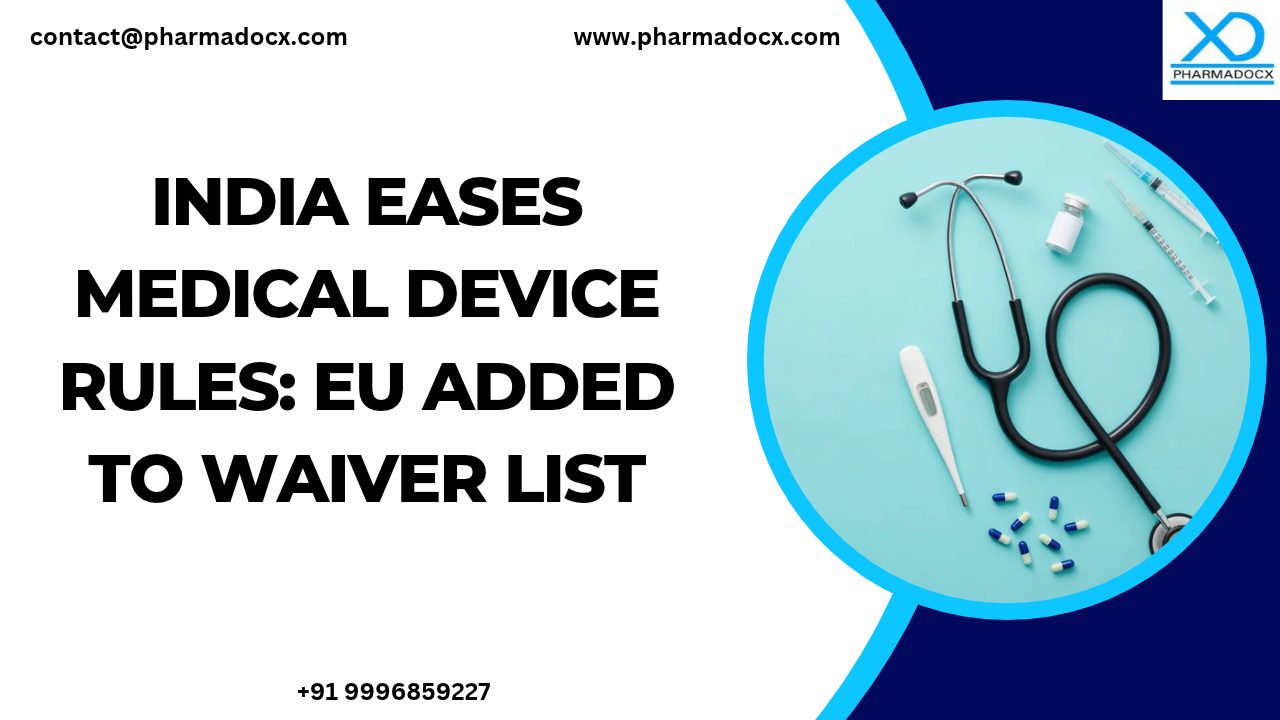
India has eased medical device rules by removing the requirement for a separate loan licence when manufacturers outsource sterilisation. However, the sterilisation facility should hold a valid licence, with a six‑month transition period to update labels. Additionally, the government has added the European Union to its list of trusted regulatory jurisdictions. This will allow EU‑approved devices to bypass local clinical trials for faster market entry. Additionally, testing fees have been standardised across categories, such as implants, syringes, sutures, and condoms. The aim is to reduce compliance costs and streamline approvals. Moreover, it will align India’s framework more closely with global practices while supporting quicker patient access to advanced technologies.
India has eased Medical Device Rules
India has eased Medical Device Rules by removing the need for a separate loan licence for outsourced sterilisation and adding the European Union (EU) to its list of trusted regulatory jurisdictions. This change will reduce compliance costs, speed up approvals, and allow EU‑approved devices faster entry into the Indian market.
Key highlights of the amendments
1. Outsourced sterilisation rules
Manufacturers outsourcing sterilisation no longer need a separate loan licence if the contracted facility already holds a valid licence under the Medical Devices Rules, 2017. This change eliminates duplication and reduces compliance costs for companies. However, manufacturers must now print the sterilisation facility’s licence number on product labels to ensure traceability. A six‑month transition period has been granted to update packaging and labelling accordingly. This amendment balances ease of business with accountability in sterilisation processes.
2. EU added to waiver list
The European Union has been added to India’s list of trusted regulatory jurisdictions for medical devices. This means EU‑approved devices can bypass local clinical trials in India, subject to certain conditions. Previously, only the US, UK, Canada, Australia, and Japan were recognized under this waiver system. The inclusion of the EU aligns India’s framework more closely with global standards and supports faster patient access to advanced technologies. Notably, it also complements the India‑EU Free Trade Agreement signed earlier in 2026, which reduced tariffs on European medical devices.
3. Testing fee standardisation
The government has introduced a new schedule of standardised testing fees for medical devices. Implantation device tests will cost ₹5,000, sterility testing ₹2,000, syringes and needles ₹1,000, surgical sutures ₹3,000, and condoms and IUDs ₹2,500 each. For tests not listed, fees will be determined by the concerned laboratory. This move provides transparency and predictability for manufacturers and importers. It also reduces disputes and delays caused by inconsistent fee structures across different testing facilities.
4. Compliance and labelling requirements
While easing rules, the government has reinforced the importance of clear labelling for traceability. Manufacturers must ensure sterilisation facility licence numbers are visible on product packaging. This requirement strengthens regulatory oversight without imposing heavy administrative burdens. Companies have six months to comply, which provides sufficient time for operational adjustments. The change reflects India’s effort to balance regulatory simplification with patient safety and accountability.
5. Strategic and market implications
These amendments are expected to reduce compliance costs and accelerate approvals for medical devices in India. They also make India more attractive to global manufacturers by aligning with international practices. However, the changes may deepen India’s reliance on imports, as 80–85% of medical devices are currently sourced from abroad. To mitigate this, stronger post‑market surveillance and domestic manufacturing incentives will be critical. Overall, the reforms signal India’s intent to modernize its regulatory framework while supporting faster access to innovative healthcare technologies.
Implications for stakeholders
- Manufacturers: The removal of the loan licence requirement reduces duplication and lowers compliance costs. It allows manufacturers to outsource sterilisation more efficiently while maintaining traceability through mandatory licence number labelling. However, they must update packaging within six months, which requires operational adjustments and coordination with suppliers.
- Importers: Adding the EU to the waiver list enables faster entry of EU‑approved devices into India. This reduces delays and costs associated with duplicative local clinical trials. However, importers must ensure robust post‑marketing surveillance to maintain safety standards.
- Patients: Patients benefit from quicker access to advanced medical technologies approved in the EU. This can improve treatment outcomes and expand choices in healthcare. However, reliance on foreign approvals means patient safety depends heavily on India’s post‑market monitoring systems.
- Regulators (CDSCO): The amendments streamline regulatory processes and align India with global practices. This enhances efficiency and reduces administrative burdens for regulators. At the same time, CDSCO must strengthen oversight mechanisms to balance ease of business with patient safety.
- Domestic industry: The reforms make India more attractive to global manufacturers. However, they may deepen import dependency since 80–85% of devices are already imported. Domestic companies must innovate and scale production to remain competitive. The government may need to complement these reforms with incentives for local manufacturing to ensure long‑term industry resilience.
Industry concerns
- Labelling burden: Manufacturers must now print sterilisation facility licence numbers on product labels, which adds operational complexity. Moreover, updating packaging within the six‑month transition period could strain supply chains and increase costs.
- Import dependency: India already imports 80–85% of its medical devices, and easing EU approvals may deepen reliance on foreign products. This could undermine long‑term goals of building self‑reliance in the sector.
- Post‑market surveillance: By waiving local clinical trials for EU‑approved devices, India shifts the burden to post‑market monitoring. Industry stakeholders are concerned about whether CDSCO has the capacity to enforce robust surveillance. Weak oversight could expose patients to risks from devices not fully tested in Indian conditions.
- Compliance costs: Although duplication is reduced, companies still face new costs from standardised testing fees and labelling changes. Smaller manufacturers may struggle to absorb these expenses compared to larger multinational firms. This could widen the gap between domestic SMEs and global players.
- Regulatory balance: Industry voices caution that while ease of business is important, patient safety must remain paramount. Rapid alignment with global jurisdictions may dilute India’s ability to enforce region‑specific safeguards. Stakeholders urge regulators to strike a balance between speed, affordability, and safety.
Conclusions
Therefore, India’s recent amendments to Medical Device Rules mark a significant step towards streamlining compliance, reducing duplication, and aligning with global standards. By easing sterilisation licensing, standardising testing fees, and adding the European Union to its waiver list, the government has created a more efficient pathway for both domestic manufacturers and international suppliers. These changes promise faster patient access to advanced technologies, lower operational costs for industry players, and greater regulatory harmonisation with trusted jurisdictions. At the same time, they highlight the need for robust post‑market surveillance and stronger domestic manufacturing to balance import dependency. Thus, the reforms signal India’s intent to modernize its medical device ecosystem while fostering innovation, safety, and global competitiveness. Drop an email at [email protected] or call/Whatsapp on 9996859227 for assistance with CDSCO medical device regulation compliance.