
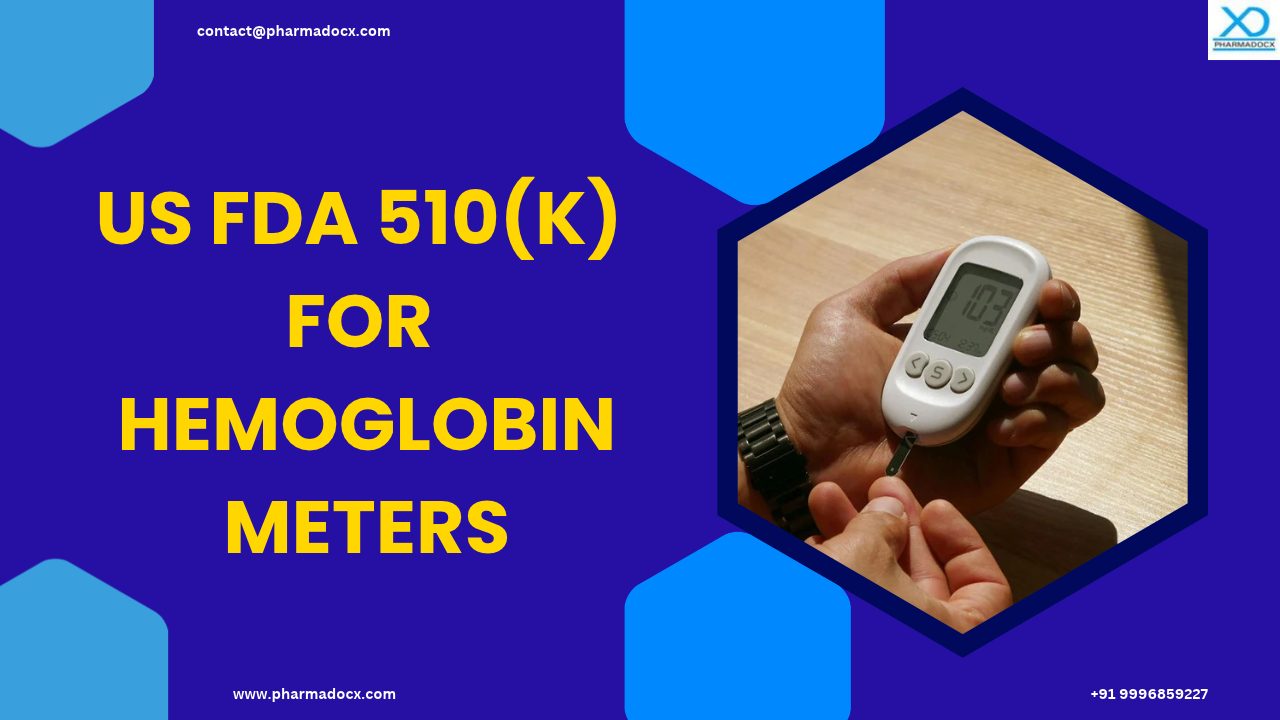
Hemoglobin meters are commonly used to measure hemoglobin levels in blood samples. They are used to assist healthcare professionals in the screening, diagnosis, and monitoring of conditions, such as anemia. FDA clearance through the 510(k) pathway provides assurance that the device performs consistently and safely for its intended clinical application. US FDA 510(k) for hemoglobin meters is a premarket regulatory pathway. As the results affect patient care, FDA requires evidence that the device performs reliably and accurately.
What is a hemoglobin meter?
A hemoglobin meter is a medical diagnostic device designed to measure the concentration of hemoglobin in a blood sample, typically using capillary or venous blood. It is commonly used in hospitals, clinics, laboratories, blood donation centers, and point-of-care settings. A hemoglobin meter is used to help screen, diagnose, and monitor conditions, such as anemia and other blood disorders. Hemoglobin meters provide rapid quantitative results, thereby enabling healthcare professionals to assess a patient’s oxygen-carrying capacity and make timely clinical decisions regarding further testing, treatment, or monitoring.
Role of hemoglobin meters in the healthcare industry
- Early detection of anemia: Hemoglobin meters play a crucial role in the early identification of anemia by providing rapid hemoglobin measurements from a small blood sample. Early detection helps healthcare professionals initiate appropriate treatment before complications develop. This is especially important in children, pregnant women, and elderly patients who are at higher risk of anemia.
- Support for point-of-care testing: These devices enable healthcare providers to obtain results within minutes at the patient’s side without relying on a central laboratory. Rapid testing improves clinical efficiency and supports faster decision-making in hospitals, clinics, and community healthcare settings. This helps reduce delays in diagnosis and treatment.
- Monitoring of patient health and treatment outcomes: Hemoglobin meters are used to monitor patients with anemia, blood disorders, chronic diseases, or ongoing treatments that may affect hemoglobin levels. Regular testing allows clinicians to evaluate whether therapies are working as intended. Continuous monitoring also helps identify changes in patient condition at an early stage.
- Blood donation and transfusion screening: Blood banks and donation centers use hemoglobin meters to determine whether potential donors meet minimum hemoglobin requirements before blood collection. This helps protect donor safety and ensures the quality of donated blood. The devices also assist healthcare professionals in assessing hemoglobin status before and after transfusion procedures.
- Improved accessibility to diagnostic services: Portable hemoglobin meters allow testing to be performed in remote, rural, and resource-limited settings where access to laboratory infrastructure may be limited. Their ease of use and quick turnaround time support broader access to essential diagnostic services. Thus, healthcare providers can reach more patients and improve overall public health outcomes.
Most hemoglobin meters are regulated by the US FDA as Class II. Hence, they generally require clearance through US FDA 510(k) for haemoglobin meters before they can be marketed in US.
US FDA 510(k) for haemoglobin meters
Hemoglobin meters are generally regulated by the US FDA as Class II devices. This means they present a moderate level of risk and are subject to special controls in addition to general regulatory requirements. As hemoglobin test results can influence the screening, diagnosis, and monitoring of conditions, such as anemia and other hematological disorders, manufacturers must demonstrate that the device provides accurate, reliable, and clinically meaningful results. As a result, most hemoglobin meters require FDA 510(k) clearance before being marketed in the United States. Through the 510(k) process, the manufacturer must establish substantial equivalence to a legally marketed predicate device. They are required to show that the new device is as safe and effective as an existing hemoglobin measurement system intended for the same clinical application.
US FDA 510(k) for hemoglobin meters is a regulatory clearance pathway that enables manufacturers to market hemoglobin measurement devices in the United States after demonstrating that the device is as safe and effective as a legally marketed predicate device. Hemoglobin meters are typically used to quantitatively measure hemoglobin concentration in human blood for the screening, diagnosis, or monitoring of conditions, such as anemia and other blood-related disorders. As part of the 510(k) process, manufacturers must provide evidence that the device delivers reliable and accurate results as well as performs consistently across its claimed measurement range. Additionally, it must meet FDA requirements for analytical performance, labeling, software validation (where applicable), and overall device safety. The US FDA 510(k) submission generally includes performance comparisons with an existing legally marketed device to establish substantial equivalence.
Example: A manufacturer developing a handheld hemoglobin meter for point-of-care testing may obtain FDA 510(k) clearance by demonstrating that the device provides hemoglobin measurements comparable to those of a legally marketed hemoglobin testing system intended for the same clinical use.
Hemoglobin meter devices commonly cleared through US FDA 510(k)
We have provided examples of device categories commonly cleared through US FDA 510(k) for hemoglobin meters.
- Point-of-care hemoglobin meters
- Portable hemoglobin analyzers
- Automated hemoglobin measurement systems
- Handheld hemoglobin testing devices
- Capillary blood hemoglobin testing systems
- Venous blood hemoglobin testing systems
- Hemoglobin and hematocrit measurement systems
- Clinical laboratory hemoglobin analyzers
- Near-patient hemoglobin testing devices
- Hemoglobin screening systems for healthcare facilities
- Associated test strips, cuvettes, and measurement accessories
Typical documentation required for US FDA 510(k) for hemoglobin meters
- Device details, including device description, intended use statement, etc.
- Predicate device comparison
- Analytical performance data
- Accuracy and precision studies
- Software documentation (if applicable)
- Risk management documentation
- Labeling and Instructions for Use (IFU)
- Electrical safety and electromagnetic compatibility data (when applicable)
- Cover Letter – Submission type, device description
- FDA Form 3601 – User Fee Cover Sheet
- CDRH Submission Cover Sheet – Predicate vs. New Device
- FDA Form 3881 – Indications for Use
- 510(k) Summary – Public-facing overview
- Truthful & Accuracy Statement
- Declarations of Conformity
- Executive Summary
- Substantial Equivalence Discussion
- Bench Performance Testing
- Animal Testing (if applicable)
- Clinical Testing (if required)
- Sterilization & Shelf Life
- Biocompatibility Testing
5 Phases of US FDA 510(k) submission for hemoglobin meters
- Regulatory assessment and predicate device selection: The submission process for US FDA 510(k) for hemoglobin meters begins with determining the FDA classification, applicable regulations, and 510(k) eligibility. Manufacturers must identify a suitable predicate device with a similar intended use and comparable technological characteristics. A well-defined regulatory strategy helps establish the basis for demonstrating substantial equivalence.
- Technical file preparation: A comprehensive technical file has to be prepared to document all information related to the hemoglobin meter and its performance. This typically includes the device description, intended use, design information, predicate comparison, performance testing reports, risk management documentation, software documentation (if applicable), and labeling materials. The technical file serves as the primary evidence package supporting substantial equivalence.
- 510(k) submission to FDA: The submission must clearly explain how the new device compares with the predicate device. Once the technical documentation is finalized, the manufacturer submits the 510(k) dossier to FDA for review. The submission must be organized according to FDA requirements and contain all required administrative, technical, and performance information. A complete and well-structured submission can help reduce review delays and requests for additional information.
- FDA review and interactive communication: FDA conducts an acceptance review followed by a substantive evaluation of the submitted evidence. The agency assesses whether the new hemoglobin meter is substantially equivalent to the identified predicate device. During this stage, FDA may issue requests for additional information or clarification to support its review.
- FDA clearance and market entry: If FDA concludes that substantial equivalence has been established, the agency grants 510(k) clearance for the device. The manufacturer can then market the hemoglobin meter in the United States for its cleared intended use. After clearance, the manufacturer must continue to comply with applicable FDA regulatory and quality system requirements.
Easily secure US FDA 510(k) for hemoglobin meters with Pharmadocx Consultants
To market your hemoglobin meters in US you need to secure the US FDA 510(k). To easily secure the US FDA 510(k) for hemoglobin meters, email at [email protected] or call/Whatsapp on 9996859227.