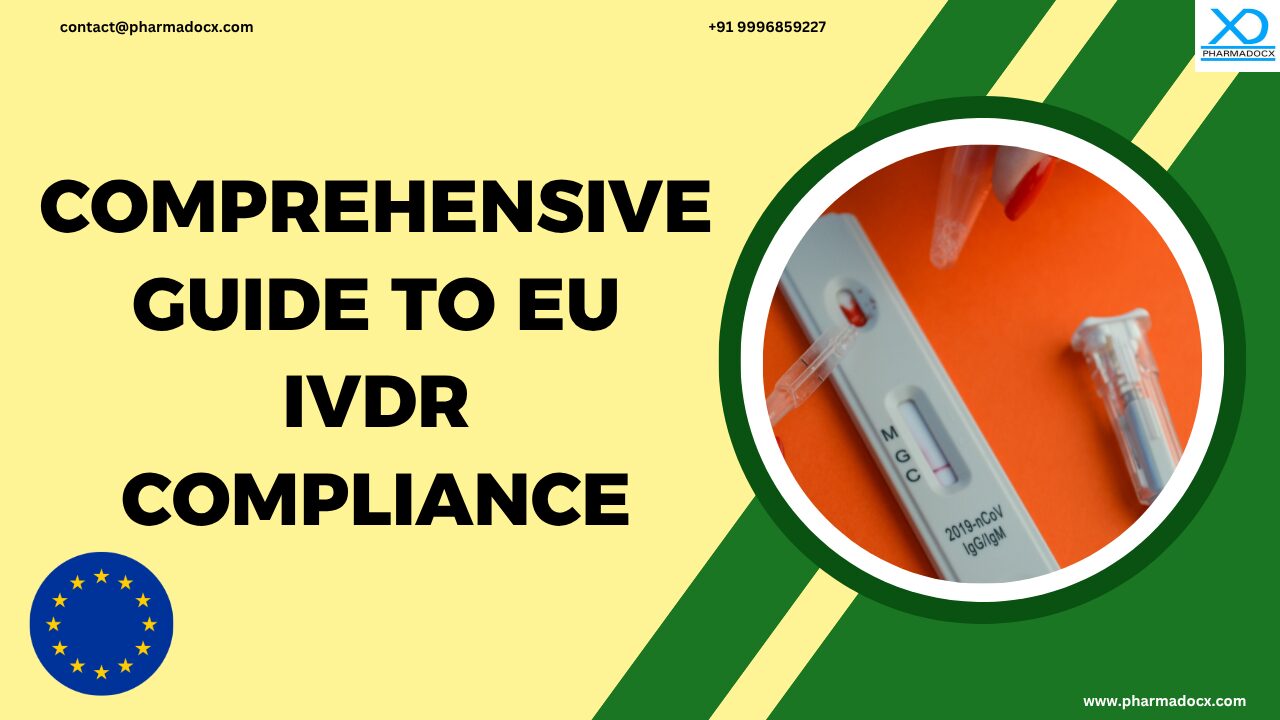

In vitro diagnostics (IVDs) are devices used to perform tests outside the human body on samples, such as blood, urine, or tissue. They are used to detect diseases, monitor health, and guide treatment decisions. They play a crucial role in healthcare by enabling early diagnosis, supporting treatment choices, and tracking disease progression. IVDs range from simple at‑home tests to complex laboratory assays. Thus, they underscore the majority of clinical decisions. Hence, they are essential for precision medicine, patient safety, and effective public health management. EU IVDR is the EU’s legal framework of IVDs entering its market. It introduces strict requirements for safety, performance, conformity assessment, and post‑market surveillance. In this blog, we have prepared a detailed guide to EU IVDR compliance.
What is EU IVDR?
The EU IVDR (In Vitro Diagnostic Medical Devices Regulation) is the European Union’s framework governing in vitro diagnostic devices. It is fully applicable since May 2022 with transition deadlines extending to 2028. It replaces the older IVDD directive and introduces a risk‑based classification system (Classes A–D). EU IVDR requires stricter conformity assessments involving notified bodies. It has introduced more rigorous requirements for clinical evidence, performance evaluation, and post‑market surveillance. The regulation aims to enhance patient safety, ensure transparency through the EUDAMED database, and harmonize standards across the EU. Compliance is mandatory for both EU and non‑EU manufacturers seeking market access in EU.
- Scope: Applies to all IVDs for human use. Covers devices used for diagnosis, monitoring, prevention, or prognosis of diseases.
- Conformity assessment: Notified bodies play a central role in assessing medium‑ and high‑risk devices. Stricter designation and monitoring of notified bodies to ensure uniform standards across the EU. Unannounced inspections of manufacturers are required.
- Performance and evidence: Manufacturers must provide scientific validity, analytical, and clinical performance data. High‑risk devices require rigorous performance studies with robust evidence.
EU IVDR classification system
- Class A (lowest risk): Class A IVDs usually cover general laboratory devices with minimal risk to patients. Non sterile Class A devices already required IVDR compliance since 2022; sterile Class A devices have transition until 2028. Examples: Specimen receptacles, general laboratory instruments, non‑critical reagents.
- Class B (low to medium risk): Class B usually cover devices with moderate risk, often used for routine diagnostics. These devices require notified body involvement for conformity assessment. Examples: Pregnancy tests, fertility tests, cholesterol test kits.
- Class C (medium to high risk): Devices that provide information critical for patient management in serious conditions. These devices require stricter performance evaluation and notified body oversight. Examples: Genetic testing kits, cancer biomarker tests, companion diagnostics.
- Class D (highest risk): Devices with the highest public health risk, often used to detect transmissible agents or blood compatibility. These devices require the most rigorous conformity assessment, including EU reference laboratories and common specifications. Examples: HIV tests, hepatitis tests, blood grouping reagents.
A step-by-step guide to EU IVDR compliance
We have provided a step-by-step guide to help you achieve EU IVDR compliance.
1. Device classification
Manufacturers must first determine the risk class of their IVD device under EU IVDR (A, B, C, or D). Correct IVD device classification is the most important step in EU IVDR compliance. This EU IVD classification is based on the intended purpose and potential impact on patient or public health. For example, HIV tests fall under Class D, while pregnancy tests are Class B. Accurate classification is critical because it defines the level of regulatory scrutiny and conformity assessment required.
2. Quality management system (QMS)
A compliant QMS aligned with ISO 13485 is mandatory for EU IVDR compliance. It must cover design, manufacturing, risk management, and post‑market activities. Moreover, the QMS should integrate IVDR‑specific requirements, such as performance evaluation and vigilance reporting. This system ensures consistent product quality and regulatory compliance across the lifecycle of the device.
3. Performance evaluation
Manufacturers must demonstrate scientific validity, analytical performance, and clinical performance of their IVD. This involves generating robust evidence through studies, literature, and clinical data. Moreover, the evaluation must be documented in a Performance Evaluation Report (PER). Notably, strong evidence is essential to prove that the device is safe, effective, and fit for its intended purpose.
4. Technical documentation
Comprehensive technical files must be prepared to show compliance with IVDR requirements. These include device description, design, manufacturing processes, risk analysis, and performance data. Additionally, the documentation must be structured and updated throughout the device’s lifecycle. It serves as the foundation for notified body review and regulatory audits.
5. Conformity assessment
Depending on the device class, manufacturers must undergo conformity assessment with a notified body. Class A non‑sterile IVD devices may be self‑certified. However, Classes B, C, and D IVD devices require notified body involvement. The assessment includes audits, technical file reviews, and sometimes laboratory testing. Successful completion leads to the CE marking, thereby allowing market access in the EU.
6. Registration in EUDAMED
Manufacturers, authorized representatives, and devices must be registered in the EU’s EUDAMED database. This ensures transparency and traceability across the European market. Each device receives a Unique Device Identifier (UDI) for monitoring and reporting. Registration is a legal requirement and supports post‑market surveillance and vigilance activities.
7. Post‑market surveillance and vigilance
Manufacturers must establish systems to monitor device performance once in the market. This includes collecting user feedback, adverse event reporting, and periodic safety update reports. Moreover, vigilance ensures that risks are identified and mitigated quickly. Continuous monitoring strengthens patient safety and regulatory trust.
8. Transition planning
Legacy devices under IVDD can remain on the market during transition if they meet IVDR conditions. Deadlines vary by class, with Class D devices requiring compliance by 2027 and Classes B/C by 2028. Manufacturers must plan resources, notified body engagement, and evidence generation well in advance. Furthermore, strategic transition planning avoids market disruption and regulatory penalties.
How can Pharmadocx Consultants help you achieve EU IVDR compliance?
We have in-depth knowledge and expertise in EU IVDR guidelines. Having helped multiple IVD manufacturers successfully achieve EU IVDR approval, we will be more than happy to make your EU IVD journey hassle-free. Our team will help you in the following ways:
- Correct classification of the IVD as per EU IVDR
- Verification of applicable standards and testing requirements
- Compile and prepare necessary supporting and technical documents
- Reviewing marketing materials, labels, and user manuals for compliance and consistency
- Ensuring adherence to essential requirements
- Implement, adjust, and maintain a robust quality management system (usually ISO 13485) to meet European standards
- Conducting risk assessment and management per applicable guidelines
- Acting as a communication bridge between the client and regulatory officials
- Providing application submission guidance and support throughout the process
- CE marking support
For successful EU IVDR compliance, drop an email at [email protected] or call/Whatsapp on 9996859227.
Common FAQs on EU IVDR compliance
Do all IVDs require CE marking?
Yes, all IVDs must comply with EU IVDR and obtain CE marking before entering the European market.
What are the challenges in EU IVDR compliance?
The challenges in EU IVDR compliance are EU IVD classification, meeting clinical evidence, and correctly preparing technical documentation. Fret not! Our team of experts with their years of experience will help you overcome the common EU IVDR compliance challenges.
Is ISO 13485 required for IVD devices?
Technically, ISO 13485 certification is not legally mandatory for the EU IVDR. However, it is the only practical way to pass your Notified Body audit. Hence, it is advisable to secure the ISO 13485 certification for your IVDs.