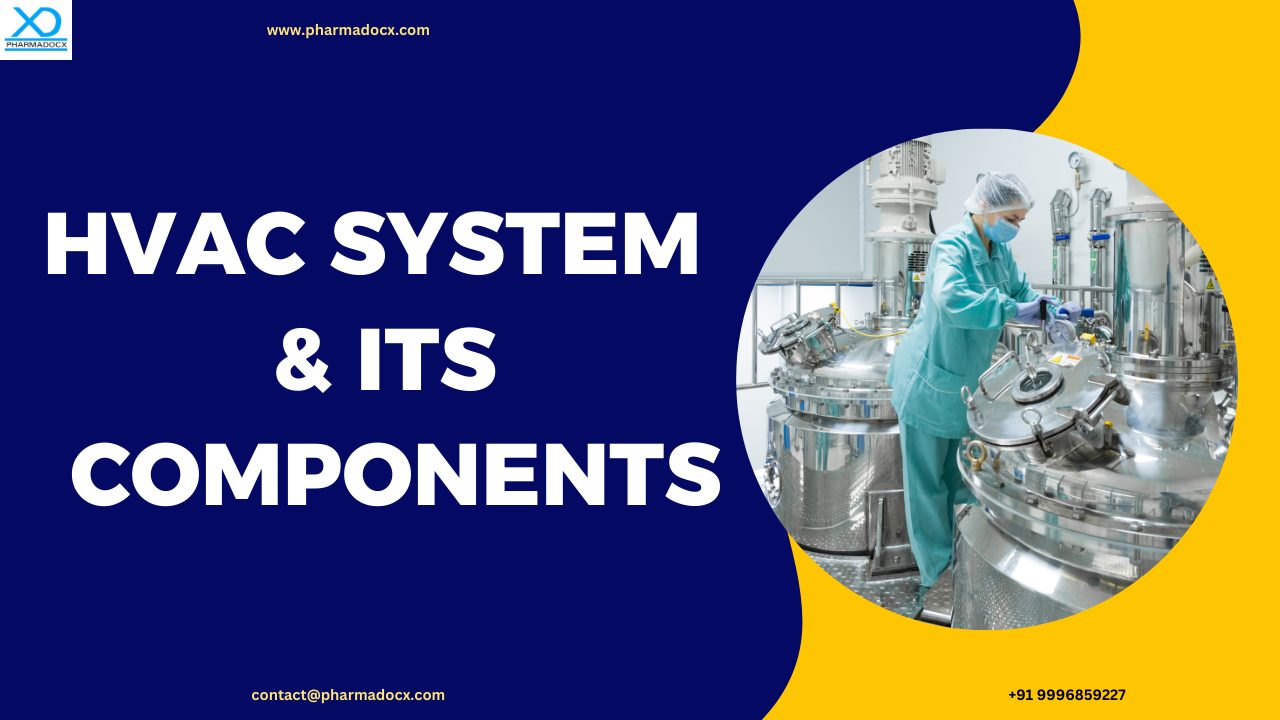

In this blog we have presented what is a HVAC system, its key components, and their roles. Additionally, we have presented the common problems HVACs face in pharma industry.
What is a HVAC system?
HVAC system stands for Heating, Ventilation, and Air Conditioning system. It is a critical infrastructure necessary for controlled temperature, humidity, air pressure, and cleanliness to maintain product quality and patient safety. Moreover, HVAC is vital for compliance with Good Manufacturing Practices (GMP). It regulates airflow patterns, filters airborne particles, and prevents cross-contamination between manufacturing zones, thereby safeguarding sterile and non-sterile production environments. By stabilizing environmental conditions, HVAC systems protect sensitive drugs and raw materials from degradation.
8 Key components of HVAC system
An HVAC system is made up of multiple specialized components. Each component is designed to control air quality, temperature, humidity, and pressure to ensure sterile, contamination-free environments. Together, these parts form a highly regulated system that supports GMP compliance and protects product integrity.
- Air handling unit (AHU): The AHU is a major component of the HVAC system. It consists of various subcomponents. The mixing box combines fresh air with return air to balance ventilation. Prefilters capture large dust particles before deeper filtration. Cooling/heating coils regulate air temperature using chilled or hot water. Blower/fan generates pressurized airflow throughout the duct system. Fine filters remove smaller particles before final filtration. High-Efficiency Particulate Air filters (HEPA) eliminate microorganisms and fine particles, which is critical for cleanrooms.
- Ductwork and dampers: Ducts distribute conditioned air across different zones. Dampers control airflow volume and direction, ensuring proper pressure differentials between clean and less-clean areas.
- Humidifiers and dehumidifiers: Maintain relative humidity (RH) within strict ranges (often 45–55%) to protect sensitive drug formulations and prevent microbial growth.
- Sensors and controls: Temperature sensors monitor and adjust heating/cooling. Humidity sensors ensure RH stability. Pressure sensors maintain positive pressure in sterile zones and negative pressure in containment areas. Building management system(BMS) is a centralized digital control for monitoring and alarms.
- Air distribution and diffusers: Laminar airflow units provide unidirectional airflow in sterile zones. Diffusers ensure even air distribution and minimize turbulence.
- Return air and exhaust systems: Return air units collect used air for recirculation or exhaust. Exhaust fans remove contaminated air, especially in hazardous or non-sterile areas.
- Plenum chambers: Enclosed sections that stabilize airflow and pressure before distribution into cleanrooms.
- Auxiliary systems: Chillers and boilers provide chilled/hot water for coils. Air compressors support pneumatic controls. Filters at multiple stages are part of the auxiallary system. Prefilter, fine filter, and HEPA ensure progressive air purification.
Why do these components matter?
- Sterility assurance: Prevents cross-contamination between production zones.
- Regulatory compliance: HVAC system components are required for FDA, EU MDR, and WHO GMP standards.
- Product stability: Protects drugs from degradation due to temperature/humidity fluctuations.
- Worker safety: Maintains breathable, clean air in hazardous environments.
Types of filters in pharma HVAC system
Filters form the cornerstone of an HVAC system in pharma because they determine how clean the air is before it reaches sensitive manufacturing zones.
- Pre-filters: Pre-filters capture large dust, fibers, and debris at the first stage and protect downstream filters (fine and HEPA) from clogging too quickly. It has typically 30–40% dust spot efficiency.
- Fine filters (intermediate filters): Fine filters remove smaller particles like fine dust, spores, and some microorganisms and provide cleaner air before final HEPA filtration.
- High-Efficiency Particulate Air (HEPA) filters: HEPA filters trap ≥99.97% of particles ≥0.3 microns (including bacteria and many viruses). They are critical for cleanrooms, sterile manufacturing, and aseptic filling areas and are placed at terminal points (ceiling diffusers or laminar flow units).
- Ultra-Low Penetration Air (ULPA) filters: ULPA filters capture ≥99.999% of particles ≥0.12 microns. They are used in Grade A cleanrooms (ISO Class 4 or better) where aseptic processing demands extreme sterility. Their efficiency is higher than HEPA but are more expensive and pressure-intensive.
- Activated carbon filters: These filters adsorb gases, vapors, and odors and are useful in areas where volatile organic compounds (VOCs) or solvent fumes may be present. They are not suitable for particulates but for chemical contamination control.
Why filters matter in pharma HVAC?
- Prevent cross-contamination: Stop particles from moving between sterile and non-sterile zones.
- Protect products: Ensure tablets, injectables, and biologics are free from dust, microbes, and impurities.
- Regulatory compliance: GMP, FDA, and EU MDR require validated filtration systems for HVAC.
- Worker safety: Filters also protect staff from inhaling hazardous powders or vapors.
Why maintaining temperature and humidity matters?
Maintaining temperature and humidity in the pharmaceutical industry is vital because both directly affect product quality, patient safety, and regulatory compliance. The HVAC system plays a vital role in maintaining the temperature and humidity of the manufacturing unit. Hence, it plays a crucial role in pharma manufacturing and maintaining product quality.
- Temperature control: Many drugs, biologics, and raw materials are highly sensitive to heat or cold. Deviations can cause chemical degradation, loss of potency, or altered physical properties (e.g., crystallization, melting). Controlled temperature ensures product stability during manufacturing, storage, and distribution.
- Humidity control: Excess humidity can promote microbial growth, cause tablets to swell or disintegrate, and lead to moisture-related contamination. Too little humidity, on the other hand, can cause powders to become electrostatically charged, making them difficult to handle and increasing cross-contamination risks.
- Cleanroom integrity: Proper temperature and humidity help maintain pressure differentials and airflow patterns, which are essential for preventing cross-contamination between sterile and non-sterile zones.
- Regulatory compliance: FDA, WHO, and EU MDR require strict environmental monitoring. Stable conditions demonstrate control over manufacturing processes and ensure audit readiness.
Therefore, temperature and humidity are critical process parameters that safeguard drug efficacy, and sterility. By maintaining controlled temperature and humidity, HVAC systems have a critical role in maintaining product quality.
Why precise performance of HVAC matters?
Precise performance of HVAC systems in the pharmaceutical industry matters because even small deviations in air quality, temperature, humidity, or pressure can compromise product safety, regulatory compliance, and patient health.
- Product stability: Many drugs and biologics are highly sensitive to environmental changes. Precise HVAC control prevents degradation, loss of potency, or contamination.
- Sterility assurance: Cleanrooms rely on exact airflow patterns and pressure differentials to stop cross-contamination. If HVAC performance drops, sterile zones can be breached.
- Regulatory compliance: Agencies, such as FDA, WHO, and EU MDR, require validated HVAC systems with documented precision. Any failure can trigger audit findings, recalls, or production shutdowns.
- Worker safety: Accurate HVAC functioning ensures hazardous fumes, powders, or solvents are contained and exhausted properly, protecting staff.
- Operational efficiency: Precise performance reduces energy waste, minimizes filter overload, and extends equipment life, thereby lowering costs while maintaining compliance.
Therefore, precise functioning of the HVAC system forms the backbone of pharmaceutical manufacturing, thereby ensuring that every batch of medicine is safe, effective, and audit-ready.
5 common problems HVACs face in pharma facilities
- Filter-related issues: Clogged or damaged filters reduce airflow and compromise air cleanliness. Improper filter installation can allow bypass leakage, contaminating cleanrooms. Delayed replacement increases microbial risk and energy consumption.
- Humidity and temperature control failures: Fluctuating humidity causes microbial growth or static charge in powders. Temperature instability leads to drug degradation and non-compliance with GMP storage conditions.
- Airflow and pressure imbalances: Incorrect pressure differentials between clean and less-clean zones allow cross-contamination. Poor airflow distribution creates turbulence, disrupting laminar flow in sterile areas.
- Maintenance and calibration gaps: Delayed preventive maintenance results in coil fouling, fan inefficiency, and sensor drift. Uncalibrated sensors give false readings, leading to incorrect environmental control.
- Energy inefficiency: Oversized or undersized systems waste energy or fail to meet environmental requirements.
Hence, a well-designed and properly installed HVAC is of fundamental importance in the pharma industry. We at Pharmadocx Consultants provide comprehensive HVAC design service as a part of our pharma factory layout design service. Email at [email protected] or call/Whatsapp on 9996859227 to hire our team of experts.