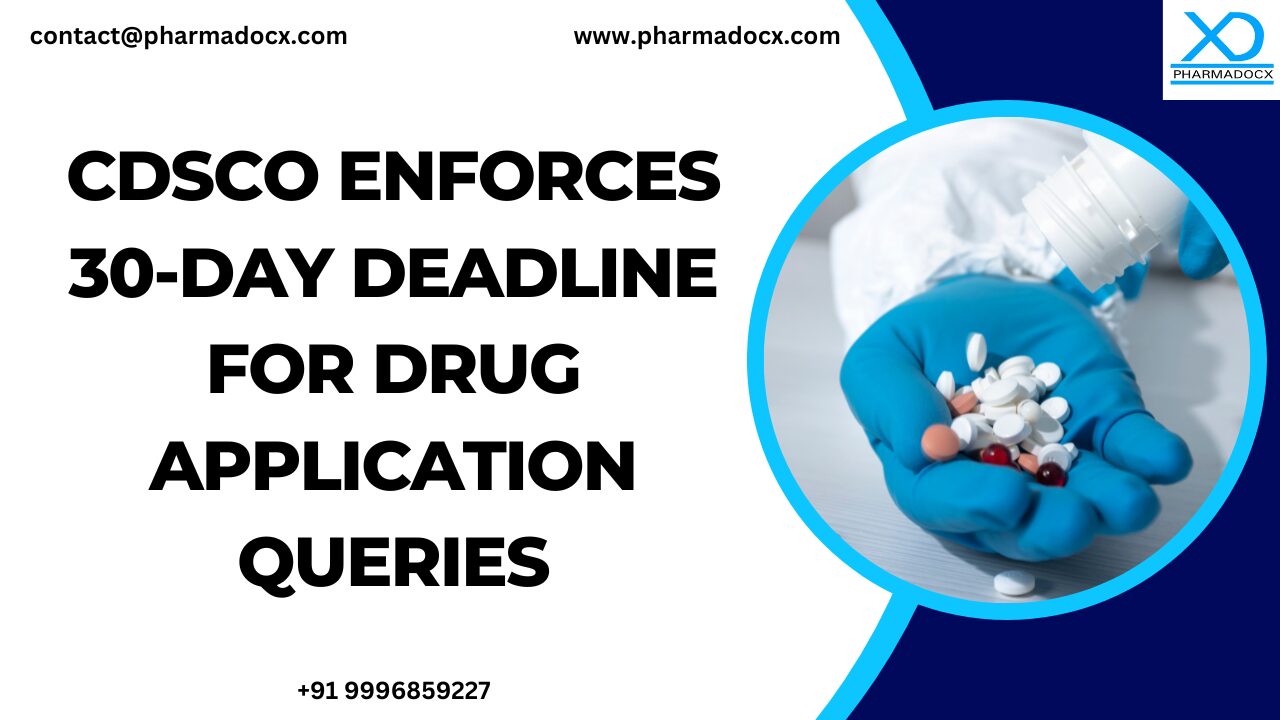
CDSCO notice, dated May 4, 2026, stated that long-pending applications on the SUGAM portal awaiting query response will be rejected. It directs all applicants to respond to regulatory queries within 30 days of issuance. The notice highlights that numerous applications across divisions, such as Global Clinical Trials (GCT), Bioavailability/Bioequivalence (BA/BE), Ethics Committees, and Veterinary, have remained pending since 2016 due to non-submission of responses. To clear this backlog, CDSCO will send three reminders through the SUGAM portal. If no reply is received within the stipulated period, the application will be rejected and the fees will be forfeited. This 30-day deadline measure aims to enforce accountability, streamline review timelines, and ensure timely disposal of applications awaiting query responses.
CDSCO mandates 30-day deadline for drug application queries
CDSCO has mandated that all drug application queries must be answered within 30 days. Failure to respond, even after three reminders, will result in automatic rejection of the application and forfeiture of fees. This move is aimed at clearing a backlog of applications pending since 2016 across multiple divisions. The goal is to clear legacy backlogs and standardize query response timelines for faster regulatory processing.
Key highlights of the directive
- CDSCO has observed that numerous applications across divisions remain pending due to non-submission of responses to regulatory queries.
- To reduce backlog, the directive continues the earlier order (dated 16 January 2026) and applies to divisions, such as Global Clinical Trials (GCT), Bioavailability/Bioequivalence (BA/BE), Ethics Committees, and Veterinary.
- Applicants are required to respond to queries within 30 days of issuance.
- CDSCO will issue three reminders through the SUGAM portal.
- If no response is received within the stipulated period, the application will be rejected and fees forfeited.
- The measure aims to streamline regulatory processing, ensure timely disposal, and enhance accountability among applicants.
Scope of the directive
- Applicable divisions: Global Clinical Trials (GCT), Bioavailability/Bioequivalence (BA/BE), Ethics Committee Approvals, Veterinary Division, and other divisions handling drug, device, and related regulatory applications
- Coverage: All applications pending on the SUGAM portal where queries have been raised and remain unanswered. Includes applications pending since 2016 and those submitted under various categories of drug and clinical trial permissions.
- Reach: Applies to both domestic and international applicants submitting through the SUGAM portal. Enforces a uniform 30-day deadline for all divisions to ensure timely disposal.
Operational implications
- Applicants must monitor the SUGAM portal regularly for pending queries.
- Applications pending since 2016 are included in this cleanup drive.
- CDSCO emphasizes that this step is essential to maintain efficiency and transparency in India’s drug approval system.
Immediate impact of the 30-day deadline directive
- Automatic rejection of dormant applications: All applications pending on the SUGAM portal without query responses (some dating back to 2016) will be rejected after 30 days if applicants fail to respond.
- Fee forfeiture: Once rejected, the application fees will be forfeited, discouraging delays and incomplete submissions.
- Regulatory cleanup drive: CDSCO is conducting a system-wide purge of inactive applications across divisions, such as Global Clinical Trials (GCT), Bioavailability/Bioequivalence (BA/BE), Ethics Committees, and Veterinary.
- Operational pressure on applicants: Companies must track SUGAM notifications daily and ensure timely query resolution to avoid rejection.
- Enhanced review efficiency: The directive will accelerate regulatory timelines, thereby allowing CDSCO to focus on active, compliant applications and reduce backlog significantly.
- Industry-wide compliance shift: Regulatory teams, CROs, and consultants will need to institutionalize 30-day response protocols and automated query tracking systems to maintain compliance.
This directive marks a decisive move toward regulatory discipline and digital accountability in India’s drug approval ecosystem.
Implications for industry
For pharmaceutical manufacturers
- Regulatory discipline: Companies must strengthen internal compliance systems to ensure queries are tracked and answered within the 30‑day deadline.
- Financial risk: Non‑response leads to automatic rejection and fee forfeiture, increasing the cost burden if applications are resubmitted.
- Operational pressure: Regulatory affairs teams will need to adopt real‑time monitoring of the SUGAM portal and establish escalation protocols for unresolved queries.
For clinical trial sponsors & CROs
- Faster turnaround: Queries related to Global Clinical Trials (GCT) and BA/BE studies must be addressed promptly, thereby reducing delays in trial approvals.
- Documentation readiness: CROs must maintain pre‑validated data sets and templates to respond quickly to regulator concerns.
- Risk of market entry delays: Any lapse in query response could stall trial initiation, impacting drug launch timelines.
For importers and distributors
- Import licensing: Queries on import applications will now face stricter timelines, thereby requiring better coordination with overseas manufacturers.
- Supply chain impact: Delays in approvals could disrupt product availability, especially for critical drugs and devices.
For regulatory consultants
- Increased demand: Companies will rely more on consultants to manage query responses, prepare documentation, and ensure compliance.
- Opportunity for value‑added services: Consultants can offer query‑response frameworks, SOPs, and compliance audits tailored to CDSCO’s 30‑day deadline.
Systemic implications
- Backlog clearance: Applications pending since 2016 will be purged, freeing CDSCO resources to focus on active submissions.
- Digital accountability: The SUGAM portal becomes the single source of truth, thereby requiring applicants to integrate portal monitoring into their compliance workflows.
- Global alignment: This move mirrors international regulators (FDA, EMA) who enforce strict timelines, positioning India’s system as more predictable and efficient.
The directive enforces operational discipline across the industry, thereby compelling stakeholders to adopt structured query‑management systems, automated reminders, and escalation workflows. It will probably reduce regulatory bottlenecks but also raise compliance costs for companies that are not adequately prepared.
Conclusions
Therefore, the CDSCO directive of 4th May 2026 marks a decisive step towards strengthening India’s regulatory discipline by enforcing a strict 30‑day query response window across all divisions of the SUGAM portal. By mandating automatic rejection and fee forfeiture for non‑compliance, the notice not only clears a decade‑long backlog of dormant applications but also compels pharmaceutical companies, trial sponsors, and importers to adopt robust compliance workflows and real‑time monitoring systems. This move aligns India’s regulatory environment with global best practices, ensuring greater transparency, efficiency, and accountability in drug approvals. Additionally, it signals to industry stakeholders that timely engagement with regulators is now non‑negotiable.