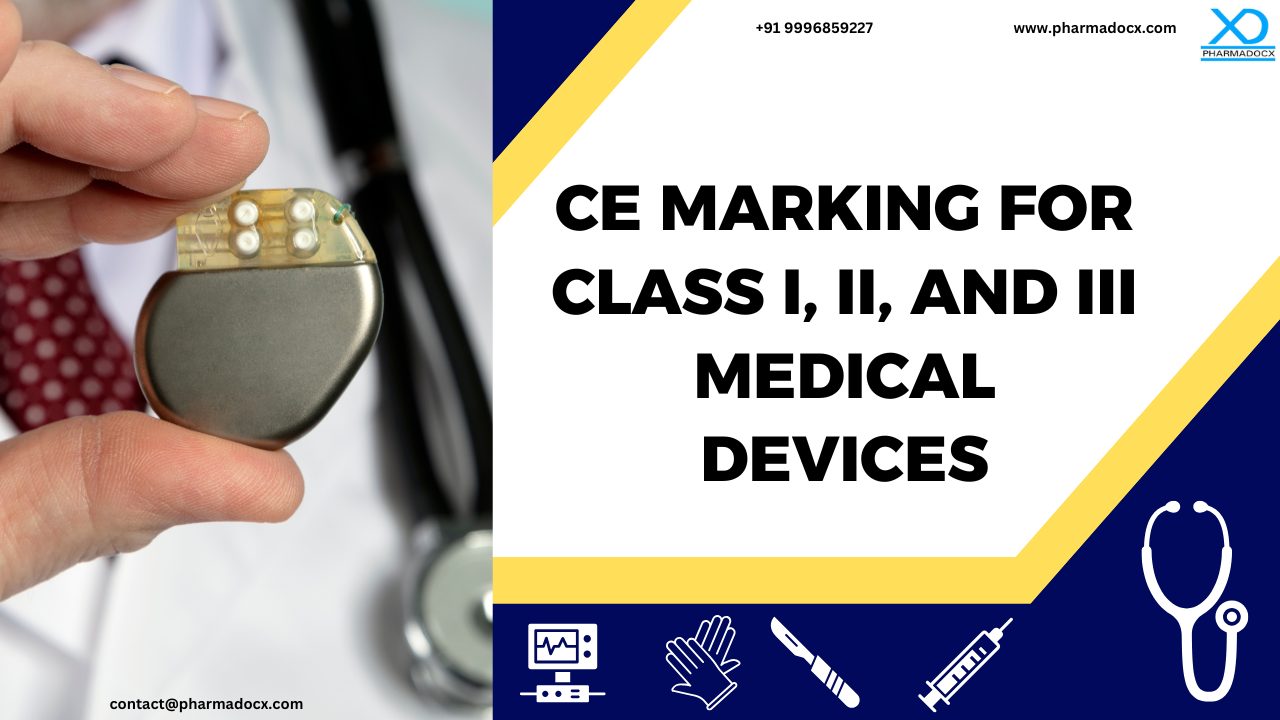

CE marking is a mandatory requirement for medical devices sold in the EU/EEA. It demonstrates compliance with EU MDR safety, performance, and quality requirements. The process involves classification, conformity assessment, technical documentation, and post-market surveillance. CE marking for Class I, II, and III medical devices requires progressively stricter conformity assessments as device risk class increases. Class I devices follow self-certification, Class II require notified body involvement, and Class III undergo the most rigorous review. Thus, the higher the EU MDR medical device class, the greater the regulatory burden.
What is the CE mark for medical devices?
CE mark for medical devices is a mandatory requirement for manufacturers and distributors who want to place their products in the European Economic Area (EEA). This logo demonstrates the product meets the essential requirements for health, safety, and environmental protection set by EU regulations. Notably, to comply with EU MDR, securing CE marking is not optional. It is a legal requirement. Having the CE mark confirms the product has successfully undergone the necessary regulatory assessments. Hence, it can be marketed across Europe without the need for additional national approvals.
3 Key criteria for securing the CE mark for medical devices
To secure the CE mark for medical devices, manufacturers must demonstrate compliance in these 3 areas.
- Scientific validity: The medical device should achieve its intended purpose based on established scientific principles.
- Analytical performance: The accuracy, sensitivity, precision, and specificity of the device are evaluated. Analytical performance tests are vital for laboratory instruments, diagnostics, and monitoring devices.
- Clinical performance: The device should be able to deliver the intended clinical benefit when used as directed. For high-risk medical devices, clinical investigations have to be performed to obtain real-world evidences.
Classification of medical devices under EU MDR
Understanding EU MDR medical device classification is crucial because CE marking requirements vary for each class. Medical devices are classified into four classes, namely Class I, IIa, IIb, and III. This classification depends on the associated risk level, intended use, and contact duration with the human body. The higher the class, the more stringent the conformity assessment.
- Class I: Class I medical devices are low risk devices. Examples: Stethoscopes, bandages, reusable surgical instruments
- Class IIa: Class IIa medical devices are medium risk. Examples: Infusion pumps, dental materials, hearing aids
- Class IIb: Class IIb medical devices are higher medium risk. Examples: Ventilators, anesthesia machines
- Class III: Class III medical devices are high risk. Examples: Pacemakers, heart valves, implantable devices
CE marking for Class I, II, and III Medical Devices
CE marking requirements for Class I medical devices
- Conformity assessment: For standard Class I medical devices (non-measuring and non-sterile), notified body is not required. Manufacturer can self-declare conformity. On the other hand, Is (sterile), Im (measuring), Ir (reusable surgical instruments) require notified body involvement. Notified body reviews sterility, measurement accuracy, or reprocessing validation. CE mark must include notified body number, where applicable.
- Technical documentation: The technical documentation should include device description and intended purpose, classification rationale, risk management file (ISO 14971), clinical evaluation, labeling and instructions for use (IFU), and PMS plan and vigilance procedures.
- Quality management system (QMS): Maintain QMS aligned with ISO 13485. For Is/Im/Ir, QMS must be audited by notified body.
- EU Declaration of conformity: Manufacturer should sign declaration stating compliance with MDR. Must be kept available for competent authorities.
CE marking requirements for Class II medical devices
- Conformity assessment: Both Class IIa and IIb require notified body involvement. For Class IIa, notified body audits manufacturer’s quality management system (QMS) and reviews sample technical documentation for representative devices. On the other hand, for Class IIb, full QMS audit is performed. Representative technical documentation is reviewed more extensively. Higher scrutiny is required due to increased risk.
- Technical documentation: Device description and intended purpose, classification rationale, risk management file (ISO 14971), clinical evaluation, labeling and instructions for use (IFU), and PMS plan and vigilance procedures have to be included. Notably, for IIb, documentation must be more detailed and robust. Periodic Safety Update Report (PSUR) will be required for Class IIa and IIb devices.
- Quality management system (QMS): ISO 13485 certification is expected. Notified body audits QMS for compliance. It must cover design, manufacturing, and post-market activities.
- EU Declaration of conformity: Manufacturer should sign declaration stating compliance with MDR. Must be available for Competent Authorities.
CE marking requirements for Class III medical devices
- Conformity assessment: Mandatory notified body involvement is required for Class III devices. The QMS is thoroughly reviewed. Design dossier review (design examination) has to be performed by the notified body. Clinical evaluation and evidence are scrutinized in detail. CE marking must include notified body number for Class III devices.
- Technical documentation: Comprehensive device description and intended purpose, classification rationale, risk management file (ISO 14971), and labeling and instructions for use (IFU) have to be included in the technical documentation. Additionally, clinical evaluation report (CER) with supporting clinical data will be required. Furthermore, PMS plan, vigilance procedures, and post-market clinical follow-up (PMCF) plan will be required. Additionally, manufacturing process validation and design verification/validation reports will be required.
- Quality management system (QMS): Full QMS has to be aligned with ISO 13485. ISO 13485 certification is expected. Notified body audits QMS covering design, manufacturing, and post-market activities. Must demonstrate risk-based controls and traceability.
- EU Declaration of conformity: Manufacturer signs declaration confirming compliance with MDR. Must be available for competent authorities.
- Post-market surveillance (PMS): Maintain PMS system with proactive data collection. Report serious incidents and field safety corrective actions. Periodic safety update report (PSUR) required annually for Class III devices. Conduct post-market clinical follow-up (PMCF) studies to continuously update CER. Technical documentation must be updated continuously.
Key steps in CE marking process
- Device classification: The device has to be classified based on intended use and risk. It is important to correctly classify the medical devices, as CE marking requirements vary for each class.
- Conformity assessment: Class I medical devices mostly require self-certification. Class IIa/IIb require notified body to audit QMS and review technical documentation. For Class III, notified body has to perform design examination and clinical evaluation.
- Technical documentation: Device description, intended use, risk management (ISO 14971), clinical evaluation, labeling, IFU, PMS plan will have to be part of technical documentation.
- Quality management system (QMS): A robust quality management system will be required. ISO 13485 certification is expected for Class II and above.
- EU declaration of conformity: Medical device manufacturers are required to sign to attest compliance.
- Affixing CE Mark: Place CE Mark on device, packaging, and IFU. Include Notified Body number on the CE mark, if applicable to your device. The device can now be marketed in EU/EEA.
- Post-market surveillance (PMS) and vigilance: Continuous monitoring, reporting of incidents, and periodic safety update reports (PSUR for Class IIa–III) will be required after marketing the medical device.
How can we help you easily achieve CE mark for your medical device?
At Pharmadocx Consultants, we specialize in walking medical device manufacturers through the CE marking process for Class I, II, and III medical devices. With years of regulatory experience, we help clients easily achieve CE certification. Our service covers the following:
- Device classification and applicable regulatory requirement assessment
- Technical documentation preparation and compilation
- Clinical evaluation and validation support
- Notified body selection and coordination
- Preparing for notified body audit with the help of our mock audit sessions
- Post-market compliance documentation
Drop an email at [email protected] or call/Whatsapp on 9996859227 to partner with us.