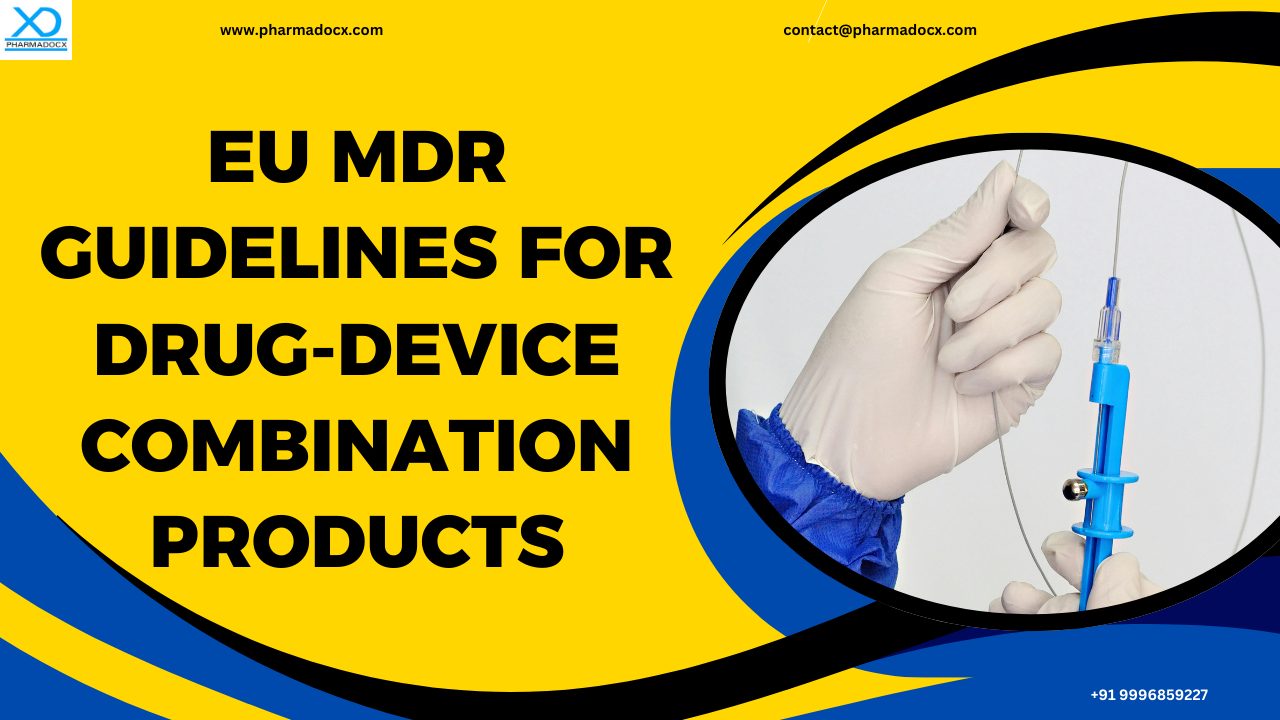
The EU Medical Device Regulation (MDR) categorises drug-device combinations based on their primary mode of action (PMOA). The regulatory pathway is determined by whether the product is primarily a medicinal product (drug) or a medical device. In this blog, we will discuss the EU MDR guidelines for drug-device combinations.
What is a drug-device combination product?
A drug-device combination product is a therapeutic product that includes both a medicinal component (the drug) and a medical device component (the delivery system or device). They enable targeted drug delivery (e.g., stents releasing drugs locally). These are regulated because the safety and effectiveness of the drug often depend on how the device delivers it, and vice versa.
Examples: Pre-filled syringes (drug + injection device), Inhalers (drug + inhalation device), Drug-eluting stents (device + drug coating)
Types of drug-device combinations:
- Integral products: The drug and device form one inseparable unit (e.g., insulin pens, pre-filled syringes).
- Co-packaged products: The drug and device are separate but packaged together (e.g., vial of medicine with a syringe).
- Cross-labeled products: The drug and device are marketed separately but intended to be used together, as specified in labelling.
Importance of drug-device combination products
Drug-device combination products are increasingly vital in modern healthcare because they bridge the gap between pharmaceutical therapy and medical technology. They offer integrated solutions that improve patient outcomes and system efficiency.
- Enhanced patient safety: Devices like auto-injectors (e.g., epinephrine pens) ensure correct dosing and reduce human error. Controlled-release systems (e.g., drug-eluting stents) minimize systemic side effects by delivering medication locally.
- Improved patient compliance: Pre-filled syringes, inhalers, and insulin pens simplify administration, making treatments more user-friendly. Reduces the need for hospital visits by enabling self-administration at home.
- Targeted and efficient therapy: Drug-eluting implants or stents deliver medication directly to the affected site, increasing therapeutic effectiveness.
- Innovation in treatment modalities: Combination products enable therapies that wouldn’t be possible with drugs or devices alone.
- Operational and economic benefits: Streamlined treatment reduces hospital stays and healthcare costs. Combination products often shorten treatment cycles and improve quality of life, which is a major public health advantage.
Thus, drug-device combinations are of critical importance in the healthcare industry. Notably, they require dual expertise in pharmaceutical and device regulations, thereby making development and approval of drug-device combinations more complex.
EU MDR guidelines for drug-device combination products
Under the EU MDR, drug-device combination products are regulated to ensure both the drug and device components meet stringent safety and performance standards. Article 117 of the EU MDR guidelines focuses on drug-device combination products. Article 117 requires a medicinal product incorporated within a device (e.g., pre-filled syringes, inhalers, drug-eluting stents) to follow certain specific requirements. The marketing authorization dossier of drug-device combination must include a Notified Body Opinion confirming the device’s compliance with MDR requirements. Furthermore, devices intended to administer medicinal products are classified under Rule 14, with risk-based categorization depending on their use. The EMA may be consulted for scientific advice in certain cases, and borderline products are handled by the European Commission or national authorities. Thus, the EU MDR guidelines for drug-device combination products emphasize early collaboration between drug developers, device manufacturers, and notified bodies to streamline approvals and safeguard patient health.
Types of drug-device combination products per EU MDR guidelines
EU MDR categorises drug-device combinations (DDCs) based on their primary mode of action. The regulatory pathway is determined by whether the product is primarily a medicinal product (drug) or a medical device. The EU framework distinguishes between products based on how the drug and device are combined:
- Integral combinations (single integral products): The drug and device form a single unit intended exclusively for use in that combination and are not reusable.
- Regulated as medicines: If the drug’s action is primary (e.g., pre-filled syringes, auto-injectors, insulin pens).
- Regulated as devices: If the device’s action is primary but it incorporates an ancillary medicinal substance (e.g., drug-eluting stents, heparin-coated catheters).
- Non-integral combinations:
- Co-packaged: The drug and device are in the same pack but not physically integrated (e.g., a reusable pen with separate cartridges).
- Referenced: The drug’s instructions refer to a specific device to be used that is sold separately.
Key provisions of EU MDR guidelines for drug-device combination products
- Article 117 for integral drug-device combinations: If a medicinal product includes a device component (e.g., pre-filled syringe, inhaler), the marketing authorization application must include evidence that the device part meets MDR safety and performance requirements. A Notified Body Opinion (NBOp) is required to confirm conformity of the device constituent part.
- Rule 14 for drug-device combinations: Devices intended to administer medicinal products are classified under Rule 14.
- EMA consultation procedure: For certain devices used with medicinal products (e.g., closed-system transfer devices, injectors), the European Medicines Agency (EMA) must be consulted. EMA provides scientific advice on the device’s compliance with MDR requirements.
- Borderline cases: Disputes may arise over whether a product is a medicinal product, a medical device, or a combination. In this case, classification guidance is provided by the European Commission and national authorities.
EU MDR guidelines for drug-device combination: Article 117
EU MDR Article 117 requires drug-device combination products, specifically those where the device and drug form a “single integral product”, to undergo a stricter assessment of the device component before receiving a marketing authorisation.
Key requirements
- Integral combination products: It applies to devices that are single-use, non-reusable, and intended exclusively for use in a specific combination (e.g., pre-filled syringes, insulin pens, or transdermal patches).
- Notified body opinion (NBOp): If the device part is not already CE marked, the manufacturer must obtain an NBOp. This opinion confirms that the device component meets the General Safety and Performance Requirements (GSPR).
- Marketing authorisation application (MAA): The NBOp must be included in the dossier submitted to the European Medicines Agency (EMA) or relevant national authority for the medicinal product’s approval.
Thus, Article 117 is a vital part of EU MDR guidelines for drug-device combination products.
Exceptions and scope
- CE marked devices: If the device part already has a valid CE mark and EU declaration of conformity, a separate NBOp is generally not required for the initial application.
- Non-integral devices: Devices that are co-packaged but not integral (e.g., a measuring spoon or a separate reusable injector) must be fully CE marked as standalone medical devices and do not fall under the Article 117 NBOp pathway.
- Class I Devices: The requirement for an NBOp does not apply to non-sterile, non-measuring Class I devices.
EU MDR guidelines for drug-device combination: Classification Rule 14
Rule 14 governs the classification of devices that incorporate a drug. It mandates that any device incorporating, as an integral part, a substance which would be considered a medicinal product if used separately, is classified as Class III (the highest risk category).
- Ancillary action: The medicinal substance must have an action that is ancillary (supportive) to the primary purpose of the device. If the medicinal action is the primary effect, the product is regulated as a drug, not a device.
- Examples of Rule 14 Devices:
- Drug-eluting stents: The drug reduces tissue regrowth, but the mechanical stent action is primary.
- Antibiotic-coated catheters: To reduce infection risk.
- Heparin-coated devices: To improve blood compatibility.
- Requirements: Manufacturers must undergo a consultation procedure with a medicinal competent authority (like the European Medicines Agency (EMA)) to verify the quality and safety of the medicinal part.
Therefore, the EU MDR guidelines for drug-device combination products establish a harmonized framework that ensures both the drug and device components meet rigorous safety, quality, and performance standards. By requiring a Notified Body Opinion under Article 117 and applying risk-based classification rules, the regulation strengthens oversight of integral products, such as pre-filled syringes, inhalers, and drug-eluting stents. This approach not only enhances patient safety and therapeutic effectiveness but also compels manufacturers to engage in early collaboration with notified bodies and regulatory authorities. We at Pharmadocx Consultants have the regulatory expertise to guide you through the EU MDR guidelines for drug-device combination products. Email at [email protected] or call/Whatsapp on 9996859227 and we will be more than happy to help.