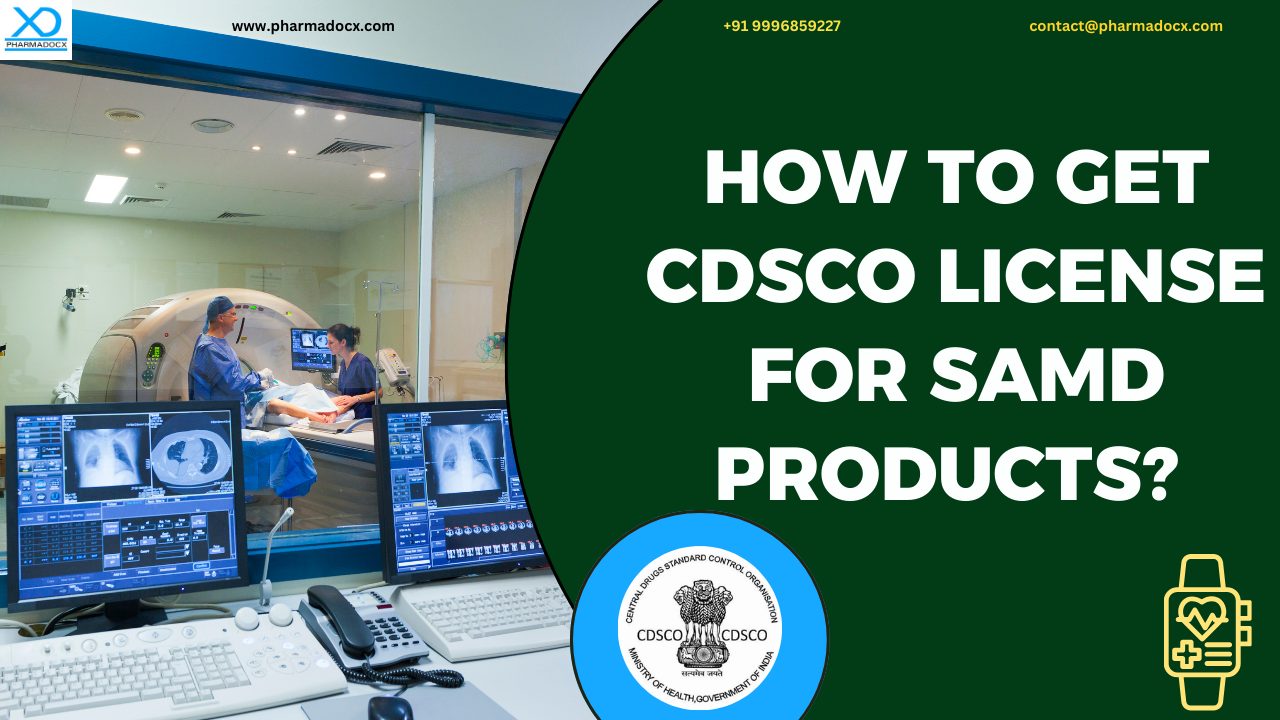
Currently, medical devices are not just limited to physical devices. A software itself can be used as a medical device. Software as a Medical Device (SaMDs) are used not only to diagnose diseases but also to decide the course of treatment. Thus, it is important to verify that the software performs as intended to minimize malfunctions that could harm patients. Furthermore, as doctors use SaMDs to diagnose diseases, confidentiality of patient data and information is important. Additionally, accuracy of the data generated by the software is essential for proper diagnosis. Thus, with technological advancement, software plays a vital role in healthcare industry. Hence, owing to its increased use and impact in the healthcare industry, CDSCO strictly regulates SaMDs. Therefore, securing the CDSCO license for SaMD products is mandatory for launching your product in India.
What is SaMD?
SaMD stands for Software as a Medical Device. SaMD refers to a software that is intended to be used for medical purposes without being part of a hardware medical device. In other words, the software itself performs medical functions, such as diagnosis, prevention, monitoring, or treatment, independent of any physical device. SaMD is central to digital health innovation, enabling AI-driven diagnostics, telemedicine, and personalized treatment pathways. It requires rigorous validation, cybersecurity safeguards, and compliance with standards, such as ISO 13485.
As per Medical Device Rules, 2017, a Software as a Medical Device is a software used to treat, diagnose, mitigate, cure, or prevent disease or other conditions. It can be a software technology or mobile app. It can used as a standalone technology or can function in combination with other software. Thus, a software will be considered a medical device only if it was developed with the intention of being used for medical purposes. Importantly, getting the CDSCO license for SaMD products is mandatory for selling and distributing your products in India.
CDSCO license for SaMD products
CDSCO criteria for qualifying a software as a medical device
The CDSCO has formulated certain criteria to classify a software as a medical device. A software will be considered a medical device only if it is used to:
- Diagnose, prevent, monitor, treat, or alleviate a disease or disorder
- Support or sustain life
- Assist in the control of conception
- Investigate, replace, modify or support the anatomy or a physiological process
- Assist individuals with injury or disability
To apply for CDSCO license for SaMD products, check whether your software fulfils either of the above criteria.
CDSCO classification for SaMD
CDSCO has classified SaMDs into four classes, namely A, B, C, and D, based on the associated risk level. This classification system has been developed to simplify the CDSCO SaMD license application process. The CDSCO SaMD class will determine the CDSCO license required and the application process. To get the CDSCO license for SaMD products, you need to understand the CDSCO SaMD classification system.
- CDSCO SaMD Class A: CDSCO SaMD Class A is low risk SaMD. The Class A software does not directly interfere with patient data. It is a software that retrospectively analyses pre-recorded clinical data of patients. Examples: Continuous glucose monitor retrospective data analysis software, Ataxiagraph with interpretive software
- CDSCO SaMD Class B: CDSCO SaMD Class B is moderate risk SaMD. The Class B software generates real time patient information based on patient’s parameters. Examples: Software for visual evoked response stimulator, Software for pulmonary exercise stress monitoring system, Software for ECG recorder with real-time analysis, Automated radiological image processing software, Image acquisition and/or optimization guided by artificial intelligence, Chairside dental CAD/CAM unit
- CDSCO SaMD Class C: CDSCO SaMD Class C is moderate-to-high risk SaMD. The Class C software can be used to diagnose diseases and analyse patient’s physiological and physical activity. Examples: Diabetic retinopathy detection device, Computer-assisted diagnostic software for lesions suspicious for cancer, Insulin pump therapy adjustment calculator for healthcare professionals, Coronary vascular physiologic simulation software, Angiographic coronary vascular physiologic simulation software, Software for visualization of vascular anatomy and intravascular devices
- CDSCO SaMD Class D: CDSCO SaMD Class D is the highest risk SaMD. CDSCO has not yet classified any medical device as Class D.
Documents required to get CDSCO license for SaMD products
We have provided an overview of the documents required for securing CDSCO license for SaMD products in India.
- Sale deed/rent deed of the premises proving the legal ownership of the medical device manufacturing facility.
- Organization identity proof, such as memorandum of association, list of directors or partners, UDYAM Aadhar, or PAN card.
- Facility layout with dimension. A detailed drawing of the medical device manufacturing facility with the dimensions of each room and the location of all equipment.
- ISO 13485 certificate
- Plant master file containing information about the layout of the facility.
- Device master file contains detailed information about the software, including its design, development process, testing procedures, and validation
- Certificate of analysis demonstrating the software meets the required quality standards
- Details and qualification of technical staff who will manufacture and test the medical devices
- Test license for the SaMD, if required
This list provides an overview of the documents required for securing CDSCO license for SaMD products. Feel free to get in touch for a detailed list of documents required for CDSCO SaMD license application. Additionally, we will help prepare and compile the documents per CDSCO guidelines.
CDSCO license for manufacturing SaMD in India
Different classes of SaMD require different CDSCO licenses.
- To manufacture Class A and Class B Software as Medical Device (SaMD) in India, CDSCO MD 5 license must be secured from the state licensing authority.
- To manufacture Class C and Class D Software as Medical Device (SaMD) in India, CDSCO MD 9 license must be secured from the central licensing authority.
7-step guide to get CDSCO license for SaMD products
- Check whether the software qualifies as a medical device
- Check the CDSCO class for the SaMD, as this will determine the application form and requirements.
- Login or create an account on CDSCO’s SUGAM Portal.
- Fill in the respective application forms
- Compile and upload the necessary supporting documents. Additionally, pay the required fees.
- The application will be reviewed and the documents will be verified by the regulatory authorities. Furthermore, the regulatory authorities may conduct an audit.
- If the regulatory officials are satisfied and no non-compliance is observed, then the application will be approved. Then, the CDSCO license for SaMD products will be granted.
Validity of CDSCO license for SaMD products
The CDSCO license for SaMD products remains valid indefinitely. However, a license retention fee has to be paid every 5 years to maintain validity.
Pharmadocx Consultants: Your trusted CDSCO SaMD regulatory support
CDSCO has formulated stringent regulatory guidelines for SaMDs to set benchmarks for ensuring the software quality, safety, and efficacy. Securing the CDSCO SaMD license is a mandatory requirement for marketing your product in India. Navigating the CDSCO SaMD regulatory guidelines can be overwhelming. Fret not! Our team of experts will be more than happy to deal with all the regulatory hassles for you. For CDSCO SaMD license application support, feel free to email at [email protected] or call/Whatsapp on 9996859227. We have extensive expertise and knowledge of the CDSCO SaMD license application process. Our team of experts has more than 27 years of industry experience. We will be more than happy to help you easily obtain the CDSCO license for SaMD products in India. Our holistic support covers everything from document preparation, application submission to query response and post license services.