
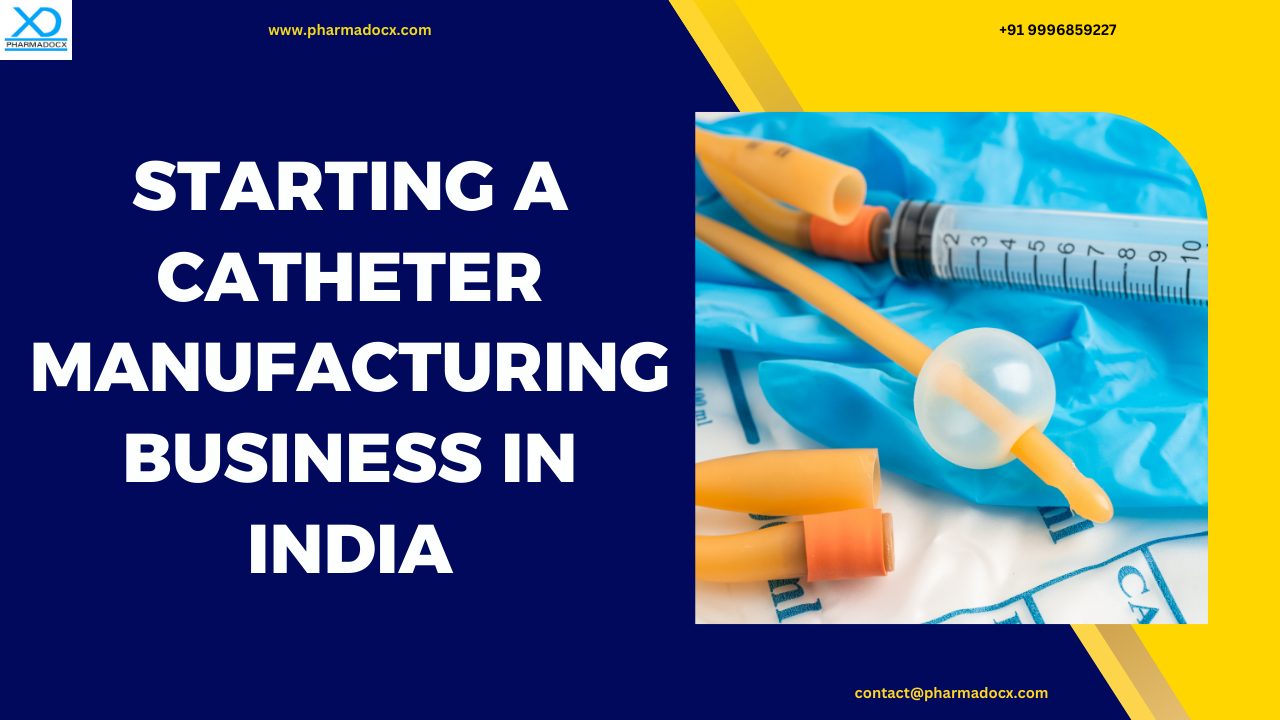

India’s catheter manufacturing business market shows strong potential. It is driven by rising demand for vascular access and urinary catheters and government incentives for medical devices. India currently imports a significant share of catheters. Hence, local production can reduce import dependency and tap into export growth. Moreover, manufacturing specialized catheters (drug-eluting, antimicrobial, pediatric) can create competitive advantage. Hence, success of a catheter manufacturing business in India requires regulatory compliance, quality assurance, and competitive differentiation.
Starting a catheter manufacturing business in India
Starting a catheter manufacturing business in India offers strong potential due to the country’s rapidly expanding medical device market, rising demand for urinary and vascular catheters, and government incentives, such as MedTech parks and Production Linked Incentive (PLI) schemes. India is currently heavily import dependant. Local production can reduce import dependency. Additionally, India’s catheter manufacturing business can tap into export opportunities across Asia, Africa, and Latin America. However, success of the catheter manufacturing business in India requires compliance with CDSCO medical device regulatory guidelines and other industry standards. To establish the business, significant investment in cleanroom facilities, sterilization infrastructure, and compliance with ISO 13485 standards is necessary. Differentiation through advanced technologies, such as antimicrobial coatings or specialized designs, can help new entrants compete with established global players. Hence, India can become a promising but competitive landscape for catheter manufacturing.
6 Factors driving the growth of the Indian catheter market
The Indian catheter market is expanding rapidly, driven by rising chronic disease prevalence, aging population, increased hospitalizations, and government support for domestic medical device manufacturing. The market is projected to grow consistently, with strong demand across cardiovascular, urology, intravenous, and neurovascular segments. We have highlighted the key growth drivers.
- Chronic disease burden: Rising cases of cardiovascular disease, diabetes, cancer, and renal disorders are fueling demand for catheters used in diagnostics, infusion, and surgical procedures. Catheters are essential in long-term disease management, especially for dialysis and chemotherapy.
- Aging population and hospitalization rates: India’s elderly population is increasing, leading to higher hospitalization rates and greater need for urinary and vascular catheters. Increase in ICU admissions and surgical procedures further boosts catheter usage.
- Government initiatives: Policies under Make in India and Atmanirbhar Bharat encourage local manufacturing of medical devices, including catheters. PLI schemes and MedTech parks provide infrastructure and financial incentives for domestic production.
- Import dependency and local manufacturing push: India imports a large share of catheters from countries like the USA, Ireland, Mexico, China, and Mauritius. Local manufacturing offers opportunities for import substitution and cost reduction.
- Technological advancements: Innovations, such as antimicrobial coatings, drug-eluting catheters, and minimally invasive designs, are driving adoption. Integration with digital health and imaging technologies enhances precision and patient outcomes.
- Expanding healthcare infrastructure: Growth of hospitals, ambulatory surgical centers, and homecare services across Tier 2 and Tier 3 cities is increasing catheter demand.
How to start a catheter manufacturing business in India?
We have prepared a detailed guide on how to start a catheter manufacturing business in India. We have touched upon the regulatory guidelines and licenses required.
Types of catheters available in the market
To start a catheter manufacturing business in India, you need to be aware of the types of catheters available in the market. Catheters available in the market can be broadly classified into urinary, cardiovascular, intravenous, and neurovascular types. Each serves a distinct medical purpose, such as bladder drainage, vascular access, infusion therapy, and specialized surgical procedures.
Materials used to manufacture catheter
Catheters are manufactured using specialized medical-grade materials, such as silicone, latex, polyurethane, polyvinyl chloride (PVC), nylon, and PTFE (Teflon). These materials are chosen for their biocompatibility, flexibility, durability, and sterilization compatibility. The choice of material directly impacts patient safety, performance, and regulatory compliance.
- Silicone is biocompatible, flexible, and inert. Application: Long-term urinary catheters
- Latex is elastic and cost-effective. Application: Short-term urinary catheters
- PU is strong, kink-resistant, and transparent. Application: CVCs, PICCs
- PVC is low-cost and widely available. Application: Intermittent urinary, IV catheters
- Nylon is durable and has high tensile strength. Application: Angiographic, guiding catheters
- PTFE is lubricious and chemical-resistant . Application: Neurovascular, specialty vascular catheters
Machinery used to manufacture catheter
Catheter manufacturing requires highly specialized machinery, such as extrusion lines, balloon forming systems, tipping machines, braiding equipment, laser cutters, and automated assembly units. Each stage of production from tubing to final inspection demands precision tools designed to handle medical-grade polymers under strict regulatory standards. We have provided a list of machinery used to manufacture catheter.
- Extrusion lines: Extrusion lines are used for producing tubing to make catheter shafts
- Balloon forming systems: Balloon forming systems are used to produce balloon catheters to shape angioplasty balloons.
- Tipping/welding machines: Tipping/welding machines are used for tip formation to smooth insertion ends.
- Braiding equipment: Braiding equipment is used at the reinforcement stage of catheter production for flexibility and kink resistance.
- Laser cutting/hole forming: Laser cutting/hole forming is required for precision features, such as drainage and guidewire ports.
- Laminating and automation units: Laminating and automation units are required during final assembly to combine components.
- Inspection/testing equipment: Inspection/testing equipment are required for quality control for regulatory compliance.
License to start a catheter manufacturing business in India
CDSCO catheter classification system
To secure the CDSCO license for manufacturing catheter in India, you need to understand the CDSCO catheter classification system. The CDSCO class will determine the CDSCO license required for your catheter. CDSCO uses a four-tier risk-based medical device classification system to simplify the regulatory pathway. The four CDSCO medical device classes are Class A (low risk), Class B (low to moderate risk), Class C (moderate to high risk), and Class D (high risk). As per CDSCO medical device classification system, depending on their intended use and risk level, catheters mostly belong to Class B and C devices. We have provided some examples of CDSCO class of catheters. To check which class your catheter belongs to, use our free tool.
- Class B (Low-moderate risk): Most common diagnostic and short-term catheters.
- Urological catheters: Sterile intermittent urethral drainage catheters.
- Rectal balloon catheters: Used for reducing rectal volume during certain procedures.
- Suction catheters: Used for precise and accurate suctioning.
- Bartholin catheters: For treating abscesses and cysts.
- Class C (Moderate-high risk): More invasive or longer-term devices.
- Cardiovascular catheters: Often fall into higher categories due to their proximity to the heart and central nervous system.
- Non-vascular catheter introduction sets: Used for percutaneous introduction (e.g., into the biliary tract or ureter).
CDSCO license for manufacturing catheter in India
To start a catheter manufacturing business in India, you need to secure the necessary CDSCO license. Different CDSCO classes require different CDSCO licenses. We have provided an overview of CDSCO license for manufacturing catheter in India.
- CDSCO class A and B medical devices: CDSCO MD5 is the license granted to manufacture class A and B medical devices in India. It is granted by the state licensing authority. The application for this license is applied on Form MD3.
- CDSCO class C and D medical devices: CDSCO MD9 is the license granted to manufacture class C and D medical devices in India. It is granted by the central licensing authority. The application for this license is applied on Form MD7.
In this blog, we have prepared a detailed guide to starting a catheter manufacturing business in India. We have presented the materials, machinery, and license required to manufacture catheter in India. Need help navigating the regulatory complexities of establishing a medical device business in India? Email at [email protected] or call/Whatsapp on 9996859227 to avail our comprehensive license service. We will help you identify the correct device class, apply for the correct license, prepare the necessary documents, and file the application correctly. Our team will provide support till you successfully secure the license.