
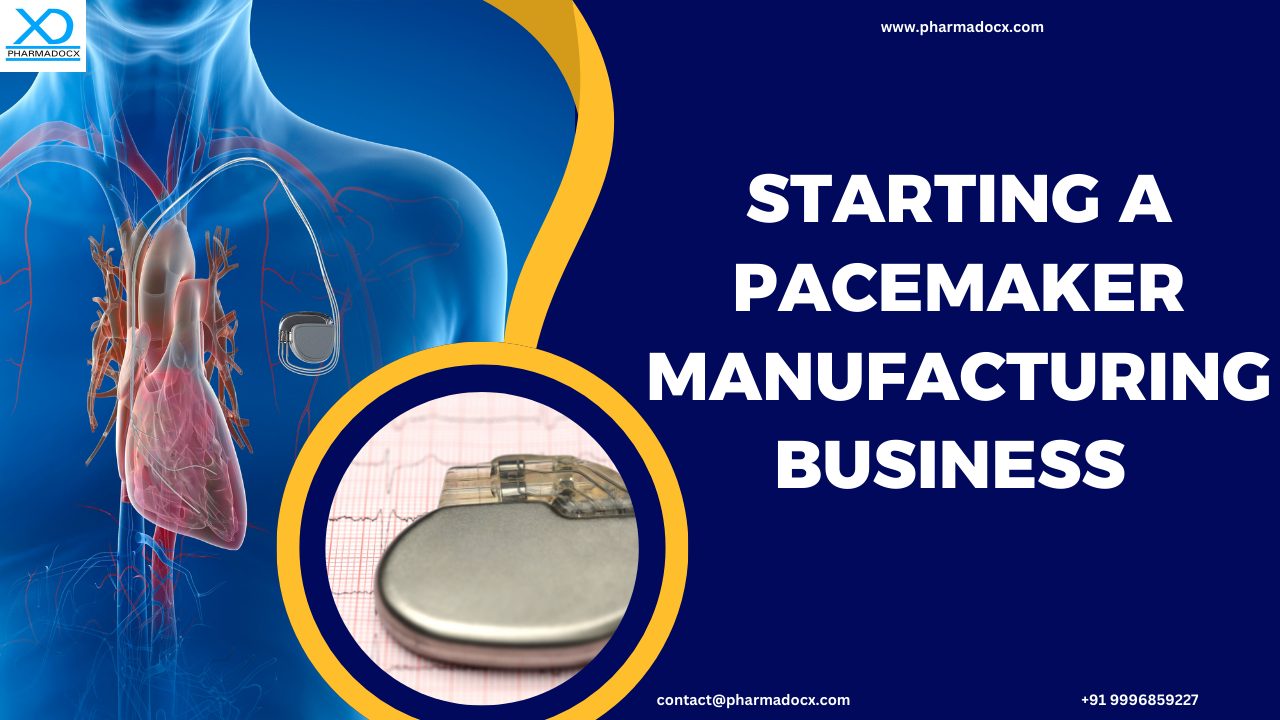

A pacemaker is a small, implanted device used to treat heart rhythm disorders (arrhythmias). Thus, a pacemaker has a considerable impact in the cardiovascular field of medicine. Starting a pacemaker manufacturing business in India is a highly lucrative opportunity. It is driven by strong demand, supportive policies, and a significant supply gap. The market is expanding rapidly due to rising cardiovascular disease prevalence, an aging population, and growing access to advanced healthcare. The sector is currently dominated by imports, leaving significant scope for domestic players to capture market share. With strong government support and favorable regulatory frameworks, local manufacturing can reduce costs, improve accessibility. Local manufacturers can position India as a competitive hub for high-quality pacemakers in both domestic and global markets. Notably, starting a pacemaker manufacturing business in India requires strict regulatory compliance with Central Drugs Standard Control Organisation (CDSCO).
Indian pacemaker market
Indian pacemaker market is lucrative, growing, and ripe for domestic manufacturing investment. The Indian pacemaker market is expanding steadily. It is a lucrative sector for investment and manufacturing. The Indian pacemaker market is facing strong demand growth driven by cardiovascular disease prevalence, aging demographics, and supportive government policies, such as “Make in India” initiatives and medical device parks.
Factors driving the growth
- Rising cardiovascular disease burden: Cardiovascular diseases are among the leading causes of death in India. Increasing cases of arrhythmias, heart failure, and other cardiac conditions directly boost pacemaker demand.
- Growing geriatric population: India’s aging demographic is more prone to heart illnesses. Longer life expectancy means more patients requiring pacemakers for sustained cardiac health.
- Government support and reimbursement policies: Initiatives like “Make in India” and medical device parks encourage local manufacturing. Expanding insurance and reimbursement coverage makes pacemaker procedures more accessible.
- Technological advancements: Demand is rising for MRI-compatible pacemakers, leadless devices, and minimally invasive solutions. Innovations in remote monitoring and wireless technology improve patient outcomes.
- Healthcare infrastructure expansion: Growth of cardiac centers in Tier-2 and Tier-3 cities increases accessibility. Rising awareness of heart health and preventive care drives adoption.
How to start a pacemaker manufacturing business in India?
We have prepared a detailed guide on how to start a pacemaker manufacturing business in India. We have detailed the materials required, manufacturing process, and touched upon the licenses required.
What is a pacemaker and what does it include?
To start a pacemaker manufacturing business in India, it is important to first understand what is a pacemaker and what does it include. A pacemaker is a small, implantable medical device that helps regulate abnormal heart rhythms by delivering electrical impulses to the heart muscle. It is a life-saving technology for patients with arrhythmias, bradycardia, or other conduction disorders. A pacemaker system typically consists of the following components:
- Pulse generator (main unit): Contains the battery (usually lithium-based, lasting 5–15 years). Houses the microcomputer circuitry that controls pacing rate, sensing, and output. Encased in a biocompatible metal shell (often titanium) to prevent corrosion and rejection.
- Leads (electrodes/wires): Flexible insulated wires that connect the pulse generator to the heart. Deliver electrical impulses to stimulate the myocardium.
- Electrodes (at the tip of leads): Sense intrinsic electrical activity and deliver pacing impulses. Can be unipolar or bipolar, depending on design.
- Software/programming interface: Physicians can adjust pacing parameters externally using a programmer device. Allows customization for patient-specific needs (rate, sensitivity, output voltage).
Materials required to manufacture pacemaker
For manufacturing pacemaker, a combination of biocompatible metals, advanced electronics, and specialized polymers is required. Titanium, lithium batteries, medical-grade polymers, and biocompatible PCB substrates are among the most critical materials.
- Pulse generator casing: Titanium (biocompatible, corrosion-resistant) is used to make pulse generator casing. It provides hermetic sealing and protects electronics from body fluids.
- Battery: Lithium-iodine or lithium-silver vanadium oxide is used to make battery that provide long-lasting power source (5–15 years lifespan).
- Circuitry/PCB: Polyimide, Rogers laminates, ceramics are used to make circuitry. They are biocompatible substrates for reliable electrical performance inside the body.
- Leads (Wires): MP35N alloy (nickel-cobalt-chromium-molybdenum), platinum-iridium are used to make the leads. They are flexible, durable, and biocompatible conductors.
- Electrodes (Lead Tips): Platinum, iridium, titanium nitride coatings are used to make electrodes. They ensure stable electrical contact with heart tissue.
- Insulation: Medical-grade silicone rubber, polyurethane are used to make the insulation. They provide flexibility and insulation for leads.
- Software/programming interface: Embedded microcontrollers, EEPROM memory are used to make the software. They enable programmable pacing modes and patient-specific customization.
10 Key steps in pacemaker manufacturing
We have provided an outline of the pacemaker manufacturing process to help you start a pacemaker manufacturing business in India.
- Component fabrication: Production of the pulse generator casing (usually titanium), battery (lithium-based), and electronic circuitry. Leads and electrodes are manufactured using alloys like platinum-iridium and MP35N for durability and biocompatibility.
- PCB assembly and electronics integration: Microcontrollers and pacing software are embedded onto biocompatible printed circuit boards. Circuitry is miniaturized to fit within the compact pacemaker housing.
- Battery integration: Long-life lithium batteries are installed and connected to the circuitry. Ensures reliable power supply for 5–15 years.
- Hermetic sealing: The titanium casing is sealed to protect electronics from body fluids. Laser welding is often used to achieve airtight closure.
- Lead attachment (for traditional pacemakers): Leads are connected to the pulse generator and tested for conductivity. Insulation with medical-grade silicone or polyurethane ensures flexibility and safety.
- Software programming: Device is programmed with pacing modes and rate-responsive algorithms. Physicians can later adjust parameters externally.
- Performance testing: Electrical output, sensing accuracy, and battery reliability are validated. Stress tests simulate long-term use inside the body.
- Sterilization: Devices undergo sterilization (commonly ethylene oxide gas or gamma radiation). Ensures safety before surgical implantation.
- Packaging and labelling: Pacemakers are packaged in sterile, sealed containers. Labels include regulatory approvals, batch numbers, and usage instructions.
- Final release under QMS: Each stage is documented under ISO 13485-compliant Quality Management Systems. Risk management per ISO 14971 ensures patient safety.
CDSCO license for manufacturing pacemaker in India
CDSCO pacemaker class
To secure the CDSCO license for manufacturing pacemaker in India, you need to understand the CDSCO medical device classification system. The CDSCO class will determine the CDSCO license required for your pacemaker. CDSCO uses a four-tier risk-based medical device classification system to simplify the regulatory pathway. The four CDSCO medical device classes are Class A (low risk), Class B (low to moderate risk), Class C (moderate to high risk), and Class D (high risk). As per CDSCO medical device classification system and depending on the intended use and risk level, pacemakers belong to CDSCO class D.
CDSCO license for manufacturing pacemaker in India
To start a pacemaker manufacturing business in India, you need to secure the necessary CDSCO license. Different CDSCO classes require different CDSCO licenses. Pacemakers have been classified as CDSCO class D. Hence, to manufacture pacemaker in India, a CDSCO MD9 license is required. It is granted by the central licensing authority. The application for this license is filed on Form MD7.
Has this post got you interested in starting a pacemaker manufacturing business in India? Your first step is to secure a CDSCO license for manufacturing pacemaker in India. We at Pharmadocx Consultants will help you easily secure the necessary CDSCO license. We will help you apply for the correct license, prepare the necessary documents, and file the application correctly. Our team will provide support till you successfully secure the license. Email at [email protected] or call/Whatsapp on 9996859227 to hire our experts.