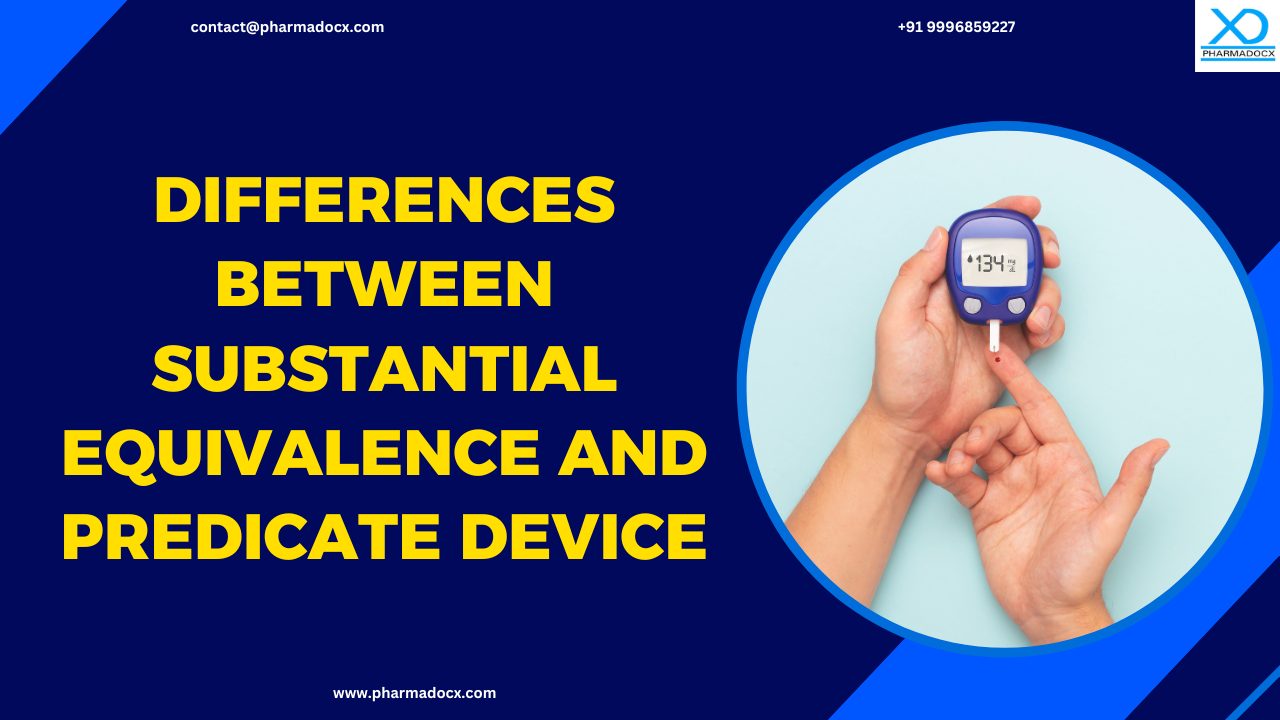
Identifying the correct predicate device is the first critical step in US FDA 510(k) submission. The FDA authorities evaluate whether your device is substantially equivalent to the predicate device you have mentioned in the application. If it is equivalent, then your medical device will be cleared for sale in US. Thus, the predicate device has a vital role in launching a new medical device in the US market. Substantial equivalence and predicate device are two important terms you will come across while preparing the US FDA 510(k) application. In this blog, we have explained what are the terms substantial equivalence and predicate device and what are the differences between them.
What is a predicate device?
To understand the difference between substantial equivalence and predicate device, it is important to first understand what is a predicate device. A “predicate device” is a medical device that is currently being legally marketed in the US. These devices have previously received US FDA 510(k) approval. Furthermore, these predicate devices can be used as a reference point for new medical devices seeking US FDA 510(k) approval. The manufacturer of the new device is required to prove the new device is at least as safe and effective as the predicate device with respect to intended use and technological characteristics. Hence, it is important to correctly identify a predicate device for US FDA 510(k) application. Notably, the predicate device does not need to be identical to the new device. It simply needs to be used to provide evidence regarding the reliability and safety of the new medical device.
Factors to consider when selecting the predicate device
- Intended use of the medical device: The broad intended use of the predicate device should be similar to that of the new device.
- Device technological characteristics: The technological characteristics of the predicate device should be similar to that of the new device in question. For example, the design, materials used, and the method of operation of both the devices should be similar.
- Predicate device should be equipped with latest technology: The predicate device’s technology should not be outdated. The predicate device should be equipped with the latest medical technology.
- Device biocompatibility: The device biocompatibility also needs to be comparable. Furthermore, the biocompatibility assessments of a medical device or its components should not be limited to the raw materials used in the device. The manufacturing process and additional chemicals should also be taken into consideration.
What is substantial equivalence?
Substantial equivalence is a process in the US FDA 510(k) approval. This process involves evaluating and comparing the new device with the predicate device already being sold in the US market. The new medical device can be cleared for the U.S. market, if it is shown to be as safe and effective as a legally marketed predicate device. To establish this, the new device must have the same intended use as the predicate and the same technological characteristics. It should not raise new questions of safety or effectiveness. Notably, if technological characteristics are different, the differences must not raise new questions of safety or effectiveness. Evidence, such as bench testing, performance data, or clinical studies, may be required to support the claim.
This pathway allows most devices to enter the market more quickly and cost-effectively than the more rigorous Premarket Approval process. However, it depends on careful predicate selection and robust justification of equivalence.
Two major steps in substantial equivalence and predicate device
- Step 1: Intended use: Does the new device have the same intended use as the predicate? If yes, move to the next step; if no, SE fails.
- Step 2: Technology and safety: Are the technological characteristics the same, or if different, do they avoid new safety/effectiveness concerns? If yes, SE is established.
How to select the appropriate predicate device for FDA 510(k) submission?
- Identify a predicate device that has an intended use similar to that of the new device in question. For example, if your device is used to measure blood glucose levels, then try choosing a blood glucose measurement device as your predicate.
- Try to select a predicate device that has been approved recently. This is because the medical device sector undergoes rapid technological advancements. A recently approved device will be equipped with the latest technologies. Hence, try to identify a predicate that the FDA has recently approved.
- Choose a predicate device that aligns with the manufacturing process of your device. Additionally, the raw material used for construction and supplementary chemicals used in your device should align with the predicate device.
- Select a predicate device with technical characteristics similar to those of the new device in question. The characteristics, such as design, materials, labelling, and operational methods, should be taken into consideration.
Substantial equivalence and predicate device
The terms substantial equivalence and predicate device are related and not identical.
- Predicate device: This is the legally marketed device in the U.S. that a company chooses as the reference point for its new device. It serves as the benchmark against which the new device is compared.
- Substantial equivalence: This is the FDA’s determination process that the new device is at least as safe and effective as the predicate. To achieve this, the new device must have the same intended use and either the same technological characteristics or differences that do not raise new safety or effectiveness concerns.
5 major differences between substantial equivalence and predicate device
- Definition: Predicate device is a legally marketed device in the U.S. chosen as the reference point. On the other hand, substantial equivalence is the process of the FDA’s regulatory determination that a new device is as safe and effective as the predicate.
- Role in 510(k): Predicate device serves as the benchmark for comparison. Whereas, substantial equivalence represents the outcome of the comparison. It is the conclusion that the new device aligns with the benchmark.
- Focus: Predicate device identifies the existing product’s intended use and technological characteristics. Substantial equivalence evaluates whether the new device matches or appropriately differs without raising new safety/effectiveness concerns.
- Regulatory status: Predicate device is already cleared or approved and legally marketed in the U.S. On the other hand, substantial equivalence is a status granted to the new device by FDA, enabling it to be marketed under the 510(k) pathway.
- Temporal relationship: Predicate device exists before the new device submission and is used as the comparator. Whereas, substantial equivalence is determined after FDA reviews the new device submission, thereby marking the regulatory decision point.
Pharmadocx Consultants: Your trusted US FDA 510(k) submission support
Owing to the importance of the predicate device in the FDA 510(k) submission, it is vital to choose the predicate appropriately. Additionally, it is crucial to correctly establish the substantial equivalence. We have presented the differences between substantial equivalence and predicate device to help you clearly understand the terms. We are a reputed US FDA 510(k) consultant. Our team will help you identify a predicate device for US FDA 510(k) submission. Furthermore, as an US FDA 510(k) consultant, we provide comprehensive FDA 510(k) submission service. In addition to selecting the appropriate predicate device, we will prepare a strong case to prove substantial equivalence with the predicate. Additionally, we will help prepare the necessary supporting documentation. Also, we will respond to FDA queries on your behalf. Drop an email at [email protected] or call/Whatsapp on 9996859227 to hire us as your trusted US FDA 510(k) consultant.