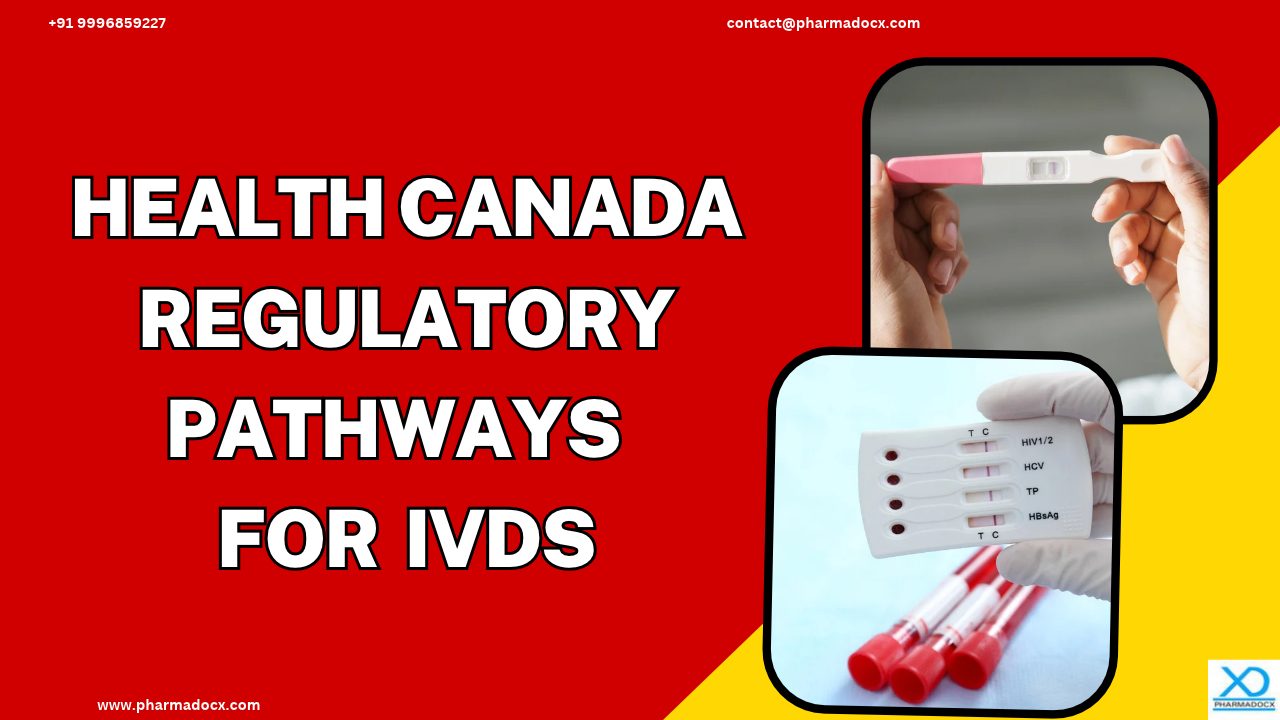

Health Canada regulates in vitro diagnostic devices (IVDs) under the Medical Devices Regulations. It uses a risk-based classification system (Class I–IV) to determine the applicable regulatory pathways. Class II–IV IVDs require a Medical Device Licence (MDL). On the other hand, Class I IVDs do not require an MDL. However, importers and distributors of all classes must hold a Medical Device Establishment Licence (MDEL). Hence, manufacturers must determine the correct class and prepare for the license application accordingly. The Class II–IV IVDs license application must include ISO 13485 quality system certification and device description. Notably, Class III–IV must require clinical performance data. Moreover, special pathways exist for near-patient tests. Additionally, Class IV IVDs (e.g., donor screening for HIV/HBV/HCV) demand the most comprehensive submissions with detailed evidence and risk management. In this blog, we will present in details the Health Canada regulatory pathways for IVDs.
Health Canada IVD classification system
IVDs are classified into four classes (I–IV) based on risk to patients and public health. They have been arranged in increasing order of risk level.
- Class I (lowest risk): Class I IVDs are simple laboratory devices or reagents that pose minimal risk to patients and public health. They are typically used for general laboratory procedures without direct diagnostic or therapeutic impact. Example: General-purpose laboratory reagents, specimen containers.
- Class II (moderate risk): Class II IVDs provide diagnostic information but are not critical for life-threatening conditions. They require a Medical Device Licence (MDL) and ISO 13485 certification but usually do not need extensive clinical data. Example: Pregnancy test kits, blood glucose meters for self-monitoring.
- Class III (high risk): Class III IVDs are used to diagnose or monitor serious diseases where incorrect results could lead to significant harm. These devices require more detailed evidence of safety, effectiveness, and clinical performance. Example: HIV diagnostic kits, hepatitis B surface antigen tests.
- Class IV (highest risk): Class IV IVDs are used for donor screening or detecting transmissible agents in blood, tissues, or organs, where false results could have catastrophic consequences. They demand the most rigorous regulatory scrutiny, including comprehensive clinical data and risk management documentation. Example: Blood donor screening tests for HIV, HBV, HCV.
Health Canada rules for classification
- Rule 1: Donor Screening IVDs that are used to test blood, tissues, or organs for transmissible agents are automatically Class IV, the highest risk. False negatives here could result in infected donations entering the supply chain.
- Rule 2: Disease Status IVDs that are intended to diagnose or determine the status of a disease or infection are generally Class III. However, it they involve life-threatening conditions, they may be designated Class IV. These tests directly influence treatment decisions.
- Rule 3: Immune Status IVDs that are used to determine immune status to transmissible agents are typically Class III. They are critical for vaccination programs and disease management.
- Rule 4: Patient Management IVDs that are used to monitor treatment or guide therapy are usually Class II or III. It depends on the seriousness of the condition. Incorrect results could mislead therapy choices.
- Rule 5: Other Purposes IVDs are used for purposes other than transmissible agents or immune status and are classified based on risk often as Class II. These include routine diagnostic or screening tests.
- Rule 6: Near-patient testing point-of-care or near-patient IVDs are classified with special consideration often as Class II or III. Moreover, it depends on the condition being tested. Their accessibility increases risk if results are inaccurate.
- Rule 7: Combined use devices IVDs are intended for use with other medical devices may inherit higher classification depending on combined risk.
- Rule 8: General laboratory instruments or reagents not intended for specific diagnostic purposes fall under Class I. These pose minimal risk and do not require an MDL.
- Rule 9: Certain borderline or novel IVDs are assessed individually, with classification adjusted based on intended use and risk profile.
Health Canada regulatory pathways for IVDs: Licensing requirements
- Class I IVDs: Asper Health Canada regulatory pathways for IVDs, Class I IVDs do not require a Medical Device Licence (MDL) from Health Canada. However, manufacturers must still comply with general safety and labeling requirements under the Medical Devices Regulations. Notably, importers and distributors of Class I devices must hold a Medical Device Establishment Licence (MDEL) to legally sell or distribute them in Canada.
- Class II IVDs: Class II IVDs require an MDL application, which must include proof of ISO 13485 quality system certification. The submission also requires a device description, intended use, and evidence of conformity to recognized standards. These devices are considered moderate risk. Hence, performance data is generally less extensive compared to higher classes.
- Class III IVDs: Class III IVDs demand a more detailed MDL application, including clinical performance data to demonstrate safety and effectiveness. Manufacturers must provide evidence of risk management and validation studies. These devices are typically used for diagnosing or monitoring serious diseases, where incorrect results could cause significant harm.
- Class IV IVDs: Class IV IVDs require the most comprehensive MDL submission, including extensive clinical evidence, risk management documentation, and detailed performance studies. They are used for donor screening or detecting transmissible agents in blood, tissues, or organs. Owing to their critical role, Health Canada applies the highest level of scrutiny to these applications.
- Medical Device Establishment Licence (MDEL): Regardless of device class, importers and distributors must hold an MDEL to operate legally in Canada. The MDEL ensures compliance with post-market obligations, such as complaint handling, adverse event reporting, and recalls. It must be renewed annually. Moreover, failure to maintain it can result in suspension of distribution rights.
Checklist to comply with Health Canada regulatory pathways for IVDs
We have prepared a detailed checklist to help you comply with Health Canada regulatory pathways for IVDs.
- Determine device classification: Carefully assess the IVD against Health Canada’s risk-based rules (Class I–IV). Notably, misclassification can delay approvals or trigger compliance issues during audits. Document the rationale and examples used to justify the classification.
- Prepare MDL application (Class II–IV): Compile device description, intended use, and ISO 13485 certification evidence. For Class III–IV, include clinical performance data and risk management documentation. Ensure all forms and user fees are submitted correctly to avoid rejection.
- Quality Management System (QMS) compliance: Maintain ISO 13485 certification and align processes with Health Canada’s expectations. Regularly audit internal systems to ensure CAPA, complaint handling, and traceability are robust. Keep certification records updated and accessible for regulatory review.
- Establishment licensing (MDEL): If importing or distributing, apply for and annually renew the MDEL. Ensure procedures for complaint handling, adverse event reporting, and recalls are documented and tested. Non-compliance can result in suspension of distribution rights.
- Labeling and safety requirements: Verify that labeling meets bilingual (English/French) requirements and includes intended use, warnings, and manufacturer details. Ensure instructions for use are clear and validated for end-users. Mislabeling is a common cause of enforcement actions.
- Clinical evidence (Class III–IV): Provide robust clinical performance studies demonstrating sensitivity, specificity, and reproducibility. Align evidence with international standards where possible to streamline multi-region submissions. Maintain raw data and analysis for audit traceability.
- Post-market surveillance: Implement systems for monitoring device performance once marketed. Establish complaint handling, vigilance reporting, and recall procedures. Regularly review adverse event data to identify trends and initiate CAPA.
- Documentation and audit readiness: Maintain a compliance binder with classification rationale, MDL/MDEL licences, QMS certificates, labeling proofs, and clinical data. Update SOPs and supplier audit records to reflect current regulatory expectations. Furthermore, be prepared for Health Canada inspections at short notice.
In this blog, we have detailed the Health Canada regulatory pathways for IVDs. For easily securing MDL/MDEL, drop an email at [email protected] or call/Whatsapp on 9996859227.