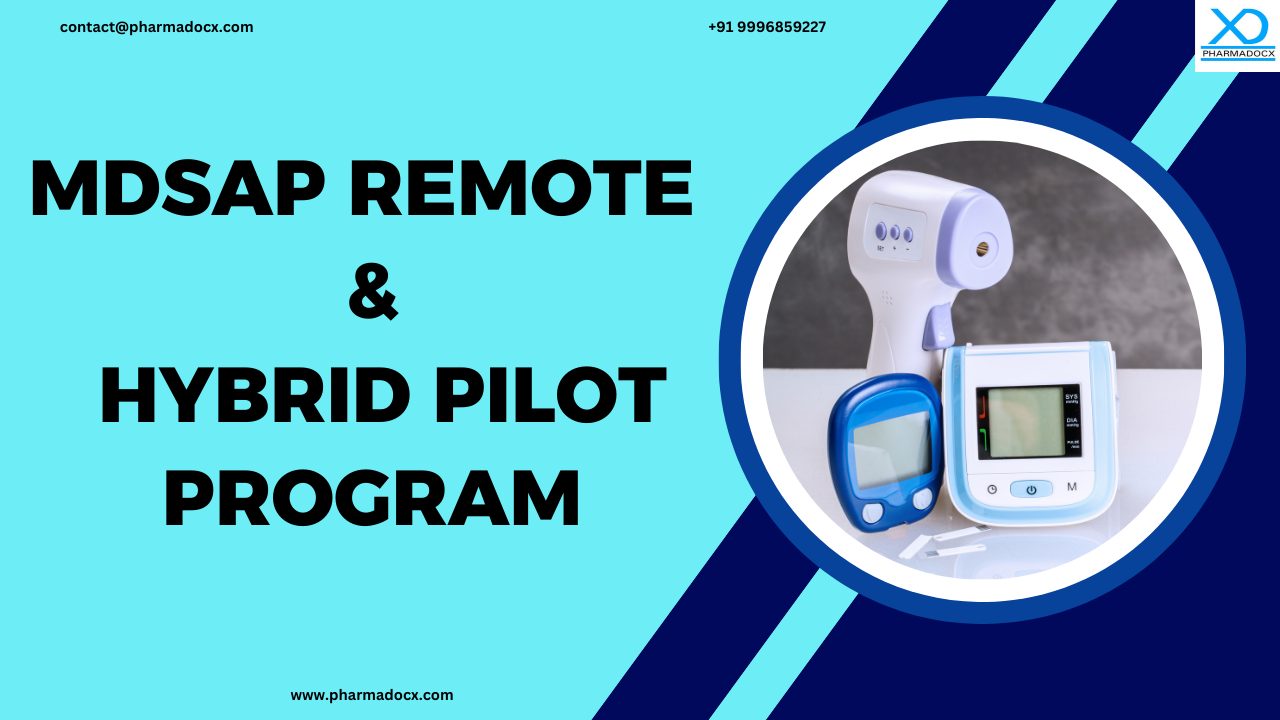
MDSAP remote and hybrid pilot program was launched to modernize medical device audits by introducing digital flexibility while preserving regulatory rigor. It emerged as a response to global challenges while ensuring manufacturers remain compliant across multiple jurisdictions. This program is a voluntary initiative that allows medical device manufacturers to undergo audits partly or entirely through remote means. This initiative blends onsite and remote auditing to modernize regulatory oversight. It balances efficiency, flexibility, and compliance integrity. This program offers manufacturers a way to navigate audits in a digital-first environment while regulators test the feasibility of broader adoption.
What is MDSAP remote and hybrid pilot program?
MDSAP remote and hybrid pilot program aims to modernize Medical Device Single Audit Program (MDSAP) by balancing efficiency, patient safety, and regulatory integrity. It is a voluntary initiative that allows medical device manufacturers to undergo Stage 2 and surveillance audits partly or entirely through remote means, while Stage 1 audits remain onsite. It was introduced to enhance efficiency, resilience, and flexibility in regulatory oversight, particularly in response to challenges, such as pandemic travel restrictions and the growing need for digital-first quality systems. Under the program, auditing organizations and manufacturers agree on which tasks, such as document reviews and interviews, can be conducted remotely. However, high‑risk processes, such as sterilization, cleanroom operations, and equipment validation, still require onsite evaluation. The pilot emphasizes a risk-based approach, ensuring that remote methods provide sufficient objective evidence without compromising compliance across participating regulators (FDA, Health Canada, TGA, ANVISA, PMDA).
Purpose and objectives
- Streamline audits: Enable remote and hybrid models to reduce logistical burdens while maintaining audit integrity.
- Enhance efficiency: Improve the flow of information between auditors and manufacturers when not physically co-located.
- Maintain compliance: Ensure that regulatory requirements across participating jurisdictions (FDA, Health Canada, TGA, ANVISA, PMDA) are still fully met.
- Adapt to modern realities: Respond to challenges, such as global travel restrictions, digital transformation, and the need for more agile oversight.
- Participating regulators: FDA (USA), Health Canada, TGA (Australia), ANVISA (Brazil), and PMDA (Japan) all recognize MDSAP audits. Hence, the MDSAP remote and hybrid pilot program had to align with their expectations.
Why was MDSAP remote and hybrid pilot introduced?
- COVID-19 disruptions: Traditional onsite audits became difficult or impossible during the pandemic, highlighting the need for remote alternatives.
- Globalization of medical device markets: Manufacturers often operate across multiple regions, making travel-heavy audits costly and inefficient.
- Digital transformation: Regulators recognized that secure digital tools could support document reviews, interviews, and evidence collection without compromising audit integrity.
- Regulatory resilience: The pilot program was designed to test whether hybrid and remote audits could maintain the same level of oversight as onsite audits, even in disruptive circumstances
Scope and structure of the pilot program
- Voluntary pilot: Manufacturers can opt in for this program. It is not mandatory.
- Audit stages: Stage 1 audits are excluded from the program. The program applies to Stage 2 and surveillance audits.
- Hybrid model: The program combines onsite and remote elements. For example, document reviews may be remote, while facility inspections remain onsite.
- Remote model: Entirely digital, using secure platforms for interviews, document exchange, and evidence review.
How does the pilot fit into MDSAP?
- MDSAP’s mission: To allow a single audit to satisfy multiple regulators’ requirements.
- Pilot’s role: To test whether remote/hybrid methods can uphold this mission without weakening compliance.
- Risk-based approach: The program emphasizes that remote elements should be chosen based on product risk, compliance history, and audit objectives.
- Audit integrity: Even when remote, auditors must gather sufficient objective evidence to support certification decisions.
Strategic importance
- Efficiency gains: Reduces travel costs and scheduling conflicts.
- Regulatory innovation: Positions MDSAP as a leader in adopting modern oversight practices.
- Industry confidence: Demonstrates regulators’ willingness to adapt without lowering standards.
- Future-proofing: Builds resilience against future disruptions, whether pandemics, geopolitical issues, or supply chain crises
Eligibility criteria for the MDSAP remote and hybrid pilot program
Eligibility for the MDSAP remote and hybrid pilot program is limited to medical device manufacturers already participating in MDSAP audits.
- Core eligibility criteria: Only manufacturers who opt in are eligible. The program is not mandatory. Stage 1 audits are excluded (these must remain onsite).Stage 2 and surveillance audits can be conducted remotely or in hybrid form. The manufacturer must already be within the scope of MDSAP certification (covering jurisdictions like FDA, Health Canada, TGA, ANVISA, PMDA).Eligibility depends on a risk assessment of the manufacturer’s products, compliance history, and audit objectives. Notably, high-risk or complex facilities may be deemed unsuitable for remote-only audits. Moreover, manufacturers must have secure IT systems capable of supporting remote document exchange, video conferencing, and digital evidence review. Both the auditing organization and the manufacturer must agree on which tasks can be performed remotely versus onsite.
- Additional considerations: Remote/hybrid audits are particularly encouraged for manufacturers in regions where travel is difficult or costly. Notably, even in remote settings, manufacturers must provide sufficient objective evidence to support certification decisions. Furthermore, as this is a pilot program, eligibility may evolve as regulators assess outcomes and refine procedures.
Key procedures
- Pre-audit planning: Auditors and manufacturers are required to agree on which tasks can be performed remotely versus onsite.
- Technology use: Secure video conferencing, electronic document portals, and digital evidence-sharing are central.
- Risk-based approach: Decisions on remote vs. onsite tasks are guided by risk assessments, product complexity, and compliance history.
- Audit evidence: Remote audits must still provide sufficient objective evidence to support certification decisions.
Limitations of the program
MDSAP remote and hybrid pilot program is not universally applicable. Regulators have placed clear boundaries when it comes to what falls under the purview of this program.
- Mandatory onsite components: For Class III or equivalent high-risk devices (e.g., implantables, life-supporting, or life-sustaining products), auditors must perform critical facility inspections onsite. Remote-only audits are generally not permitted for these products, since physical verification of manufacturing controls, cleanroom practices, and sterility assurance is essential.
- Complex manufacturing processes: Facilities producing devices with aseptic processing, sterilization, or biologic components require onsite observation. Remote review of documents alone cannot provide sufficient objective evidence of compliance.
- Compliance history concerns: Manufacturers with prior regulatory findings, CAPAs, or enforcement actions are less likely to qualify for remote audits. Regulators expect onsite presence to verify corrective actions and ensure sustained compliance.
- Critical supplier oversight: If a manufacturer relies on high-risk suppliers (e.g., raw materials for implants, critical components for diagnostic accuracy), auditors may insist on onsite verification of supplier controls.
- Technology limitations: Even if a manufacturer is technically ready for remote audits, regulators may restrict remote elements if digital evidence cannot adequately demonstrate product safety and quality.
Strategic planning for hybrid and remote audits
- Pre-audit preparation: Identify product categories, facility processes, and compliance history to determine which audit elements can be remote vs. onsite. Clarify audit objectives, regulatory jurisdictions, and which standards (ISO 13485, MDR, FDA QSR, etc.) are in play. Ensure secure platforms for video conferencing, document exchange, and evidence sharing. Agree with the auditing organization on the hybrid plan, including timelines and division of tasks.
- Audit segmentation: Segregate remote-suitable tasks and onsite-mandatory tasks. Remote-suitable tasks will include document reviews (QMS procedures, CAPA records, risk management files), interviews with staff and management, and review of electronic logs and traceability systems. Onsite-mandatory tasks will include facility walkthroughs (cleanrooms, sterilization areas, environmental controls), observation of operator practices, and verification of equipment calibration and maintenance.
- Execution strategy: Sequence remote reviews first, followed by onsite verification of high-risk processes. Use secure portals for uploading records, with clear version control. Establish daily check-ins, escalation paths, and contingency plans for technical failures. Ensure remote evidence is logged, timestamped, and traceable to maintain credibility.
- Risk mitigation: If remote evidence is insufficient, auditors must be able to pivot to onsite verification. Protect sensitive regulatory and product data during remote exchanges. For critical suppliers, plan onsite visits or hybrid verification depending on risk profile.
- Post-audit actions: Continuous improvement is required to capture lessons learned to refine hybrid models for future audits. Document how hybrid/remote methods met MDSAP requirements for transparency.
Thus, MDSAP remote and hybrid pilot program aims to modernize medical device audits. However, understanding the eligibility and following the pilot program can be a tricky task. Fret not! Our team of experts will be more than happy to guide you through every step. Email at [email protected] or call/Whatsapp on 9996859227 to easily secure the MDSAP certification.