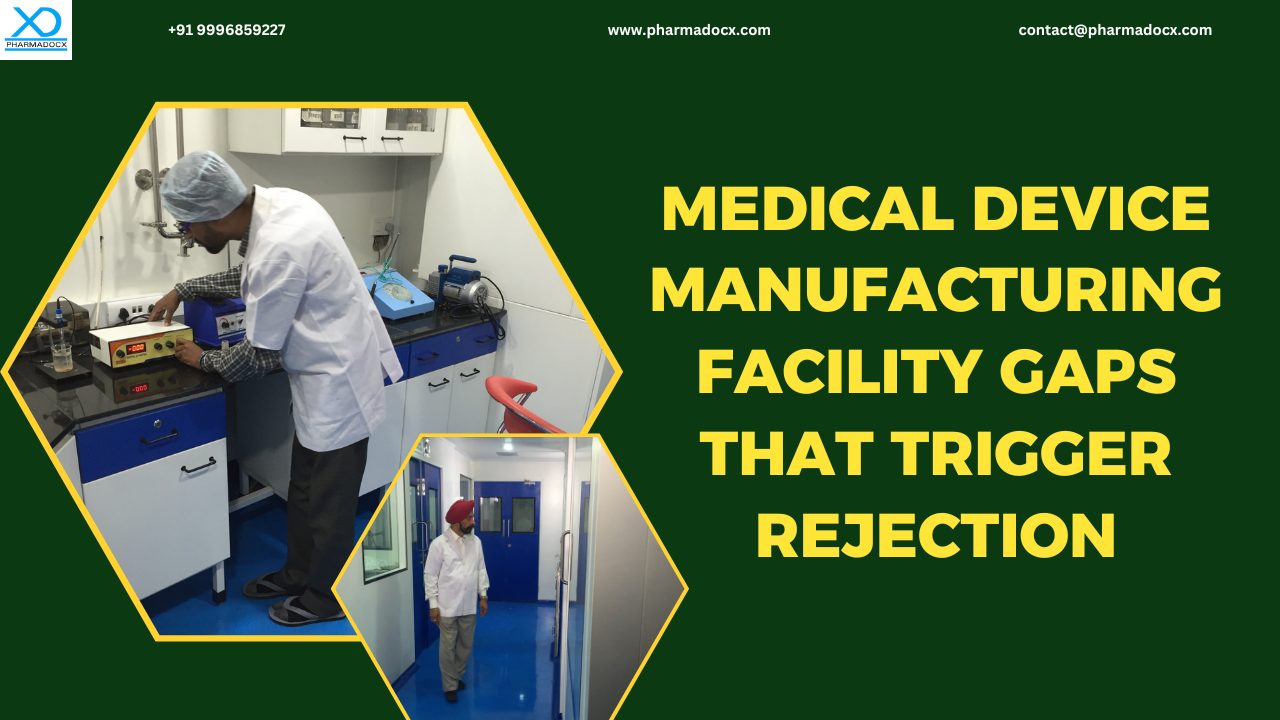

In this blog, we have discussed medical device manufacturing facility gaps that trigger regulatory rejection. Additionally, we have provided tips on how to fix the facility gaps before they trigger rejection.
10 medical device manufacturing facility gaps that trigger regulatory rejection
- Inadequate quality management system (QMS): A weak or poorly implemented QMS is one of the most common reasons regulators reject a medical device manufacturing facility. Without ISO 13485 alignment, processes lack consistency and traceability. Auditors quickly flag missing SOPs, uncontrolled documents, or ineffective CAPA systems. Regulators view this as systemic risk, which undermines product safety and compliance.
- Poor environmental controls: Manufacturing areas must maintain strict temperature, humidity, and particulate controls. Failure to validate HVAC systems or maintain cleanroom classifications leads to contamination risks. Regulators expect documented monitoring and corrective actions for deviations. Gaps here suggest uncontrolled environments that compromise sterility and product integrity.
- Incomplete equipment qualification: Unqualified or poorly calibrated equipment undermines process reliability. IQ/OQ/PQ protocols must be executed and documented for all critical machines. Regulators reject a medical device manufacturing facility where calibration logs are missing or outdated. This signals that product specifications cannot be consistently met.
- Weak supplier management: Unvetted or poorly monitored suppliers introduce uncontrolled risks. Regulators expect supplier qualification, audits, and ongoing performance reviews. Missing supplier details or lack of traceability in raw materials is a red flag. This gap suggests systemic vulnerability in the supply chain.
- Deficient validation of manufacturing processes: Processes must be validated to demonstrate reproducibility and compliance. Regulators reject facilities where validation reports are incomplete or lack statistical rigor. Absence of worst-case scenario testing is particularly damaging. This signals that products may not meet specifications under real-world conditions.
- Inadequate training and competency records: Personnel must be trained and competent for their roles. Regulators often find missing training records, outdated curricula, or lack of role-specific assessments. This gap suggests that staff may not understand regulatory requirements or technical procedures. It undermines confidence in the facility’s ability to maintain compliance.
- Poor documentation practices: Incomplete, inconsistent, or uncontrolled documentation is a major rejection trigger. Regulators expect clear batch records, traceable signatures, and version-controlled SOPs. Facilities with handwritten corrections, missing approvals, or undocumented deviations raise alarms. Documentation gaps imply systemic non-compliance and lack of audit readiness.
- Ineffective CAPA system: Corrective and Preventive Actions must be robust and timely. Regulators reject facilities where CAPAs are closed without root cause analysis or effectiveness checks. A backlog of unresolved CAPAs signals poor compliance culture. This medical device manufacturing facility gap demonstrates inability to learn from failures and prevent recurrence.
- Insufficient sterility assurance: For sterile devices, regulators demand validated aseptic processes and sterility testing. Gaps in cleanroom protocols or sterilization cycle validation are serious findings. Inadequate environmental monitoring programs trigger rejection. These failures directly compromise patient safety.
- Lack of risk management integration: ISO 14971 requires risk management throughout the product lifecycle. Regulators reject facilities where risk files are incomplete, outdated, or disconnected from design and production. Absence of risk-based thinking in change control or supplier qualification is a major gap. This signals that hazards are not systematically identified or mitigated.
Why do companies discover facility gaps too late?
Companies often discover facility gaps too late because systemic weaknesses remain hidden until regulators or auditors expose them. We have presented some of the main reasons.
- Reactive instead of proactive auditing: Many organizations rely on external inspections rather than conducting rigorous internal audits. This reactive approach means issues surface only when regulators arrive. Internal teams may overlook gaps due to familiarity bias or lack of independence.
- Weak change control: Operational changes, such as new equipment, processes, or suppliers, are sometimes implemented without full risk assessment. Documentation and validation are not per real-world operations. Regulators quickly detect these gaps during inspections. Companies realize too late that their change control system failed to capture risks.
- Insufficient training follow-through: Training programs may exist on paper but lack depth or regular refreshers. Staff may not fully understand compliance requirements or SOPs. Regulators uncover inconsistencies in execution, revealing that training was ineffective. Companies discover the gap only when deviations accumulate.
- Poor data integrity oversight: Electronic records and batch documentation often suffer from incomplete entries or uncontrolled edits. Internal reviews may not catch these subtle lapses. However, regulators scrutinize data integrity with precision. Companies then realize their systems were not audit-ready.
- Neglecting supplier audits: Suppliers are often trusted without ongoing monitoring. Companies assume initial qualification is sufficient. Regulators demand continuous oversight and traceability of raw materials. Problems surface only when supplier failures cascade into compliance findings.
- Delayed CAPA effectiveness checks: CAPAs may be logged but not verified for effectiveness. Companies close them prematurely to appear compliant. Regulators test whether issues were truly resolved and often find recurrence. This exposes systemic weaknesses too late for proactive correction.
- Underestimating environmental monitoring: Facilities sometimes treat cleanroom monitoring as routine rather than critical. Deviations are ignored or rationalized without corrective action. Regulators interpret this as lack of sterility assurance. Companies discover the severity only when rejection occurs.
How to fix medical device manufacturing facility gaps before they trigger rejection?
To fix medical device manufacturing facility gaps before they escalate into regulatory rejection, companies need a structured proactive framework.
- Strengthen the quality management system (QMS): Conduct a gap analysis against ISO 13485 requirements. Rewrite SOPs for clarity, consistency, and audit readiness. Implement electronic document control with version tracking. Schedule quarterly internal audits to ensure continuous compliance.
- Tighten environmental controls: Validate HVAC and cleanroom systems for the medical device manufacturing facility with documented protocols. Establish continuous monitoring for temperature, humidity, and particulates. Train staff on aseptic practices with periodic refreshers. Investigate and document every deviation with CAPA follow-through.
- Ensure equipment qualification: Complete IQ/OQ/PQ for all critical equipment before use. Maintain calibration logs with automated reminders for due dates. Link equipment qualification records to batch documentation. Audit equipment performance annually to detect drift early.
- Improve supplier governance: Develop supplier qualification criteria and audit schedules. Keep track of supplier performance and compliance. Escalate poor supplier performance into CAPA and risk management.
- Validate manufacturing processes: Perform statistical validation with worst-case scenarios included. Document reproducibility with clear acceptance criteria. Revalidate processes after any change in equipment, materials, or methods. Integrate validation reports into the QMS for easy auditor access.
- Enhance training programs: Create role-specific training modules with competency assessments. Maintain electronic training records. Refresh training annually or after regulatory updates. Audit training effectiveness through observed practices on the floor.
- Fix documentation practices: Implement electronic batch records with audit trails. Enforce controlled templates for SOPs and work instructions. Train staff on proper documentation etiquette (no backdating, no white-outs).Review documentation weekly to catch errors before audits.
- Strengthen CAPA effectiveness: Mandate root cause analysis before closing CAPAs. Verify effectiveness through follow-up audits or monitoring. Track CAPA timelines with escalation triggers for delays. Report CAPA metrics to management for accountability.
- Improve sterility assurance: Validate sterilization cycles with biological indicators. Audit gowning procedures and environmental monitoring logs. Document sterility assurance in risk management files.
- Integrate risk management: Update ISO 14971 risk files regularly with new data. Link risk assessments to design, supplier, and process controls. Use risk-based thinking in change control and CAPA prioritization. Train teams to apply risk management in daily decision-making.
The key to avoiding medical device manufacturing facility gaps is continuous vigilance.
How can Pharmadocx Consultants help you avoid facility gaps that trigger regulatory rejection?
We provide tailored services for your facility to help you avoid regulatory rejection. Our service covers:
- Medical device manufacturing facility plant layout service
- Compliance gap assessment
- QMS implementation
- Equipment and process validation
- Clean room setup
- Mock audits to find regulatory lapses
- Staff training sessions
To have your medical device manufacturing facility established and run per regulatory guidelines, email at [email protected] or call/Whatsapp on 9996859227.