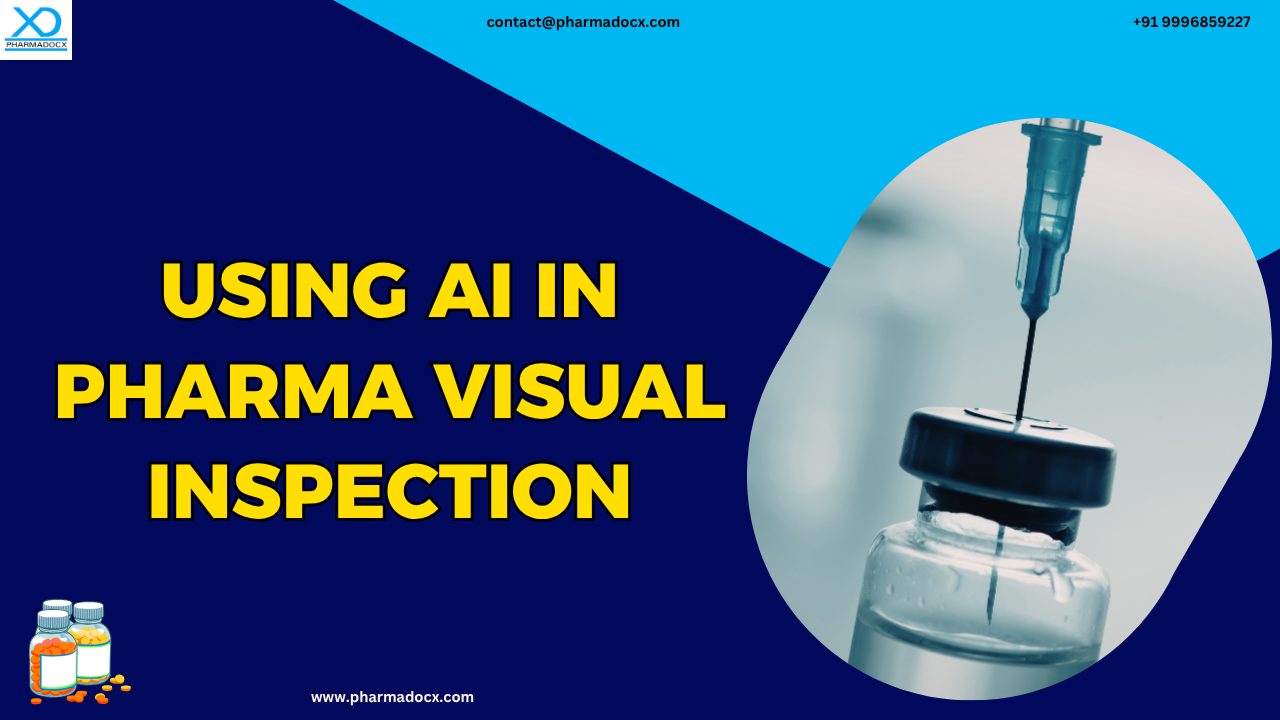
Visual inspection in the pharmaceutical industry is a critical quality control step. Pharma visual inspection is a systematic examination of pharmaceutical products (often 100% of units) to identify visible defects before release. It is primarily applied to sterile injectable drugs but also relevant for tablets, capsules, and packaging. The aim is to prevent defective or unsafe products from reaching patients. Furthermore, using AI in pharmaceutical visual inspection is transforming quality control. Machine learning and computer vision can be used to detect defects more accurately, reduce human error, and improve regulatory compliance. It enables faster, more consistent inspection of sterile injectables and packaging compared to manual methods. In this blog, we will focus on using AI in pharma visual inspection.
What is pharma visual inspection?
Pharma visual inspection is a mandatory quality control process where drug products, especially sterile injectables, are examined to detect visible defects, such as particles, cracks, leaks, discoloration, or labeling errors. It is typically performed either manually by trained operators or through automated camera-based systems. The goal is to ensure patient safety, product integrity, and compliance with global regulatory standards. By identifying and removing defective units before release, visual inspection acts as a critical safeguard against contamination and quality failures in pharmaceutical manufacturing.
Thus, visual inspection is a non-negotiable safeguard in pharma manufacturing, especially for sterile injectables. It blends human expertise with technology to ensure that every vial, ampoule, or syringe reaching patients is safe, compliant, and defect-free.
Key elements of visual inspection
- Defects detected:
- Particulate matter (extrinsic, intrinsic, or inherent particles).
- Container integrity issues (cracks, leaks, improper seals).
- Labeling errors (wrong dose, incorrect potency).
- Appearance changes (discoloration, precipitation, turbidity).
- Inspection methods:
- 100% manual inspection by trained operators.
- Automated inspection systems using cameras, sensors, and AI.
- Acceptable quality level (AQL) sampling for statistical assurance.
Advantages of visual inspection in pharmaceutical industry
- Protects patient safety by removing defective units.
- Ensures regulatory compliance and audit readiness.
- Supports continuous improvement in manufacturing processes.
Using AI for visual inspection in the pharmaceutical industry
AI-driven pharma visual inspection uses machine learning and computer vision to automatically detect defects, such as particles, cracks, leaks, or labeling errors in drug products, especially sterile injectables. Unlike manual inspection, which is prone to fatigue and subjectivity, AI systems deliver faster, more consistent, and highly accurate results across large production batches. They also generate valuable data insights, helping manufacturers identify defect trends, improve processes, and strengthen regulatory compliance. By combining speed, precision, and traceability, AI-powered inspection is emerging as a key tool for enhancing patient safety and operational efficiency in pharma manufacturing.
How does AI enhance pharma visual inspection?
AI enhances pharma visual inspection by combining computer vision with machine learning to deliver faster, more precise, and consistent defect detection compared to human operators. It eliminates subjectivity and fatigue, ensuring uniform inspection across large batches of sterile injectables, tablets, and packaging. Beyond defect identification, AI systems generate real-time data insights, allowing manufacturers to spot trends, trace root causes, and optimize processes. This not only strengthens patient safety and product integrity but also supports regulatory compliance by providing validated, traceable inspection records. Hence, AI transforms visual inspection from a manual safeguard into a smart, scalable, and predictive quality control system.
- Accuracy and precision: AI systems detect particles, cracks, leaks, and labeling errors with higher reliability than human inspectors.
- Consistency: Unlike manual inspection, AI does not suffer from fatigue or subjectivity, ensuring uniform results across batches.
- Speed and scalability: AI-powered inspection can process thousands of units per hour, making it ideal for large-scale production.
- Data insights: AI generates defect trend reports, root cause analysis, and predictive insights for continuous process improvement.
- Regulatory compliance: Validated AI systems provide traceable records that strengthen audit readiness and meet regulatory requirements.
- Reduced human error: Minimizes human errors during pharma visual inspection.
- Cost efficiency: Though requiring higher upfront investment, AI reduces long-term labor costs and inspection cycle times.
- Integration with automation: AI seamlessly fits into automated production lines, enhancing overall operational efficiency.
Thus, AI transforms visual inspection from a manual safeguard into a smart, scalable, and predictive quality control system that boosts patient safety and manufacturing efficiency.
Applications in pharma
- Sterile injectables: Detecting particulate matter, turbidity, or container integrity issues in vials, ampoules, and syringes.
- Packaging: Ensuring correct labeling, seal integrity, and tamper-proof features.
- Tablets and capsules: Identifying broken, chipped, or discolored units.
- Regulatory compliance: AI systems can be validated to meet FDA and EU MDR requirements, thereby supporting audit readiness.
Challenges in using AI for pharma visual inspection
- Validation complexity: Regulatory agencies (FDA, EMA, etc.) require rigorous validation of AI systems to prove accuracy, reproducibility, and reliability.
- False positives/negatives: AI models may misclassify defects if not trained on diverse, high-quality datasets.
- Data quality and availability: Building robust AI for pharma visual inspection requires large volumes of defect images, which can be difficult to collect in pharma due to low defect occurrence.
- Integration costs: High upfront investment in hardware, software, and training can be a barrier.
- Regulatory acceptance: While regulators are open to AI, companies must demonstrate transparency, audit trails, and explainability of AI decisions.
- Change management: Shifting from manual inspection to AI requires retraining staff and adapting SOPs.
- System limitations: AI may struggle with rare, complex, or borderline defects that humans can better interpret.
- Cybersecurity risks: As AI systems are digital, they introduce risks of data breaches or system manipulation.
Benefits of AI-driven visual inspection for pharma company
- Enhanced patient safety: More accurate detection of defects reduces the risk of contaminated or unsafe products reaching patients.
- Regulatory confidence: Validated AI systems provide traceable, auditable records that strengthen compliance with regulatory standards.
- Operational efficiency: Faster inspection cycles allow companies to process large batches quickly, reducing bottlenecks in production.
- Cost savings: Though requiring higher upfront investment, AI lowers long-term labor costs and minimizes waste from false rejects.
- Consistency and reliability: AI eliminates human fatigue and subjectivity, ensuring uniform inspection results across all units.
- Data-driven improvement: Continuous monitoring and analytics help identify defect trends, root causes, and process optimization opportunities.
- Scalability: AI systems can easily adapt to high-volume production environments without compromising accuracy.
- Competitive advantage: Demonstrating advanced quality control builds trust with regulators, healthcare providers, and patients, strengthening market reputation.
Future of using AI in pharma visual inspection
The future of AI in pharmaceutical visual inspection is moving towards smarter, fully integrated systems that combine speed, precision, and predictive analytics. AI is set to transform visual inspection from a reactive safeguard into a proactive, intelligent quality assurance system. It will be reshaping how pharma companies manage risk and compliance.
- Advanced computer vision: AI models will evolve to detect even subtle or rare defects that traditional systems miss.
- Predictive quality control: Instead of just rejecting defective units, AI will forecast defect trends and help prevent issues upstream in manufacturing.
- Regulatory harmonization: Global agencies (FDA, EU MDR, CDSCO) are increasingly open to AI, and future guidelines will formalize validation frameworks for AI-based inspection.
- Hybrid systems: AI will complement human oversight, with inspectors focusing on complex cases while AI handles routine, high-volume checks.
- Continuous learning: AI systems will adapt in real time, improving accuracy as they process more defect data across different product types.
- Integration with digital QMS: Inspection data will feed directly into quality management systems, enabling automated CAPA.
- Cost and efficiency gains: As adoption scales, AI inspection will reduce costs, speed up release cycles, and improve overall operational resilience.
Therefore, we have discussed how AI will enhance pharma visual inspection and what the future holds. For any pharma regulatory consultation or support, email at [email protected] or call/Whatsapp on 9996859227.