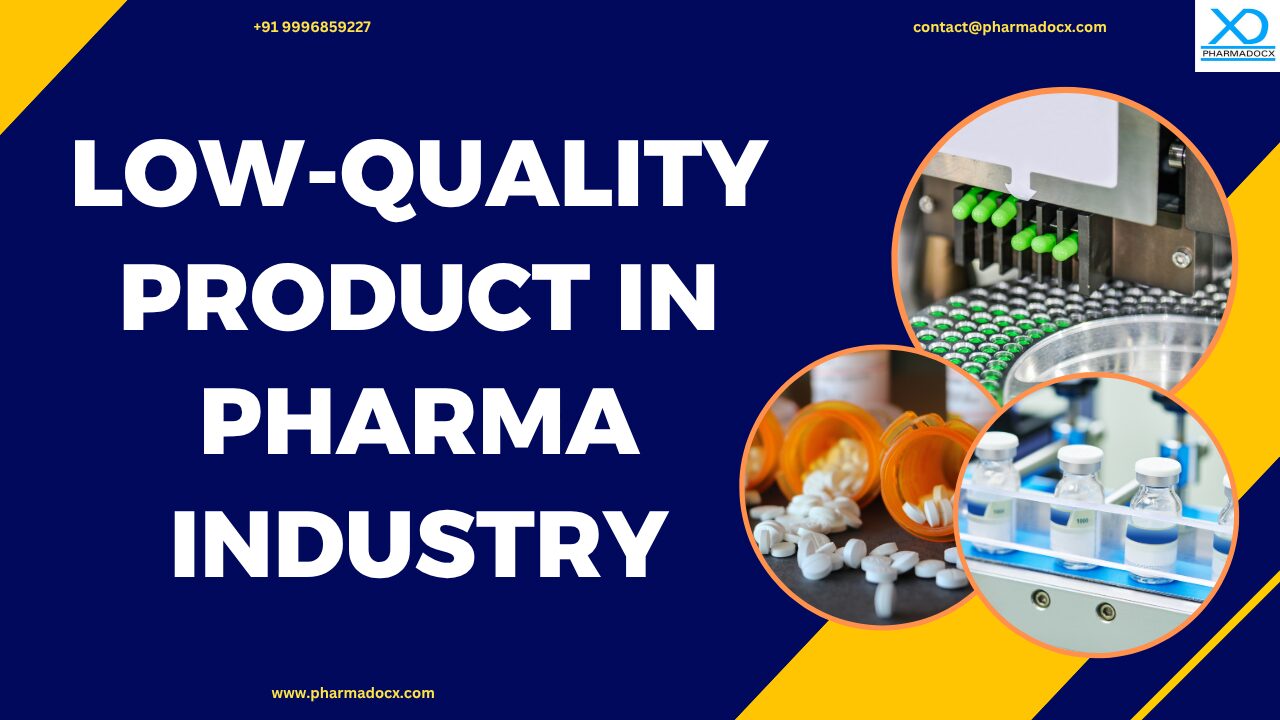
In this blog, we will discuss the common causes of low-quality product in pharma industry. Additionally, we will present the consequences of low-quality products and how companies prevent them.
What is considered a low-quality product in pharma industry?
In the pharmaceutical industry, a “low-quality product” refers to any drug or medical product that fails to meet required standards of safety, efficacy, purity, or compliance with Good Manufacturing Practices (GMP). Low-quality product in pharma industry can cause patient harm, trigger regulatory recalls, and damage the company’s reputation.
- Non-compliance with GMP/GLP standards: Poor manufacturing practices, inadequate documentation, or lack of validated processes.
- Substandard raw materials: Use of impure or incorrectly sourced active pharmaceutical ingredients (APIs).
- Incorrect formulation: Wrong dosage strength, poor bioavailability, or unstable chemical composition.
- Contamination: Microbial, particulate, or chemical contamination during production or packaging.
- Packaging and labeling errors: Mislabeling, incorrect expiry dates, or poor packaging that compromises stability.
- Failure in stability testing: Products that degrade faster than expected, losing potency before expiry.
- Regulatory non-compliance: Lack of adherence to FDA, CDSCO, EMA, or WHO guidelines.
10 common causes of low-quality product in pharma industry
Most causes of low-quality products stem from systemic weaknesses in governance, validation, and training rather than isolated incidents. A robust Quality Management System (QMS) with risk-based monitoring, supplier audits, and continuous training is necessary to mitigate these causes. We have listed the common causes of low-quality product in pharma industry.
1. Poor manufacturing practices
Pharmaceutical production requires strict adherence to Good Manufacturing Practices (GMP). When facilities fail to maintain cleanrooms, validated equipment, or proper documentation, product quality suffers. Cross-contamination between batches can occur if hygiene protocols are ignored. Inadequate training of staff further increases the risk of errors. Weak manufacturing discipline leads to production of low-quality product in pharma industry.
2. Substandard raw materials
Active Pharmaceutical Ingredients (APIs) and excipients must meet pharmacopeial standards. Using low-grade or adulterated raw materials compromises drug potency and safety. Suppliers who are not audited or qualified often introduce hidden risks. Impurities in APIs can trigger adverse reactions in patients. Poor supplier governance is a major root cause of substandard products.
3. Inadequate process validation
Every critical step in drug manufacturing must be validated to ensure consistency. Skipping validation of sterilization cycles, mixing times, or filling processes leads to variability. This variability can cause some batches to be effective while others fail. Regulators demand evidence of reproducibility, and lack of it results in non-compliance. Without validation, companies cannot guarantee product quality across production runs.
4. Contamination
Drugs can be contaminated by microbes, particulates, or chemicals during production. Poor facility design or inadequate environmental monitoring increases the risk of manufacturing low-quality product in pharma industry. Contaminated products can cause infections or toxic reactions in patients. Even minor contamination can trigger large-scale recalls. Preventing contamination requires strict aseptic techniques and continuous monitoring.
5. Human error
Operators play a critical role in pharmaceutical manufacturing. Errors such as mislabeling, incorrect batch records, or improper handling can compromise product quality. Fatigue, lack of training, or negligence often contribute to mistakes. Unlike automated systems, human actions are harder to standardize. Regulatory agencies view human error as preventable with proper training and oversight.
6. Weak supplier governance
Pharma companies often rely on global supply chains for APIs and excipients. Without rigorous supplier audits, substandard or counterfeit materials may enter production. Weak governance leads to variability in raw material quality. This directly impacts drug stability and efficacy. Strong supplier qualification programs are essential to prevent low-quality inputs.
7. Cost-cutting measures
Companies sometimes reduce costs by sourcing cheaper materials or skipping quality checks. While this may save money short-term, it increases long-term risks. Low-cost excipients may not have the same stability profile as approved ones. Skipping analytical testing can allow defective batches to reach the market. Cost-cutting undermines patient safety and regulatory compliance.
8. Inadequate stability testing
Drugs must remain effective until their expiry date. Poor stability testing fails to detect degradation over time. This leads to products losing potency or forming harmful by-products. Patients may unknowingly consume ineffective or unsafe medicines. Proper accelerated and real-time stability studies are critical to ensure shelf-life integrity.
9. Regulatory non-compliance
Ignoring FDA, EMA, CDSCO, or WHO guidelines results in production of low-quality product in pharma industry. Non-compliance may include incomplete dossiers, missing SOPs, or lack of audit readiness. Regulators enforce strict penalties, including recalls and bans. Companies that cut corners risk losing licenses and market access. Compliance is not optional. It is the foundation of pharmaceutical credibility.
10. Inadequate training and competence
Pharma staff must be trained in GMP, documentation, and risk-based thinking. Without proper training, employees may mishandle equipment or overlook critical steps. Competence gaps lead to repeated errors and poor quality assurance. Training programs should be continuous and not one-time events. Building team competence is essential for sustainable quality culture.
Consequences of low-quality product in pharma industry
- Patient safety risks: Low-quality drugs can be ineffective or harmful, leading to treatment failure or adverse reactions. Patients may suffer worsening of their condition or develop new health complications. Thus, compromised patient safety is the most severe consequence of low-quality product in pharma industry.
- Regulatory action: Authorities such as the FDA, EMA, or CDSCO impose strict penalties for non-compliance. Companies producing low-quality products face recalls, import bans, or license suspensions.
- Financial losses: Recalls, litigation, and halted production result in massive financial setbacks. Companies lose revenue from withdrawn products and face compensation claims.
- Reputational damage: A single incident of poor-quality drugs can tarnish a company’s image for years. Healthcare providers may hesitate to prescribe products from the affected brand. Patients lose confidence, impacting long-term sales.
- Market disruption: Low-quality products destabilize supply chains and healthcare delivery. Hospitals and pharmacies must scramble to replace recalled drugs. Shortages of essential medicines can occur, affecting patient care.
- Legal liability: Companies producing substandard drugs face lawsuits from patients, healthcare providers, and governments.
- Loss of market access: Countries may ban imports from manufacturers with poor quality records. Export licenses can be revoked, cutting off global revenue streams. International buyers demand proof of compliance before procurement. Losing access to regulated markets like the US or EU severely limits growth.
- Operational disruption: Investigations and recalls disrupt normal production schedules. Companies must divert resources to corrective actions and audits. Supply chain relationships weaken due to uncertainty. Operational disruption slows innovation and delays new product launches.
- Increased monitoring and costs: Once flagged, companies face heightened regulatory inspections. This increases compliance costs and slows approvals. Additional testing, documentation, and audits become mandatory. Firms must invest heavily in corrective and preventive actions (CAPA).
- Public health impact: Substandard medicines undermine entire healthcare systems. Patients lose faith in prescribed treatments, leading to non-adherence.
How do companies prevent low-quality product in pharma industry?
To prevent low-quality products, pharmaceutical companies build layered safeguards across manufacturing, quality assurance, and regulatory compliance.
- Robust quality assurance (QA) systems: Companies implement ISO 13485 and CAPA frameworks.
- Supplier audits and qualification: Companies ensure raw materials meet pharmacopeial standards to prevent low-quality product in pharma industry.
- Risk-based monitoring: Companies use statistical process control and digital QMS dashboards.
- Training and competence building: Companies impart regular GMP training for staff.
- Regulatory compliance checks: Companies conduct mock audits, SOP reviews, and dossier harmonization.
Therefore, low-quality product in pharma industry represents profound risk to patient safety, public health, and organizational credibility. They arise from systemic weaknesses, such as poor manufacturing practices, inadequate supplier governance, and insufficient training. Furthermore, their consequences ripple across regulatory, financial, and reputational domains. Preventing such failures requires a disciplined commitment to robust Quality Management Systems, validated processes, and continuous vigilance in compliance and risk management. Companies that invest in strong governance, digital modernization, and a culture of quality not only safeguard patients but also secure long-term market trust and resilience. For all your pharma industry regulatory queries, email at [email protected] or call/Whatsapp on 9996859227.