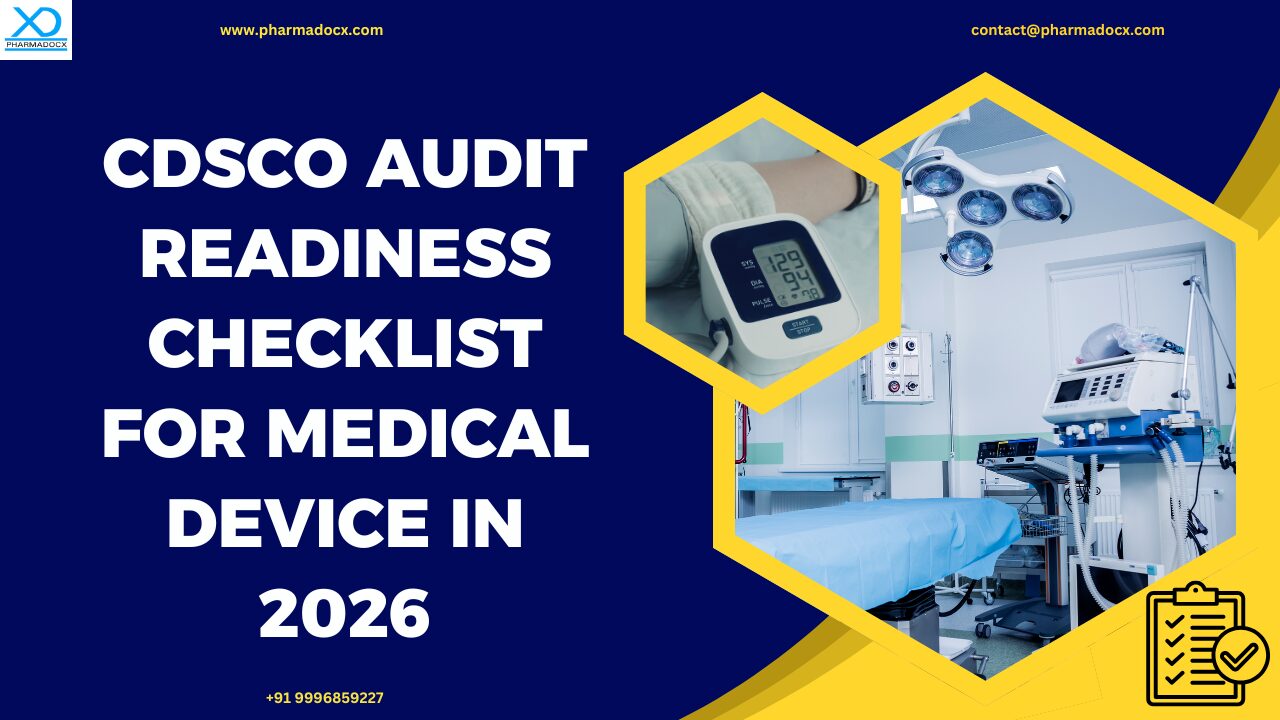
CDSCO audit for medical device manufacturers is a regulatory inspection conducted to verify compliance with the Medical Device Rules (MDR). It ensures that manufacturers follow Good Manufacturing Practices (GMP) and maintain a robust Quality Management System (QMS). Additionally, manufacturers must meet safety and performance standards. Auditors review documentation, such as Device Master Files, risk management reports, and clinical evaluation data. Moreover, they also inspect facilities, supplier records, and post‑market surveillance systems. The goal is to confirm that devices are safe, effective, and traceable before and after market approval. We have provided a CDSCO audit readiness checklist to help manufacturers prepare for CDSCO medical device audit in 2026.
Key audit readiness areas for medical device manufacturers for CDSCO inspections in 2026
We have presented some key areas medical device manufacturers should keep in mind for CDSCO inspection.
- Quality management system (QMS): Ensure your QMS is harmonized with ISO 13485 and MDR 2017 requirements. Auditors will check for documented procedures, CAPA systems, and consistency between records and shop‑floor practices.
- Device Master File (DMF) and technical documentation: Maintain updated DMFs and technical files for each device category. These must include design, validation, and risk management data aligned with CDSCO expectations.
- Clinical evaluation and performance data: Prepare CERs and performance evaluation reports for IVDs and high‑risk devices. Ensure data integrity and consistency with product claims and regulatory submissions.
- Labeling and packaging compliance: Verify that labeling meets CDSCO rules on language, warnings, and traceability. Packaging and IFU must be consistent with approved submissions and free of errors.
- Supplier and vendor governance: Document supplier qualifications, audits, and CAPA actions. Risk‑based supplier management is critical to demonstrate upstream compliance.
- Post‑market surveillance (PMS) and vigilance: Establish systems for adverse event reporting and PMS records. Auditors will test whether vigilance processes are functional and timely.
- Digital submission and portal readiness: Prepare dossiers for CDSCO’s online portal with validated electronic records. Digital readiness demonstrates compliance maturity and reduces approval delays.
- Training and competence verification: Maintain training logs and competence assessments for all staff. Auditors often interview personnel to confirm regulatory awareness and role‑specific skills.
- Internal audit and mock inspections: Conduct structured internal audits simulating CDSCO inspections. Findings should be documented, corrected, and tracked for closure.
- Facility and environmental controls: Keep cleanroom, calibration, and environmental monitoring records updated. Auditors will inspect both physical conditions and supporting documentation.
CDSCO audit readiness checklist for medical device manufacturers in 2026
We have prepared a detailed CDSCO audit readiness checklist which medical device manufacturers can use to prepare for a CDSCO audit. We have highlighted the operational and regulatory areas to be included in the checklist.
- Clinical evaluation data: Prepare Clinical Evaluation Reports (CER) and performance evaluation data for IVDs. Ensure studies are ethically approved and documented per CDSCO guidelines. Summarize outcomes with risk‑benefit analysis and post‑market relevance. Auditors will check for consistency between CER and product claims.
- QMS alignment: Ensure your QMS is fully aligned with ISO 13485:2016 and India’s MDR 2017 requirements. Document all processes, SOPs, and CAPA systems with clear traceability. Internal audits should verify consistency between written procedures and shop‑floor practices. Any gaps must be closed before the actual CDSCO inspection.
- Technical documentation: Maintain a complete DMF, including design, risk analysis, validation, and performance data. Ensure technical files are updated for each device category and classification. Cross‑check against CDSCO’s submission requirements for accuracy.
- Labeling and IFU compliance records: Verify that labeling complies with CDSCO’s MDR 2017 rules, including language, warnings, and traceability. Instructions for Use must be clear, validated, and accessible. Cross‑check against packaging and marketing materials for consistency.
- Supplier and vendor audit records: Maintain supplier qualification records, audit scorecards, and corrective actions. Ensure raw material and component suppliers meet CDSCO and ISO standards. Document risk‑based supplier evaluations and approvals. It should be noted weak supplier governance often leads to audit observations.
- Adverse event and vigilance reporting system: Establish a robust post‑market surveillance system for adverse event reporting. Train staff to identify, document, and escalate incidents promptly. Ensure reporting timelines match CDSCO’s vigilance requirements. Auditors will test the effectiveness of your vigilance system. Hence, give adverse event and vigilance reporting system priority in the checklist.
- Digital submission readiness: Prepare dossiers and applications for CDSCO’s online portal. Ensure electronic records are validated and secure. Keep submission templates updated for 2026 regulatory changes. Digital submission readiness is often an overlooked component of CDSCO audit readiness checklist but is essential.
- Internal audit and mock inspection records: Conduct internal audits simulating CDSCO inspections. Mock inspections build confidence and reduce surprises during real audits. The CDSCO audit readiness checklist should record findings, corrective actions, and closure timelines.
- Facility and environmental control records: Ensure cleanroom, calibration, and environmental monitoring records are up to date. Validate equipment and maintain preventive maintenance logs. Cross‑check facility controls against QMS documentation. Auditors will inspect both physical conditions and record integrity. Hence, it is vital to properly maintain these records. Thus, the checklist should give priority to maintenance of these records.
- Training and competence records: The CDSCO audit readiness checklist should cover training logs for all staff involved in manufacturing and quality. Ensure competence assessments are documented and linked to job roles. Regular refresher training should be scheduled for regulatory updates. Auditors often interview staff to verify training effectiveness. Hence, training and competence records should not be missed in the checklist.
How to prepare CDSCO audit readiness checklist for medical device manufacturers in 2026?
- Define scope and regulatory basis: Start by mapping your device categories against CDSCO’s MDR 2017 and 2026 updates. This ensures the checklist is tailored to your product portfolio and compliance obligations.
- Structure the checklist framework: Divide the CDSCO audit readiness checklist into sections: QMS, documentation, labeling, vigilance, supplier governance, and facility controls. This modular approach makes it easier to assign responsibilities and track readiness.
- Align with ISO 13485 and CDSCO requirements: Cross‑reference ISO 13485 clauses with CDSCO audit expectations. This dual alignment strengthens compliance and reduces audit findings.
- Gather documentation templates: Prepare standardized templates for DMF, CER, risk files, and supplier audits. Using uniform formats ensures consistency and speeds up internal reviews.
- Integrate risk‑based thinking: Include risk identification and mitigation steps for each checklist item. This demonstrates proactive compliance and satisfies CDSCO’s emphasis on risk management.
- Embed supplier governance: Add supplier qualification, audit scorecards, and CAPA tracking into the checklist. This ensures upstream compliance and strengthens your audit defense.
- Include post‑market surveillance (PMS): Design checklist items for vigilance reporting, adverse event handling, and PMS records. Auditors will expect evidence of a functioning surveillance system.
- Digital readiness and portal compliance: Incorporate steps for dossier preparation and electronic submissions via CDSCO’s online portal. Validate your digital systems for security and traceability.
- Training and competence verification: Add items to verify staff training records, competence assessments, and refresher sessions. This ensures personnel readiness during auditor interviews.
- Mock audit and continuous improvement: Schedule internal mock audits using the checklist as a scoring tool. Capture findings, implement CAPA, and update the checklist regularly for evolving regulations.
Importance of using a checklist to prepare for a CDSCO medical device audit in 2026
Using a checklist for CDSCO medical device audits in 2026 is critical because it provides structure and ensures no compliance area is overlooked. It helps manufacturers systematically verify QMS, documentation, labeling, and vigilance systems before auditors arrive. A CDSCO audit readiness checklist also reduces the risk of missing small but significant details that could lead to non‑compliance findings. It enables teams to assign responsibilities clearly and track readiness across departments. Finally, it builds confidence during audits by demonstrating operational discipline and proactive regulatory alignment. We at Pharmadocx Consultants provide mock audit services to help identify shortcomings and provide tips to overcome them. To avail our CDSCO medical device mock audit service, drop an email at [email protected] or call/Whatsapp on 9996859227.