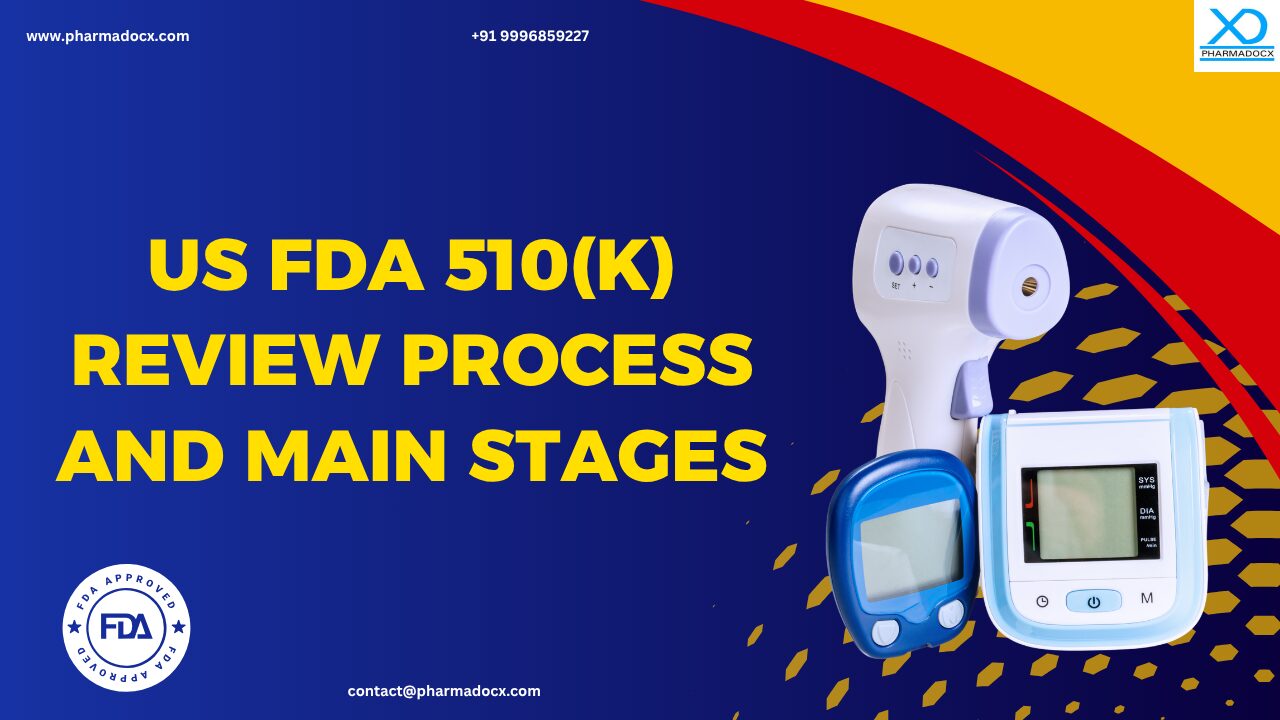
The FDA 510(k) review process is the most common pathway for bringing moderate-risk medical devices to the U.S. market. It is a structured pathway ensuring a medical device is substantially equivalent to a legally marketed predicate device before clearance. The process involves three main stages: Acceptance Review, Substantive Review, and Interactive Review. After clearance, the device will be legally permitted in the US market.
What is the US FDA 510(k) review process?
The FDA 510(k) review process is a less rigorous process used for approval of medium-risk devices, Class I and Class II, for the US market. This process is only for medical devices having a predicate device. FDA 510(k) review process begins when a manufacturer submits a 510(k) application demonstrating that their device is substantially equivalent to a legally marketed predicate device. The FDA first performs an Acceptance Review to ensure the submission is complete. Then, a Substantive Review is performed where scientific and regulatory experts evaluate safety, effectiveness, and performance data. During this stage, an Interactive Review may occur, allowing FDA reviewers and the applicant to resolve questions in real time. Finally, the FDA issues a clearance letter, if substantial equivalence is established.
- Purpose: To show the device is as safe and effective as an existing legally marketed device.
- Eligibility: Most Class II devices and some Class I devices. Notably, only devices having a predicate device are eligible for US FDA 510(k) clearance.
6 Steps of the FDA 510(k) review process
- Submission of application: The manufacturer prepares and submits the 510(k) dossier to the FDA. The 510(k) dossier includes device description, predicate comparison, and supporting test data. This package must demonstrate that the new device is substantially equivalent to a legally marketed device. The submission also includes labeling, intended use, and performance evidence. Once filed, the FDA assigns a tracking number and begins the review clock.
- Acknowledgment of receipt: FDA assigns a unique number and verifies fee payment and valid submission format. Then, an Acknowledgment Letter is sent to the applicant.
- Acceptance review: The FDA conducts an administrative screening to ensure the submission is complete. They check for required forms, predicate device information, and supporting documentation. If deficiencies are found, the FDA issues a “Refuse to Accept” (RTA) letter, pausing the process. If accepted, the file moves forward into substantive scientific review.
- Substantive review: FDA reviewers evaluate the device’s safety and effectiveness compared to the predicate. They analyze performance testing, biocompatibility, sterilization, and clinical data if applicable. The central question is whether the new device is “substantially equivalent” to one already cleared. If major issues arise, the FDA issues an “Additional Information” (AI) request, pausing the review until the applicant responds.
- Interactive review: This phase involves direct communication between FDA reviewers and the applicant. Minor clarifications or supplemental data requests are handled through emails or calls. The goal is to resolve issues quickly without formal deficiency letters. Timely responses from the applicant help maintain momentum toward clearance.
- Final decision: If the FDA agrees the device is substantially equivalent, it issues a clearance letter. This letter authorizes the manufacturer to market the device in the U.S. under the same classification as the predicate. If the device is deemed “Not Substantially Equivalent” (NSE), the applicant must pursue another pathway such as De Novo or PMA.
Main stages of FDA 510(k) review process
- Acceptance review (Administrative Screening): In the acceptance review, the FDA first checks whether the submission is complete and meets the basic requirements outlined in the 510(k) checklist. This step ensures that all necessary forms, predicate device information, and supporting data are included. If deficiencies are found, the FDA issues a “Refuse to Accept” (RTA) letter. Then, the applicant has 180 days to correct and resubmit. Once accepted, the submission moves forward to substantive scientific review.
- Substantive review (Scientific Evaluation): FDA reviewers analyze the device’s safety and effectiveness compared to the chosen predicate device. They examine performance testing, biocompatibility, sterilization, labeling, and clinical data if applicable. The goal is to determine whether the new device is “substantially equivalent” to an existing legally marketed device. If major issues are identified, the FDA issues an “Additional Information” (AI) request, pausing the FDA 510(k) review process until the applicant responds.
- Interactive review (Ongoing Communication): During this phase, FDA reviewers may contact the applicant directly to clarify minor issues or request supplemental data. This interactive dialogue helps resolve questions quickly without formal deficiency letters. It often shortens the review timeline by avoiding unnecessary delays. The applicant must respond promptly and thoroughly to avoid setbacks and achieve clearance faster.
- Final decision (Clearance or NSE): If the FDA agrees the device is substantially equivalent, it issues a 510(k) clearance letter. This allows the manufacturer to market the device in the U.S. The device classification will be same as the predicate. However, if the device is deemed “Not Substantially Equivalent” (NSE), the FDA issues a NSE letter.
5 Common causes for FDA 510(k) delays or rejections
- Administrative incompleteness: Up to 60% of submissions fail at the RTA stage due to missing forms, incorrect templates, or incomplete documentation. Common gaps include errors in FDA forms, outdated eSTAR templates, or missing labeling details. Even minor inconsistencies across cover sheets and headers can trigger rejection. This stage is entirely within the applicant’s control and can be avoided with disciplined checklist use.
- Inadequate device description: Submissions often fail to clearly describe the device’s design, components, and intended use. Ambiguity in technical specifications makes it difficult for FDA reviewers to assess equivalence. Inconsistent or vague descriptions across sections of the dossier raise red flags. A strong narrative that aligns with the predicate device is essential.
- Inconsistent indications for use: Misalignment between the indications stated in forms, labeling, and technical sections is a frequent cause of rejection. FDA requires consistency across all documents to ensure clarity of intended use. Even small wording differences can trigger RTA or AI requests. Thus, applicants must harmonize language across the entire submission package.
- Poor predicate selection: Choosing an inappropriate predicate device undermines the substantial equivalence argument. If the predicate differs too much in technology or intended use, FDA may issue an NSE (Not Substantially Equivalent) decision. Applicants often underestimate the importance of predicate logic in shaping review outcomes. Pre-submission meetings with FDA can help validate predicate choice.
- Insufficient testing data: Missing or inadequate performance, biocompatibility, sterilization, or software validation data frequently delay reviews. FDA often issues AI requests when testing evidence is incomplete or poorly presented. Owing to this reason, a large chunk of submissions receives at least one AI request, thereby pausing the review clock. Notably, each cycle can add 30–60 days and significant costs for retesting and rewriting
How can Pharmadocx Consultants help?
Owing to incorrect application, thousands of FDA 510(k) are rejected. Furthermore, in certain cases, the applicants cannot complete their application, as the process is difficult. Our team is committed to provide proper guidance to the clients to help them successfully secure the approval. We specialize in US FDA 510(k) submission. We help:
- Identify FDA product code and applicable regulations
- Identify predicate device
- Compile necessary supporting documents
- Evaluate substantial equivalence
- Create 510(k) technical documents
- Respond to FDA queries
- Act as a communication bridge between clients and FDA
Our expertise and support and can help you easily clear the US FDA 510(k) review process. Simply drop an email at [email protected] or call/Whatsapp on 9996859227 for a smooth US FDA 510(k) journey.