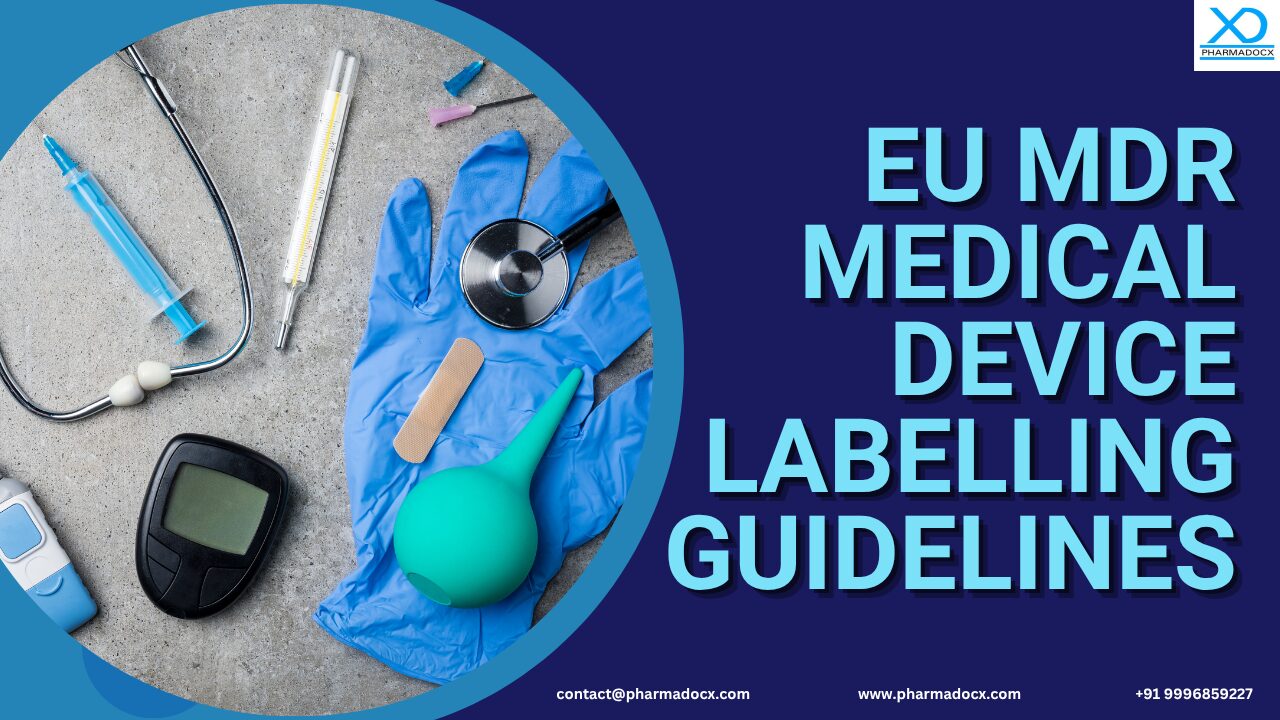
EU MDR medical device labelling is critically important because it ensures patient safety, regulatory compliance, and EU market access. Labels provide essential information, such as device identification, manufacturer details, usage instructions, warnings, and traceability. By standardizing symbols and requiring language localization, EU MDR enhances clarity for healthcare professionals and patients across member states. Proper labelling also supports post‑market surveillance, reduces risks of misuse, and strengthens transparency in the supply chain. Hence, compliant labelling is not just a regulatory requirement. It is a cornerstone of trust, accountability, and safe medical device use in the EU. In this blog, we have detailed EU MDR medical device labelling guidelines.
What are EU MDR medical device labelling guidelines?
EU MDR medical device labelling guidelines require manufacturers to provide clear, standardized, and traceable information on device labels to ensure patient safety and regulatory compliance. The guidelines are outlined in Annex I Section 23.2 of Regulation (EU) 2017/745. Labels must include device identification details (name, model, lot/serial number, manufacturing/expiry date), manufacturer and EU authorized representative information, the Unique Device Identifier (UDI), CE marking with notified body number if applicable, and essential safety or usage instructions. Standard symbols are recommended to ensure consistency. Additionally, all information must be presented in the official language(s) of the EU member state where the device is marketed. Hence, these guidelines strengthen transparency, support post-market surveillance, and safeguard against misuse. Therefore, making compliant labelling a critical requirement for EU market access.
5 key EU MDR medical device labelling requirements
1. Device identification
Manufacturers must clearly state the device name, trade name, and model/reference number on the label. This ensures healthcare professionals can distinguish the product from similar devices. The label must also include the lot number, serial number, and manufacturing or expiry date for traceability. Additionally, the Unique Device Identifier (UDI) must be present to enable tracking across the EU supply chain.
2. Manufacturer and authorized representative
The label must display the manufacturer’s name, registered address, and contact details. For non-EU manufacturers, the EU Authorized Representative (EC REP) details must also be included. This ensures accountability. Additionally, it provides a point of contact for regulatory authorities and users. Moreover, the EC REP symbol must be used to standardize representation across member states.
3. Safety and usage information
As per EU MDR medical device labelling requirements, labels must include essential safety details, such as expiry date, implantation deadline, and storage or handling conditions. Additionally, warnings, contraindications, and precautions must be clearly stated to prevent misuse. Any residual risks must be communicated to safeguard patient safety. Moreover, these instructions must be concise yet comprehensive to guide healthcare professionals effectively.
4. Symbols and language
Standardized symbols must be used to represent key information, such as sterility, single-use, expiry, and manufacturer details. This reduces language barriers and ensures consistency across the EU market. Medical device labels must be translated into the official language(s) of the member state where the device is marketed. Basically, this requirement guarantees accessibility and comprehension for both professionals and patients.
5. CE marking
As per EU MDR medical device labelling requirements, the CE mark must be visible, legible, and indelible on the device or packaging. If a notified body is involved, its four-digit identification number must accompany the CE mark. This symbol confirms conformity with EU MDR requirements and allows legal market placement. Without proper CE marking, the device cannot be sold in the EU.
Need for EU MDR medical device labelling requirements
- Patient safety: Labels provide critical information, such as warnings, contraindications, and expiry dates. This ensures patients and healthcare professionals use devices correctly and safely. Moreover, clear labelling reduces risks of misuse or adverse events. Thus, it acts as a safeguard for vulnerable populations, especially with implantable devices.
- Traceability and post‑market surveillance: The Unique Device Identifier (UDI) enables tracking of devices across the EU supply chain. Traceability supports quick identification during recalls or adverse event investigations. It strengthens post‑market surveillance by linking devices to performance data. This helps regulators and manufacturers respond rapidly to safety concerns.
- Regulatory compliance and market access: Labelling is a mandatory requirement of EU MDR guidelines. Without compliant labelling, CE marking cannot be granted. Notably, CE marking is essential for legal market entry in the EU. Non‑compliance can block distribution, delay launches, or trigger penalties.
- Transparency and trust: Labels communicate manufacturer details and authorized representative information. This builds accountability and confidence among healthcare providers and patients. Moreover, standardized symbols and multilingual labelling enhance clarity across member states. Furthermore, transparent labelling strengthens brand reputation and regulatory credibility.
Special considerations under EU MDR medical device labelling guidelines
- Implantable and Class III devices: Require additional transparency measures, such as patient information leaflets and implant cards. Implant cards must include device details, manufacturer information, and UDI for traceability. These ensure patients and healthcare providers have critical information for long‑term safety. Enhanced labelling supports post‑market surveillance and adverse event reporting.
- Small devices and limited packaging space: Even with space constraints, all mandatory information must be provided. Manufacturers may distribute details across the device, immediate packaging, and IFU. Use of standardized symbols helps reduce text volume while maintaining clarity. Digital access (e.g., eIFU) can supplement physical labelling where permitted.
- Language requirements: Labels must be translated into the official language(s) of each EU member state where marketed. This ensures accessibility for both healthcare professionals and patients. Failure to comply can result in rejection during notified body review. Language localization must be accurate and consistent across all packaging levels.
- Durability and legibility: Labels must remain legible and indelible throughout the product’s lifecycle. Printing methods should withstand sterilization, handling, and storage conditions. Symbols and text must not fade or become unreadable during use. This requirement ensures safety information is always available when needed.
Risks of non-compliance
We have highlighted the risk of non-compliance with EU MDR medical device labelling guidelines.
- Market access barriers: Without compliant labelling, devices cannot legally be placed on the EU market. Notified bodies will reject CE marking applications if labelling requirements are incomplete or inaccurate. This directly blocks distribution and sales, thereby causing delays in product launches. For exporters, especially from outside the EU, this can mean losing critical business opportunities.
- Regulatory penalties: Authorities may impose fines, sanctions, or even criminal liability for serious violations. Non‑compliance can trigger warning letters, product seizures, or suspension of licenses. These penalties increase operational costs and damage credibility with regulators. Persistent violations may lead to long‑term exclusion from the EU market.
- Product recalls and FSCA: Incorrect or missing labelling can result in product recalls or field safety corrective actions (FSCA). Recalls disrupt supply chains, create financial losses, and erode customer trust. Moreover, they also attract negative publicity, which can harm brand reputation.
- Reputational damage: Non‑compliance signals weak governance and poor quality systems to stakeholders. Healthcare providers and patients lose confidence in the manufacturer’s products. Competitors may exploit this gap by emphasizing their stronger compliance record. Thus, reputational harm can outweigh direct regulatory penalties.
Therefore, EU MDR medical device labelling is a vital safeguard for patient safety, product traceability, and market credibility. By mandating clear identification, standardized symbols, multilingual accessibility, and durable presentation, the regulation ensures that devices are used correctly and responsibly across diverse healthcare settings. Proper labelling also strengthens post‑market surveillance. This enables rapid response to adverse events and recalls. Finally, compliance with EU MDR labelling requirements is essential for manufacturers to secure CE marking and gain EU market access. For easy EU MDR compliance, email at [email protected] or call/Whatsapp on 9996859227.