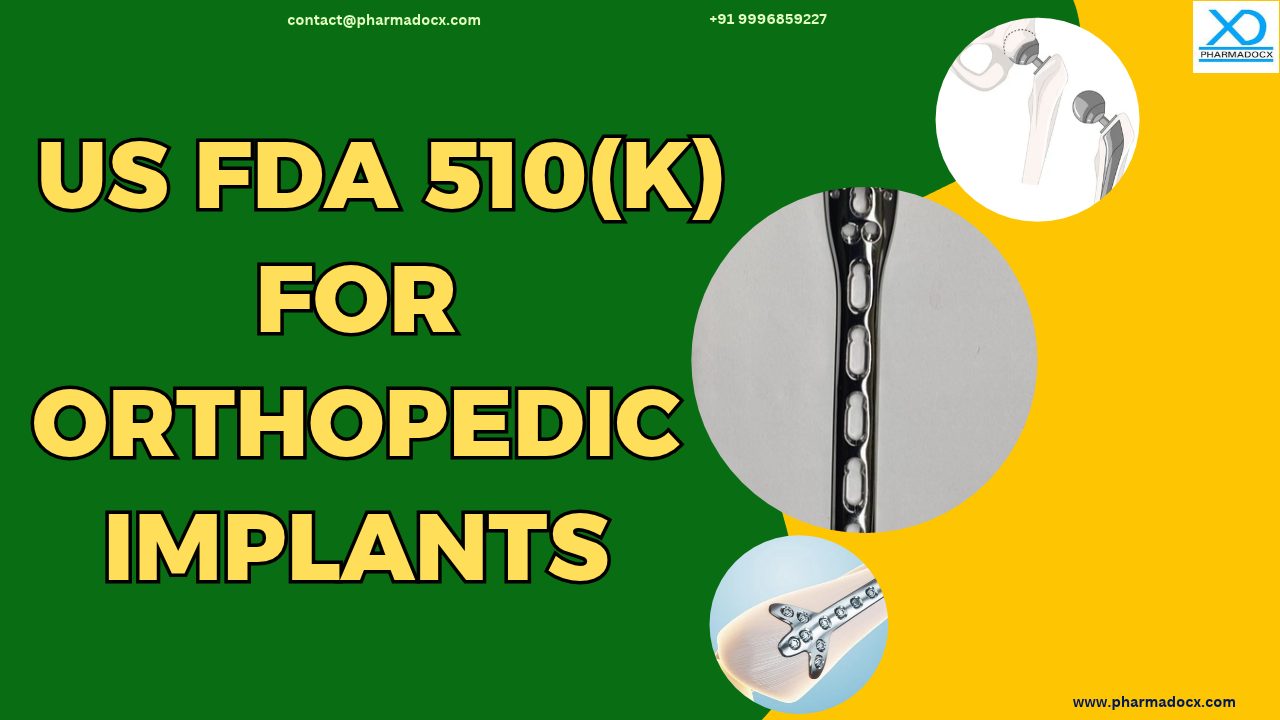

In this blog, we have prepared a detailed guide to walk you through US FDA 510(k) for orthopedic implants. We have presented the eligible class, requirements, and process for US FDA 510(k) for orthopedic implants.
What are orthopedic implants?
An orthopedic implant is a medical device surgically placed in the body to replace, support, or stabilize damaged bones, joints, or cartilage in the musculoskeletal system. These devices are primarily designed to relieve pain, restore mobility, and help patients return to their normal activities after a severe fracture, sports injury, or degenerative condition, such as osteoarthritis. Orthopedic implants generally fall into three main functional categories:
- Joint replacements (Arthroplasty): These are permanent implants designed to completely or partially replace an articulating joint that has been severely damaged by arthritis or wear and tear. The most common procedures include total hip, knee, and shoulder replacements.
- Fracture fixation devices: These are temporary or permanent internal hardware components used to stabilize broken bones so they can heal in the correct anatomical alignment. This category includes bone plates, screws, pins, wires, and intramedullary nails (rods inserted down the center of long bones).
- Spinal implants: Used to treat conditions, such as degenerative disc disease, scoliosis, or spinal stenosis. Examples include pedicle screws, rods, cages, and artificial discs that help stabilize or fuse vertebrae together.
Materials used to manufacture orthopedic implant
As these devices must function inside the human body under heavy mechanical loads, they are engineered from highly durable, biocompatible materials.
- Metals: Medical-grade titanium, stainless steel, and cobalt-chromium alloys are widely used because they offer exceptional strength and resist corrosion.
- Polymers: High-strength plastics, such as ultra-high-molecular-weight polyethylene (UHMWPE), are commonly used as liners in joint replacements to mimic the smooth, low-friction surface of natural cartilage.
- Ceramics: Often used in hip replacements for their extreme wear resistance and smoothness.
In most cases, implants remain in the body permanently, even after a bone has fully healed. Over time, bone and dense scar tissue grow tightly around the hardware.
What is US FDA 510(k)?
The US FDA 510(k) is the most common regulatory pathway used to market medical devices in the United States. It is a premarket notification pathway used to obtain FDA clearance for medical devices by demonstrating that the new device is substantially equivalent to a legally marketed device in the U.S., known as a predicate device. Rather than proving safety and effectiveness independently through the more rigorous PMA pathway, the manufacturer shows that the device has the same intended use as the predicate. The 510(k) pathway is primarily used for most Class II medical devices and a limited number of Class I devices that are not exempt from premarket review. A valid predicate device is required. Additionally, substantial equivalence must be established against that predicate.
The FDA reviews the evidence to determine whether the new device is as safe and effective as the predicate, and once clearance is granted, the manufacturer can legally market the device in the United States.
US FDA 510(k) for orthopedic implants
US FDA 510(k) for orthopedic implantsis a regulatory clearance pathway that allows a manufacturer to market a new orthopedic device by demonstrating that it is substantially equivalent to a legally marketed predicate device already available in the United States. It is commonly used for Class II orthopedic devices. Under the 510(k) framework, the manufacturer must show that the new implant has the same intended use as the predicate and either the same technological characteristics or differences that do not raise new questions of safety or effectiveness. Substantial equivalence is assessed based on factors, such as design, materials, performance, biocompatibility, labeling, and intended use.
Example of using US FDA 510(k) for orthopedic implants for approval: A new titanium bone plate for fracture fixation may obtain FDA 510(k) clearance by demonstrating substantial equivalence to an already cleared bone plate with the same intended use and comparable performance characteristics.
Device class eligibility for US FDA 510(k) for orthopedic implants
- Class I: Some orthopedic accessories may be exempt or require 510(k)
- Class II: Primary category for 510(k). Most orthopedic implants are Class II
- Class III: Generally not eligible for 510(k). They typically require PMA unless FDA has down-classified the device type
Orthopedic implants commonly cleared through 510(k)
We have provided examples of devices commonly cleared through US FDA 510(k) for orthopedic implants.
- Bone plates
- Bone screws
- Intramedullary nails
- External fixation systems
- Spinal fixation systems
- Interference screws
- Suture anchors
- Hip prosthesis components
- Knee prosthesis components
- Shoulder implants
- Orthopedic instruments and accessories
Checklist for US FDA 510(k) submission for orthopedic implants
We have prepared a detailed checklist to help you with your US FDA 510(k) submission.
- Cover Letter – Submission type, device description
- FDA Form 3601 – User Fee Cover Sheet
- CDRH Submission Cover Sheet – Predicate vs. New Device
- FDA Form 3881 – Indications for Use
- 510(k) Summary – Public-facing overview
- Truthful & Accuracy Statement
- Declarations of Conformity
- Executive Summary
- Detailed Device Description
- Substantial Equivalence Discussion
- Proposed Labeling & IFU
- Sterilization & Shelf Life
- Biocompatibility Testing
- Bench Performance Testing
- Animal Testing (if applicable)
- Clinical Testing (if required)
6 Key phases of US FDA 510(k) submission for orthopedic implants
- Medical device classification and predicate identification: Determine whether the orthopedic implant qualifies for 510(k) and identify a legally marketed predicate device. Use FDA’s product classification database and 510(k) summaries to identify the best predicate with minimal risk of not substantially equivalent (NSE).
- Technical file preparation: The technicalfile for US FDA 510(k) for orthopedic implants should include the medical device description, intended use, labelling. Additionally, it should contain performance testing along with risk analysis per ISO 14971. If applicable, include sterilization validation. Align the file with recognized consensus standards and include declarations of conformity to reduce FDA queries.
- Pre-submission strategy: Opt for pre-submissionto seek FDA feedback on testing protocols, substantial equivalence, and regulatory strategy. It will help align with regulatory expectations early on to avoid delays. Pre-submission pathway allows you to request FDA feedback on specific aspects of your planned submission before your formal US FDA 510(k) submission.
- Submission and RTA review: Refer to FDA’s refuse to accept (RTA) checklistto ensure completeness before substantive review. Missing labeling elements, poor predicate justification, incomplete test reports are common pitfalls to avoid. Additionally, conduct internal RTA audit before submission to avoid delays.
- Substantive review and interactive process: The FDA review clock is90 calendar days. However, it is often paused for additional information. During the interactive review phase, FDA may request clarifications, additional data, or revised labelling. Respond to all queries within 30 days to avoid withdrawal or reset of the review clock.
- Clearance and post-market steps: If the orthopedic implant is cleared, it can be marketed in the U.S. Post-clearance device listing, UDI compliance, and QMS alignment with 21 CFR Part 820 will be necessary. Prepare SOPs for complaint handling and CAPA to ensure audit readiness.
End-to-end regulatory ownership for FDA 510(k) approval for orthopedic implants
We at Pharmadocx Consultants offer full-spectrum support for FDA 510(k) approval from device classification and predicate selection to final FDA clearance. Our service includes technical file preparation, testing protocol guidance, labeling and UDI compliance, submission strategy, and FDA communication. We offer a single point of accountability, thereby reducing fragmentation and submission errors. Based on our rich experience, we have formulated a strategic approach to 510(k) application. Our team will help you avoid all the common pitfalls and have a successful application. Our familiarity with FDA reviewer expectations can accelerate clearance and reduce costly delays. For US FDA 510(k) for orthopedic implants, email at [email protected] or call/Whatsapp on 9996859227.