
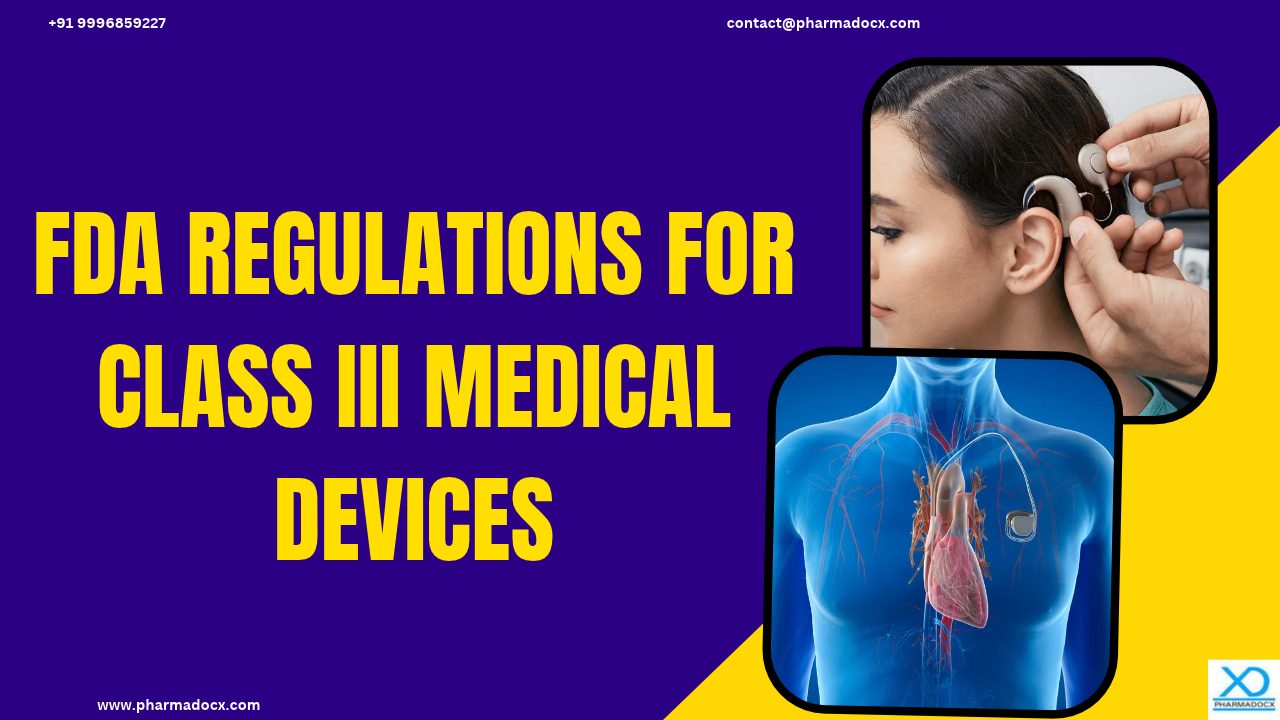

Class III medical devices are the FDA’s highest-risk category and require rigorous Premarket Approval (PMA) before marketing. These devices sustain or support life, prevent serious health impairment, or pose significant risk if they fail. Unlike Class I and II devices, Class III devices cannot rely on general or special controls alone. They must demonstrate safety and effectiveness through valid scientific evidence, often including clinical trials. In this blog, we have detailed FDA regulations for Class III medical devices.
What are the Class III medical devices?
Class III medical devices are the FDA’s highest‑risk category, reserved for products that sustain or support life, prevent serious health impairment, or pose significant risk if they fail. Hence, they require the most stringent regulatory pathway, namely Premarket Approval (PMA). PMA demands valid scientific evidence, often including clinical trials, to prove safety and effectiveness before marketing. Examples of Class III devices include pacemakers, heart valves, implantable defibrillators, cochlear implants, and breast implants. Notably, all of these devices require rigorous testing and continuous post‑market surveillance to ensure patient safety.
Thus, Class III devices are those that support or sustain human life, prevent serious impairment of health, or present a potential, unreasonable risk of illness or injury. They make up about 10% of all FDA‑classified devices. Most Class III devices cannot be cleared via 510(k). They require full PMA. Failure to obtain PMA makes the device adulterated under FDA law.
FDA regulatory requirements for Class III medical devices
Class III medical devices are considered by the FDA to pose the highest risk to patients. Therefore, they must undergo the most stringent regulatory pathway, Premarket Approval (PMA). Manufacturers are required to submit valid scientific evidence, often including extensive clinical trial data, to demonstrate safety and effectiveness. In addition to PMA, these devices must comply with Quality System Regulations (21 CFR Part 820) covering design controls, risk management, and CAPA. Additionally, they are subject to post‑market surveillance and mandatory adverse event reporting. Without PMA, a Class III device cannot be legally marketed in the U.S.
Clinical evidence requirement
- Investigational Device Exemption (IDE): Before conducting clinical trials, manufacturers must obtain an IDE from the FDA. This allows the device to be used in studies to collect safety and effectiveness data.
- Clinical trial design: Trials must be scientifically rigorous, often randomized and controlled, to generate valid evidence. The design must align with the device’s intended use and risk profile.
- Safety and effectiveness data: Evidence must demonstrate that the device performs as intended without unreasonable risk. Both short‑term and long‑term outcomes are evaluated.
- Patient population: Clinical studies on Class III medical devices must include representative patient groups for the device’s intended use. This ensures results are generalizable and relevant to real‑world conditions.
- Endpoints and outcomes: FDA requires clearly defined endpoints, such as survival rates, functional improvement, or reduced adverse events. These outcomes must be statistically significant and clinically meaningful.
- Post‑market evidence: Even after PMA approval, manufacturers must continue collecting data through post‑market surveillance. This ensures ongoing safety and effectiveness in broader patient populations.
Manufacturing and quality system requirement
- Quality system regulation: Manufacturers must establish and maintain a comprehensive quality management system covering design, production, packaging, labeling, and servicing. Compliance ensures consistency, traceability, and accountability across the device lifecycle.
- Design controls: Class III medical devices require documented design inputs, outputs, verification, validation, and design transfer processes. This ensures the final product meets user needs and regulatory standards before commercialization.
- Corrective and Preventive Actions (CAPA): A CAPA system must be in place to identify, investigate, and resolve quality issues. Preventive measures are equally critical to avoid recurrence and strengthen long‑term compliance.
- Supplier management: Manufacturers must qualify, audit, and monitor suppliers to ensure raw materials and components meet FDA standards.
- Production and process controls: Processes must be validated to demonstrate reproducibility and reliability. Continuous monitoring and documentation safeguard against variability and ensure product integrity.
- Document and record controls: All procedures, specifications, and records must be properly maintained and readily available for FDA inspection. Electronic batch records and audit trails enhance transparency and compliance.
- Post‑market surveillance integration: Manufacturing systems must link with post‑market feedback to capture adverse events and performance data. This closed‑loop system drives continuous improvement and regulatory alignment.
Post‑market surveillance requirements
- Medical device reporting (MDR): Manufacturers must report adverse events, device malfunctions, and serious injuries to the FDA under 21 CFR Part 803. Timely reporting ensures that risks are identified and mitigated quickly.
- Post‑approval studies (PAS): The FDA may require additional clinical studies after PMA approval to monitor long‑term safety and effectiveness. These studies provide real‑world evidence beyond premarket trials.
- Annual reports: Manufacturers must submit annual reports summarizing device performance, adverse events, and any changes in labeling or manufacturing. This keeps FDA updated on ongoing compliance and product safety.
- Recalls and corrections: If safety issues arise, manufacturers must initiate recalls or corrective actions and notify FDA promptly. Proper recall management protects patients and maintains regulatory trust.
- Quality system integration: PMS data must feed into the manufacturer’s Quality System Regulation (QSR) processes, including CAPA. This closed‑loop system ensures continuous improvement and risk reduction.
- FDA inspections and audits: The FDA conducts routine and for‑cause inspections to verify PMS compliance. Notably, non‑compliance can lead to warning letters, fines, or withdrawal of PMA approval.
Premarket approval (PMA) for Class III medical devices
- Purpose of PMA: PMA is the FDA’s most stringent regulatory pathway. It is required for Class III medical devices that pose the highest risk to patients. It ensures that the device is safe and effective for its intended use before marketing. Unlike the 510(k) clearance process, PMA is based on valid scientific evidence rather than substantial equivalence. This makes PMA essentially a license to market the device in the U.S.
- Submission requirements: A PMA application must include detailed device descriptions, intended use, nonclinical and clinical study data, labeling, and manufacturing information. The FDA expects comprehensive evidence covering biocompatibility, bench testing, and clinical trial results. Manufacturers must also provide risk analyses and design control documentation. This submission demonstrates that the device meets stringent safety and performance standards.
- FDA review process: The FDA conducts a thorough scientific and regulatory review of the PMA application. This includes evaluating clinical data, inspecting manufacturing facilities, and assessing labeling for accuracy and clarity. Advisory panels of experts may be consulted for complex or novel devices. The review timeline is typically 180 days. However, extensions are common if additional data is requested.
- Post‑approval obligations Once approved, manufacturers must comply with ongoing post‑market surveillance requirements. This includes adverse event reporting, annual reports, and sometimes mandated post‑approval studies. The FDA can withdraw approval if safety or effectiveness concerns arise. Continuous compliance with Quality System Regulations (QSR) ensures the device remains legally marketable.
Step‑by‑step guide to the FDA Premarket Approval (PMA) process for Class III medical devices
- Pre‑submission preparation: Manufacturers begin by gathering all scientific, technical, and clinical data needed to demonstrate safety and effectiveness of the Class III medical devices. Early engagement with FDA through pre‑submission meetings helps align expectations and reduce review delays.
- PMA application submission: The PMA dossier must include device description, intended use, nonclinical and clinical study results, labeling, and manufacturing information. Submission also involves paying user fees and formally entering the FDA review pipeline.
- FDA review process: FDA scientists and engineers conduct a comprehensive review of the PMA application, evaluating both clinical and nonclinical evidence. The review timeline is usually 180 days.
- Facility inspection: FDA inspects the manufacturing facility to verify compliance with Quality System Regulations (21 CFR Part 820).
- FDA decision: If the evidence demonstrates safety and effectiveness, FDA grants PMA approval, allowing the device to be marketed in the U.S.
- Post‑approval obligations: Manufacturers must comply with ongoing post‑market surveillance requirements, including adverse event reporting and annual reports.
To easily secure the PMA for Class III medical devices, email at [email protected] or call/Whatsapp on 9996859227.