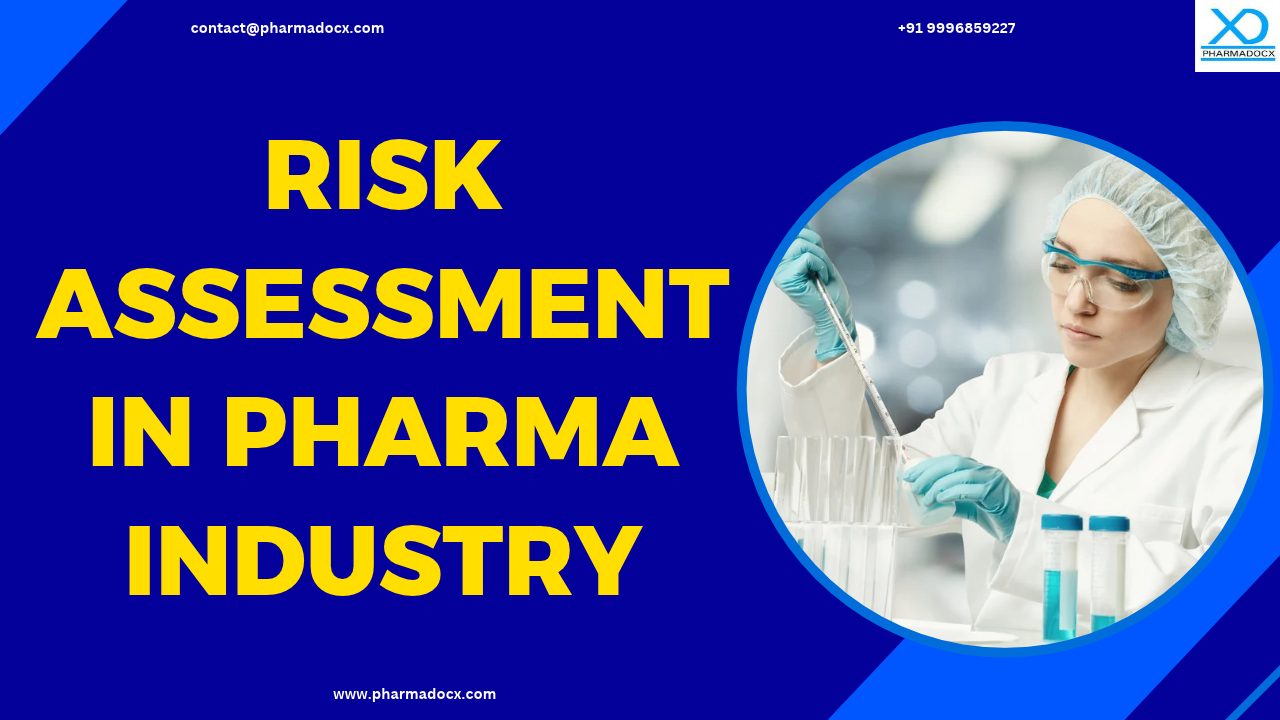
Risk assessment in pharma industry is a systematic evaluation of hazards, their probability, and severity. It is followed by decisions on control measures. Basically, it is a structured process of identifying, analyzing, and controlling potential hazards that could impact product quality. Risk assessment in pharma industry is mandated by global guidelines and is central to Good Manufacturing Practices (GMP).
What is risk assessment in pharma industry?
Risk assessment in pharma industry is a structured, science-based process used to identify, analyze, and control potential risks that could affect product quality, patient safety, or regulatory compliance. It involves systematically evaluating hazards, such as contamination, equipment failure, or supplier issues, thereby determining their likelihood and severity. Additionally, it focuses on implementing appropriate controls to mitigate them. Common tools, such as FMEA, HACCP, and risk ranking, help prioritize risks and ensure resources are focused on critical areas. Thus, risk assessment supports GMP compliance, strengthens quality management systems, and enables companies to make data-driven decisions that protect patients and maintain regulatory trust.
Importance of risk assessment in pharma industry
- Patient safety: Risk assessment ensures that potential hazards, such as contamination or formulation errors, are identified and controlled before they reach patients. This proactive approach minimizes adverse health outcomes and builds trust in medicines.
- Regulatory compliance: Global regulators, such as FDA, EMA, and CDSCO, require risk-based decision-making. Effective risk assessment demonstrates compliance during inspections and reduces the likelihood of regulatory penalties.
- Quality assurance: By systematically analyzing risks, companies can maintain consistent product quality across batches. This strengthens the reliability of the Quality Management System (QMS) and supports continuous improvement.
- Operational efficiency: Risk assessment helps prioritize resources toward high-risk areas, thereby avoiding wasted effort on low-impact issues. This leads to streamlined processes, reduced costs, and faster resolution of deviations.
- Supplier and supply chain management: Evaluating risks in raw material sourcing and supplier performance prevents disruptions and ensures reliable supply. It also strengthens supplier qualification programs and mitigates dependency risks.
- Innovation and change control: Risk assessment in pharma industry supports safe implementation of new technologies, processes, or AI-driven systems in pharma. It ensures that innovations are validated without compromising patient safety or compliance.
5 key elements of risk assessment in pharma industry
1. Risk identification
Risk identification is the first step, where potential hazards that could affect product quality, patient safety, or compliance are recognized. These hazards may arise from raw materials, equipment, processes, or human factors. Additionally, it requires cross-functional input from manufacturing, QA, engineering, and regulatory teams. The goal is to capture all possible risks before they manifest into issues. A thorough identification process sets the foundation for effective risk management.
2. Risk analysis
Risk analysis involves evaluating the probability of occurrence and the severity of impact for each identified hazard. Scientific data, historical records, and expert judgment are used to quantify risks. Tools, such as FMEA or HACCP, help structure this analysis systematically. This step ensures that risks are not just listed but understood in terms of their potential consequences. A well-executed analysis provides the basis for prioritization and control.
3. Risk evaluation
Risk evaluation compares the analyzed risks against predefined acceptance criteria or regulatory thresholds. It helps determine which risks are tolerable and which require immediate action. This step ensures that decision-making is consistent and aligned with GMP expectations. Evaluation also highlights residual risks that remain even after controls are applied. Finally, it guides resource allocation toward the most critical areas.
4. Risk control
Risk control focuses on reducing or eliminating risks through preventive and corrective measures. Strategies may include process redesign, equipment upgrades, stricter SOPs, or enhanced training. The effectiveness of controls must be validated to ensure they truly mitigate the identified risks. Documentation of control measures is essential for regulatory inspections and audits. This step transforms risk assessment into actionable improvements.
5. Risk review and reevaluation
Risk review is a continuous process of monitoring and reassessing risks over time. It ensures that controls remain effective as processes, technologies, or regulations evolve. Periodic reviews help identify new risks introduced by changes in suppliers, equipment, or market conditions. Moreover, reevaluation also captures lessons learned from deviations, audits, or inspections. This ongoing cycle keeps the risk management system dynamic and future-proof.
Common tools for risk assessment in pharma industry
We have listed the common tools used for risk assessment in pharma industry.
| Tool | Purpose | Methodology | Strengths | Pharma Applications |
| FMEA (Failure Mode and Effects Analysis) | Identifies potential failure points and their impact | Systematically lists failure modes, effects, and assigns Risk Priority Numbers (RPN) | Quantitative, structured, prioritizes risks | Equipment malfunction in sterile filling, process validation, packaging defects |
| HACCP (Hazard Analysis and Critical Control Points) | Focuses on contamination and safety risks | Identifies hazards, sets critical control points, establishes monitoring procedures | Strong for contamination control, widely accepted in food & pharma | Sterility assurance in aseptic manufacturing, contamination prevention in cleanrooms |
| FTA (Fault Tree Analysis) | Maps root causes of failures | Uses logic diagrams to trace events leading to system failure | Visual, root-cause oriented, good for complex systems | Investigating batch deviations, analyzing system breakdowns |
| Risk Ranking & Filtering | Prioritizes risks based on severity and likelihood | Assigns scores or ranks to risks, filters out low-priority issues | Simple, resource-efficient, adaptable | Supplier qualification, raw material risk assessment |
| Hazard Analysis | Broad identification of hazards | Brainstorming, checklists, expert judgment | Flexible, captures wide range of risks | Raw material contamination, environmental risks |
| SWOT Analysis (Strengths, Weaknesses, Opportunities, Threats) | Evaluates internal and external risk factors | Strategic mapping of organizational strengths vs threats | Strategic, holistic, good for business-level risks | Market entry risks, supplier dependency evaluation |
| Fishbone Diagram | Identifies root causes of quality issues | Categorizes causes under People, Process, Equipment, Materials, Environment | Easy visualization, encourages team collaboration | Root cause analysis for deviations, CAPA investigations |
Best practices
- Science-based, data-driven evaluations: Risk assessment in pharma industry should rely on validated data, historical trends, and scientific evidence rather than assumptions. This ensures objectivity and consistency across departments. A data-driven approach also strengthens credibility during regulatory inspections.
- Focus on high-risk areas: Resources should be directed toward risks that have the greatest impact on patient safety and product quality. Low-priority risks can be monitored but should not consume excessive effort. This prioritization improves efficiency and compliance outcomes.
- Cross-functional collaboration: Risk assessment in pharma industry must involve QA, manufacturing, engineering, supply chain, and regulatory teams. Diverse perspectives help identify risks that a single department might overlook. Collaboration also ensures ownership of controls and smoother implementation.
- Living risk registers: Risk registers should be dynamic documents updated regularly with new findings, deviations, or regulatory changes. Static registers quickly become outdated and lose relevance. Continuous updates keep the QMS aligned with evolving industry standards.
- Integration with QMS processes: Risk assessment should not be a standalone exercise but embedded into change control, deviation management, and supplier qualification. This integration ensures risks are managed proactively rather than reactively. It also demonstrates a culture of quality to regulators.
- Training and consistency: Teams must be trained to apply risk assessment tools consistently across projects. Inconsistent application leads to gaps and weakens the overall risk management framework. Regular training builds competence and resilience under audit pressure.
Therefore, risk assessment in pharma industry plays a vital role in patient safety, product quality, and organizational resilience. By systematically identifying, analyzing, evaluating, and controlling risks, companies can prevent failures before they occur, optimize resources, and maintain compliance with global standards. For any regulatory support for pharma industry, drop an email at [email protected] or call/Whatsapp on 9996859227.