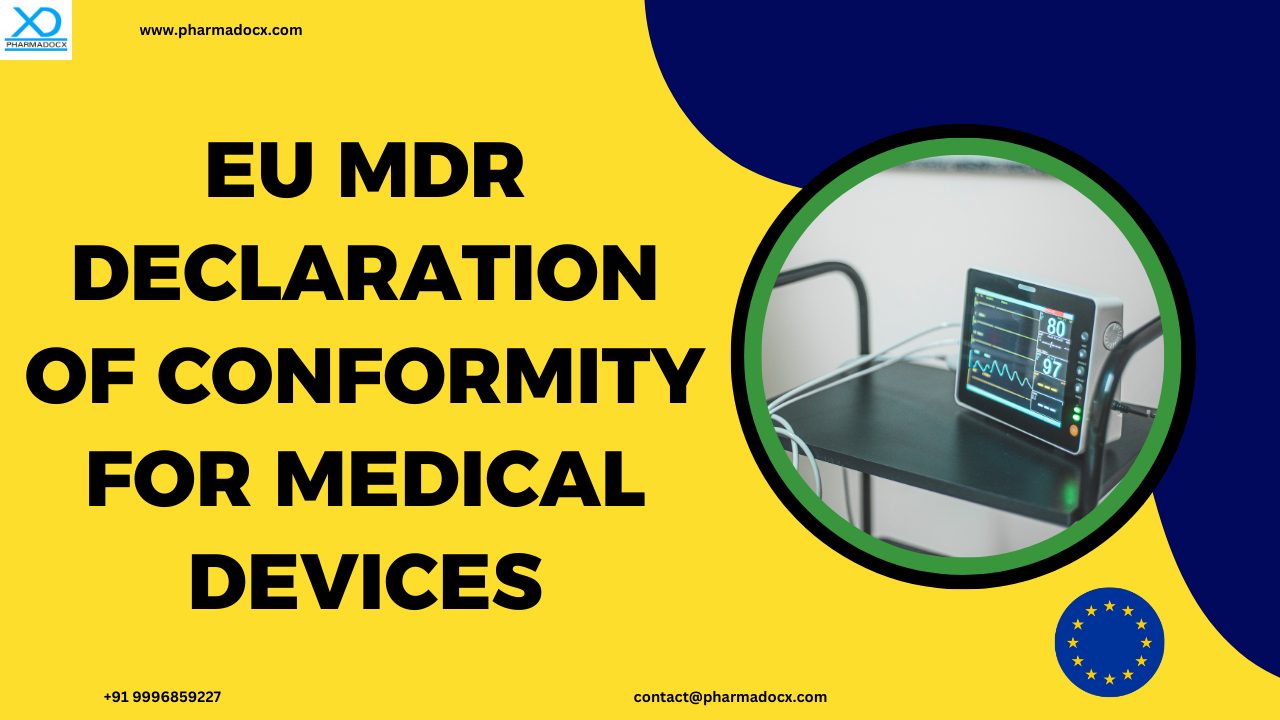
The EU MDR declaration of conformity (DoC) is a legally binding document required under EU medical device regulation (MDR). Every medical device manufacturer must issue the DoC before placing a device in the European market. It serves as the manufacturer’s formal statement of sole responsibility, confirming that the device complies with all applicable General Safety and Performance Requirements (GSPRs) of the MDR. The DoC must follow the standardized format in Annex IV. It must include key details, such as manufacturer information, basic UDI-DI, conformity assessment references, applied standards, and notified body certificates. Additionally, it should be signed by an authorized person. It is essential for CE marking and ensures traceability and regulatory oversight. Moreover, it must be kept up to date and translated into required EU languages.
Furthermore, the declaration of conformity should be readily available to competent authorities throughout the device’s lifecycle. Thus, the declaration of conformity (DoC) is important because it is the legal backbone of EU MDR compliance.
What is EU MDR declaration of conformity for medical devices?
The EU MDR declaration of conformity for medical devices is a mandatory legal document that confirms a medical device meets all applicable safety, performance, and regulatory requirements under MDR. It is the foundation for CE marking and EU market access, thereby ensuring accountability, traceability, and compliance throughout the device’s lifecycle. It must follow the structure outlined in Annex IV of MDR 2017 and be signed by the manufacturer’s authorized representative.
The declaration of conformity is a formal statement by the manufacturer declaring that the medical device meets all EU MDR requirements. It serves as proof of compliance during audits, inspections, and regulatory reviews.
8 Core requirements for EU MDR declaration of conformity
The core requirements are mentioned in the Annex IV of MDR. They establish the obligations manufacturers must meet when issuing a DoC.
- Legal obligation: Every manufacturer must draw up a DoC before placing a device on the EU market. The DoC is a legally binding statement of compliance.
- Format and structure: The EU MDR declaration of conformity must follow the Annex IV MDR template. The structure is standardized to ensure consistency across all manufacturer’s documents.
- Language requirement: The DoC must be translated into the official language(s) of the EU member state(s) where the device is being marketed.
- UDI requirement: It must include the Unique Device Identifier – Device Identifier (Basic UDI-DI) for the device family. This links the DoC to the EU’s EUDAMED database.
- Responsibility and signature: The DoC must be signed by the manufacturer (or authorized representative). The manufacturer bears sole responsibility for compliance.
- Availability: The DoC must be kept up to date and be made available to competent authorities upon request. For certain devices, it must also be accessible to the public (via EUDAMED).
- Integration with CE marking: The DoC is the legal foundation for affixing the CE mark. Without a valid DoC, CE marking is not permitted.
- Notified body involvement (if applicable): If conformity assessment requires a notified body, the DoC must reference the certificate number and notified body ID.
Contents of the declaration of conformity
The DoC must contain all of the following elements:
- Manufacturer information: Name, registered trade name/trademark, and if available, the Single Registration Number (SRN) under Article 31. Address of the registered place of business. If applicable, details of the authorized representative.
- Responsibility statement: A clear statement that the DoC is issued under the sole responsibility of the manufacturer.
- Product identification: Device name, model, and description need to be provided. The basic unique device identifier – device identifier (UDI-DI) as per Annex VI, Part C will be required. For systems or procedure packs (Article 22), the DoC must also align with UDI requirements.
- Conformity statement: Explicit declaration that the device complies with EU MDR will be required. Reference should be provided to other applicable EU legislation (if relevant).
- Standards and specifications: List of harmonized standards or common specifications applied has to be mentioned. This demonstrates conformity with essential safety and performance requirements.
- Notified body details (if applicable): Name and identification number of the notified body have to be provided. Additionally, certificate number(s) and scope of conformity assessment have to be provided.
- Place, date, and signature: The declaration of conformity must be signed by the manufacturer or authorized representative. Moreover, it must include the name and function of the signatory.
Why is the EU MDR declaration of conformity important?
The EU MDR declaration of conformity is the manufacturer’s formal binding statement that the medical device meets all applicable safety, performance, and quality requirements. It enables CE marking and market access in the European Union.
- Legal requirement for market access: Without a valid DoC, a medical device cannot be legally placed in the EU market. Hence, the DoC is the foundation for CE marking, which signals compliance with EU law.
- Manufacturer’s accountability: The DoC is issued under the sole responsibility of the manufacturer. It demonstrates that the company supports its device’s compliance with MDR 2017.
- Proof of compliance: The DoC serves as official evidence that the device meets General Safety and Performance Requirements (GSPRs). Regulators, notified bodies, and auditors rely on it during inspections and conformity assessments.
- Transparency and traceability: The DoC includes the basic UDI-DI, linking the device to the EU’s EUDAMED database. It ensures traceability across the supply chain and supports post-market surveillance.
- Risk management and patient safety: By requiring a DoC, the MDR enforces a risk-based approach to device design and manufacturing. This protects patients and healthcare providers by ensuring only compliant devices reach the market.
- Global recognition: The EU MDR DoC is widely recognised internationally. Thus, it strengthens the medical device manufacturer’s reputation and can support access to other regulated markets.
Consequences of not having a DoC
- Without a DoC, you will not be able to obtain CE marking. Hence, the device cannot be sold in the EU.
- Authorities may impose regulatory penalties, such as fines, recalls, or ban, in case of absence of DoC.
- Notified bodies will reject submissions without a compliant DoC. This will lead to audit failures.
- Even minor errors in the DoC can stall approvals. This will lead to market delays.
Best practices for preparation of declaration of conformity
- Use a clear structured template aligned with Annex IV of the EU MDR.
- Ensure consistency with technical documentation and CE marking.
- Keep the EU MDR declaration of conformity up to date whenever changes occur (e.g., new standards, design modifications).
- Maintain audit readiness of the documents. Regulators and notified bodies often request the DoC during inspections.
Pharmadocx Consultants will help you easily create EU declaration of conformity
Therefore, the EU declaration of conformity is the cornerstone of regulatory compliance for medical devices under MDR 2017. By affirming that a device meets all applicable safety, performance, and quality requirements, the DoC is essential for CE marking. Moreover, it ensures traceability through UDI and places the responsibility of accountability on the manufacturer.
We at Pharmadocx Consultants will support medical device manufacturers easily navigate the complexities of the EU MDR and help achieve regulatory success. Our expertise in regulatory affairs and declaration of conformity development can help you meet the EU MDR requirements efficiently and confidently. We will help you easily launch your products in the EU market while upholding the highest safety and performance standards. For assistance with creation and maintenance of the EU declaration of conformity, email at [email protected] or call/Whatsapp on 9996859227.