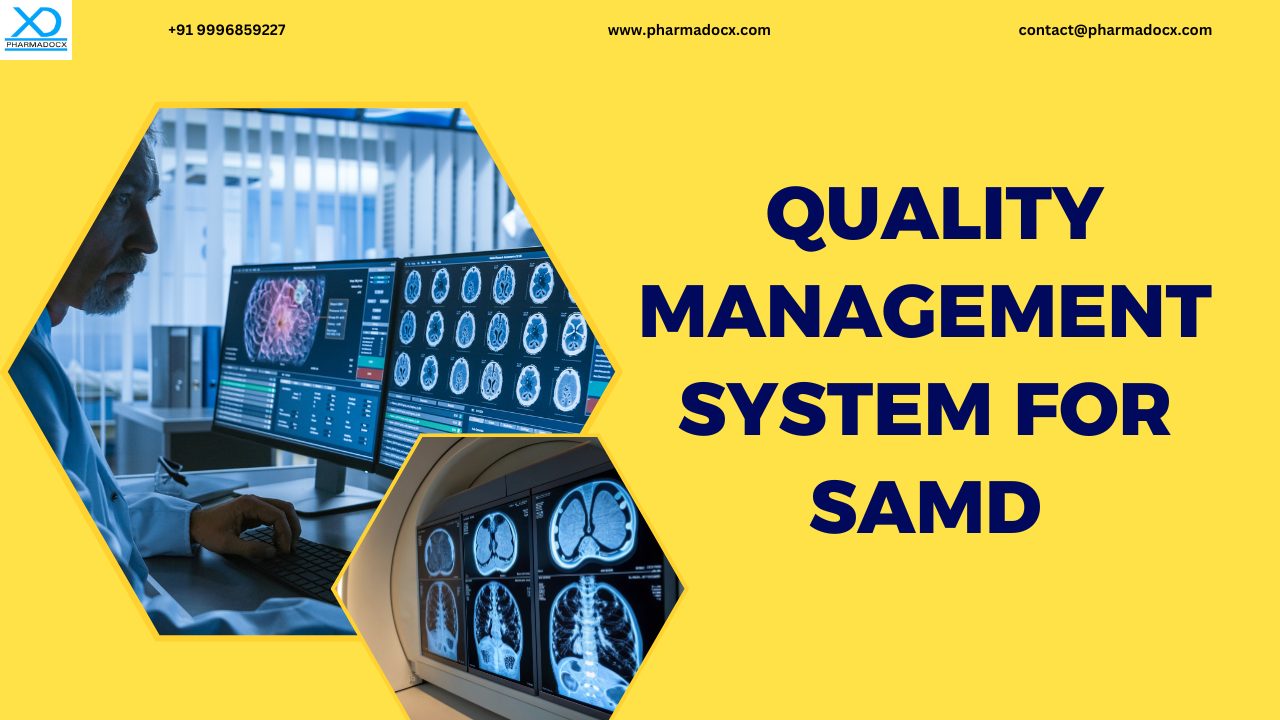
Software as a Medical Device (SaMD) refers to a software that is intended to be used for medical purposes. SaMDs are not part of a physical medical device. The software itself is regulated as a medical device, even though it runs independently on computers, smartphones, or cloud platforms. Quality management system for SaMD is a structured framework. It ensures the software is developed, validated, maintained, and monitored in compliance with global medical device regulations. QMS for SaMD focusses on patient safety, effectiveness, and cybersecurity. It adapts traditional medical device QMS principles (like ISO 13485) to the unique lifecycle of software. The emphasis is on design controls, risk management, and continuous updates.
What is SaMD?
Software as a Medical Device (SaMD) is a software that is intended to be used for medical purposes, such as diagnosis, prevention, monitoring, or treatment, without being part of a physical medical device. Unlike embedded software that controls hardware (like pacemaker firmware), SaMD operates independently on platforms, such as computers, smartphones, or cloud systems. The software itself is regulated as a medical device. As SaMD can directly impact patient health, global regulators, such as the FDA, EU MDR, and CDSCO, apply risk-based frameworks to ensure its safety, effectiveness, and cybersecurity. SaMD is central to digital health innovation. It plays a vital role in remote monitoring, telemedicine, and AI-driven diagnostics. However, SaMD raises challenges in data privacy, cybersecurity, and clinical validation, thereby making regulatory compliance critical.
Examples of SaMD
- Diagnostic apps: AI-powered software that analyzes medical images (like CT scans) to detect cancer.
- Monitoring tools: Apps that track heart rhythm or glucose levels using data from sensors.
- Decision support systems: Software that helps clinicians choose treatment options based on patient data.
- Digital therapeutics: Programs that deliver behavioral therapy for conditions, such as insomnia or depression.
What is quality management system for SaMD?
Quality management system for SaMD ensures that the software is developed, maintained, and monitored in a way that guarantees safety, effectiveness, and regulatory compliance. According to IMDRF guidance, QMS for SaMD rests on three core principles: leadership and organizational support, lifecycle support processes, and realization and use processes. Thus, these principles create a structured, risk-based framework that integrates quality into every stage of the SaMD lifecycle, enabling traceability, audit readiness, and patient safety.
Core focus areas of QMS for SaMD
We have highlighted the core focus areas of quality management system for SaMD.
- Regulatory alignment: The SaMD QMS must comply with ISO 13485 (medical device QMS standard) guidelines. FDA requires adherence to 21 CFR Part 820 (Quality System Regulation). EU MDR mandates QMS integration for SaMD for CE marking.
- Risk management: Apply ISO 14971 principles to identify, evaluate, and mitigate risks associated with SaMD. Special focus areas for software-specific risks are cybersecurity, data integrity, and algorithm bias.
- Design controls: Design control is a vital component of quality management system for SaMD. Documented requirements, architecture, coding standards, verification & validation should be covered under design control. Traceability should be from user needs, design inputs, outputs, testing to release.
- Lifecycle management: Continuous monitoring, updates, and patching form a part of lifecycle management. Post-market surveillance is necessary to capture adverse events and performance issues.
- Documentation and audit readiness: SOPs are required for development, testing, release, and maintenance. Evidence of validation, usability testing, and clinical evaluation will be necessary.
6 Key components of quality management system for SaMD
- Software development lifecycle (SDLC) is a structured, documented process
- Configuration management focuses on control versions and changes
- Verification and validation (V&V) ensure requirements are met
- Cybersecurity controls protect patient data and safety
- Post-market surveillance monitors performance and risks
- Competence and training of workforce on ISO 13485 and SaMD guidance
7 Benefits of a robust quality management system for SaMD
A robust QMS for SaMD delivers significant benefits that go beyond regulatory compliance.
- Patient safety and clinical effectiveness: A robust quality management system for SaMD ensures software is designed, validated, and maintained to minimize risks, protect patient data, and deliver reliable clinical outcomes.
- Regulatory compliance and market access: SaMD QMS facilitates approvals under FDA, EU MDR, CDSCO, and other frameworks by demonstrating adherence to ISO 13485, ISO 14971, guidelines. Hence, it is vital to gain market access.
- Audit readiness and transparency: It provides documented evidence of design controls, risk management, and post-market surveillance, thereby making inspections smoother and reducing nonconformities.
- Risk mitigation and cybersecurity: A QMS identifies and controls hazards, including clinical risks, algorithmic bias, and cybersecurity threats, through structured risk management processes.
- Operational efficiency and continuous improvement: It streamlines development with traceability, configuration management, and CAPA systems, thereby enabling faster iterations without compromising compliance.
- Trust and market confidence: A robust quality management system for SaMD builds credibility with regulators, clinicians, and patients, thereby fostering adoption of SaMD solutions in healthcare settings.
- Global scalability Harmonized QMS principles allow companies to expand across multiple jurisdictions with fewer redesigns or compliance gaps.
Thus, a strong QMS for SaMD ensures both safety and commercial success.
3 Key quality management system (QMS) principles for Software as a Medical Device (SaMD)
We have discussed the 3 key principles of quality management system for SaMD.
1. Leadership and organizational support
- Management responsibility: Senior leadership must establish quality objectives, allocate resources, and ensure compliance with regulatory requirements.
- Governance and accountability: Clear roles and responsibilities for SaMD development, maintenance, and post-market activities.
- Culture of quality: Encourage transparency, continuous improvement, and risk-based thinking across teams.
- Competence and training: Staff must be trained in both software engineering and medical device regulatory requirements.
2. Lifecycle support processes
These processes ensure that SaMD is developed and maintained in a controlled, traceable, and compliant manner. Hence, the lifecycle support processes is a vital principle of quality management system for SaMD.
- Planning and documentation: Define lifecycle stages, deliverables, and quality objectives.
- Risk management (ISO 14971): Identify hazards (clinical, technical, cybersecurity), assess risks, and implement mitigations.
- Document and record control: Maintain SOPs, design history files, and audit trails.
- Configuration and change management: Control versions, track changes, and ensure updates do not compromise safety.
- Supplier and outsourcing controls: Evaluate and monitor third-party software components or cloud services.
- Continuous Improvement: Use CAPA (Corrective and Preventive Actions) to address nonconformities and improve processes.
3. Realization and use processes
These are the operational processes that directly impact the design, development, and deployment of SaMD.
- Requirements management: Capture user needs, regulatory requirements, and clinical context.
- Design and development controls: Structure software development lifecycle with traceability from requirements, design, and implementation to testing.
- Verification and validation (V&V): Ensure software meets specifications and performs safely in real-world conditions.
- Deployment and release management: Controlled release processes, including cybersecurity checks and regulatory submissions.
- Maintenance and post-market surveillance: Monitor performance, collect feedback, and manage updates/patches.
- Incident and complaint handling: Systematic process for investigating and resolving adverse events or user complaints.
Why do these principles matter?
- They embed quality into every stage of the SaMD lifecycle.
- They ensure audit readiness for FDA, EU MDR, CDSCO, and other regulators.
- They balance agile software practices with regulatory rigor.
- They protect patients by ensuring safety, effectiveness, and cybersecurity resilience.
Therefore, a robust quality management system for SaMD is vital for safe, effective, and trusted digital health solutions. By embedding quality into leadership practices, lifecycle support processes, and realization activities, organizations can ensure that their SaMD products meet global standards, withstand audits, and adapt to evolving risks, such as cybersecurity. Thus, a well-structured QMS fosters continuous improvement, patient safety, and market confidence. Do you need help developing a robust and effective QMS for your SaMD? Well, look no further. You have landed in the right place. Drop an email at [email protected] or call/Whatsapp on 9996859227 and our team will be more than happy to guide you.