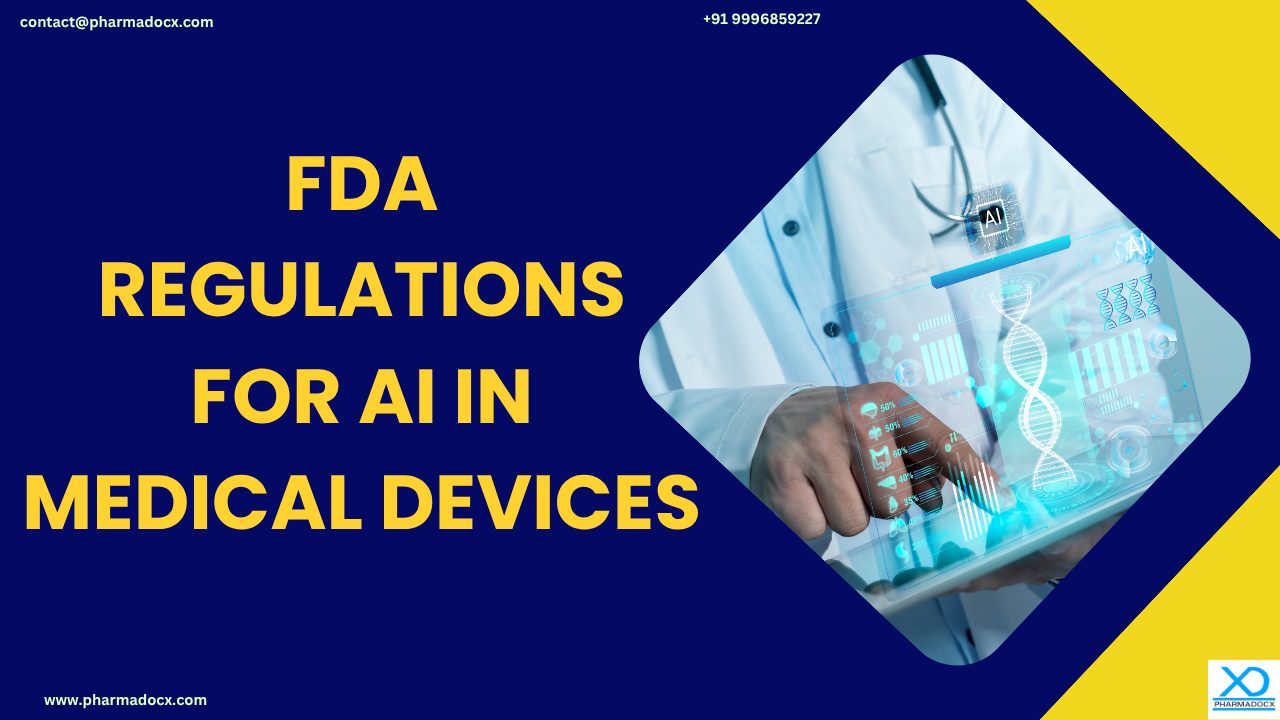
The FDA currently regulates AI in medical devices through existing pathways (510(k), De Novo, PMA). However, it has issued draft guidance and new discussion papers to address AI-specific risks, namely bias, transparency, and continuous learning. In this blog, we have discussed in details the FDA regulations for AI in medical devices.
FDA regulations for AI in medical devices are through its established premarket pathways. The applicable pathways are 510(k) for devices substantially equivalent to existing ones, De Novo for novel devices without predicates, and PMA for high‑risk Class III devices requiring robust clinical evidence. AI‑specific guidance emphasizes a Total Product Life Cycle (TPLC) approach. It requires manufacturers to document design, bias mitigation, transparency, and post‑market monitoring. For adaptive algorithms, the FDA allows predetermined change control plans to manage updates without repeated submissions. Most recently, the FDA has proposed a framework for generative AI devices. It focuses on competency‑based evaluation and continuous oversight. However, these remain under discussion. Thus, while AI devices follow the same regulatory pathways as traditional devices, they face added obligations around lifecycle risk management and transparency.
Beyond the traditional pathways, FDA imposes added obligations on AI-enabled devices. Manufacturers must implement bias mitigation strategies to ensure training datasets are representative and outputs are equitable. Additionally, they are required to maintain transparency in labeling and disclosures, making clear when results are AI-generated. Hence, adaptive algorithms must follow predetermined change control plans and undergo continuous postmarket monitoring to detect drift and safeguard patient safety.
Need for regulation of AI-based medical devices
- Regulation ensures patient safety, preventing harm from biased, inaccurate, or unpredictable AI outputs.
- It establishes trust and transparency, thereby requiring clear labeling and disclosure of AI’s role in clinical decisions.
- Oversight enforces quality and reliability, thereby mandating rigorous validation before devices reach the market.
- It provides a framework for adaptive algorithms, thereby ensuring updates and continuous learning do not compromise safety.
- Regulation supports accountability and postmarket monitoring, enabling detection of drift, adverse events, and long-term risks.
Core FDA regulations for AI in medical devices
- 510(k) premarket notification: The 510(k) pathway is the most common route for AI-enabled devices that are substantially equivalent to an already legally marketed predicate device. Manufacturers must demonstrate that the AI system performs safely and effectively in comparison to the predicate. This often has to be demonstrated through bench testing and limited clinical validation. This pathway is typically used for Class II devices and some Class I devices, thereby making it less resource-intensive than PMA. While clinical trials are not always required, the FDA may request additional evidence if the AI introduces novel risks. Example: An AI-powered ECG interpretation tool cleared by showing equivalence to an existing ECG analysis device.
- De novo classification: The De Novo pathway is designed for novel AI devices that have no predicate but present low to moderate risk. It allows manufacturers to establish a new device type and classification, which can later serve as a predicate for future 510(k) submissions. Evidence of safety and effectiveness is required, often including clinical validation studies tailored to the AI’s intended use. The FDA reviews risk controls, algorithm transparency, and bias mitigation strategies as part of the submission. Example: An AI dermatology app that identifies skin lesions for early detection of non-critical conditions, thereby creating a new device category.
- Premarket approval (PMA): PMA is the most stringent pathway. It is reserved for Class III AI devices that diagnose or treat critical, life-threatening conditions. It requires comprehensive clinical trial data, detailed design documentation, and proof of long-term safety and effectiveness. The FDA conducts an in-depth review of design controls, cybersecurity safeguards, and postmarket surveillance plans. This pathway is resource-intensive and time-consuming but ensures the highest level of patient safety. Example: AI software that diagnoses strokes from CT scans and directly informs emergency treatment decisions.
Additional FDA regulations for AI in medical devices
- Bias mitigation strategies: Manufacturers must demonstrate that training datasets are diverse and representative of the intended patient population to avoid discriminatory outputs. They are expected to conduct bias testing and validation studies, thereby showing that the algorithm performs consistently across demographic subgroups. Ongoing monitoring is required to detect emerging biases as new data is introduced postmarket.
- Transparency in labeling and disclosures: Device labeling must clearly state when outputs are AI-generated, including the role of the algorithm in clinical decision-making. The FDA requires explainability features so that clinicians can understand how the AI reached its conclusions. Transparency also extends to user instructions, ensuring healthcare providers know the limitations, confidence levels, and intended use of the AI system.
- Predetermined change control plans: For adaptive algorithms, manufacturers must submit a Predetermined Change Control Plan (PCCP) outlining the types of modifications expected after approval. This plan includes data management protocols, retraining triggers, and validation methods to ensure updates remain safe and effective. By approving the PCCP, the FDA allows certain algorithmic updates without requiring a new submission, thereby streamlining innovation while maintaining oversight.
- Continuous postmarket monitoring: AI devices must undergo real-world performance monitoring to detect drift, anomalies, or safety concerns. Manufacturers are expected to establish feedback loops with clinicians and patients for reporting adverse events and retraining needs. The FDA emphasizes lifecycle surveillance. Hence, compliance does not end at approval but requires ongoing vigilance to ensure sustained safety and effectiveness.
FDA’s TPLC approach for AI-enabled medical devices
The FDA’s Total Product Life Cycle (TPLC) approach for AI-enabled medical devices emphasizes oversight from design through postmarket use. This ensures safety and effectiveness across the entire lifespan of the product. It requires manufacturers to integrate risk management, bias mitigation, and transparency into the design and development phase, establish robust validation and documentation during premarket submission, and maintain predetermined change control plans for adaptive algorithms. Postmarket, the TPLC framework mandates continuous monitoring, adverse event reporting, and performance re-benchmarking. Thus, TPLC framework recognizes AI systems evolve over time and must be managed as living technologies rather than static devices. This holistic model shifts regulation from a one-time approval to an ongoing lifecycle responsibility.
Tips to comply with FDA regulations for AI in medical devices
We have provided some pro tips to help you comply with FDA regulations for AI in medical devices.
- Engage FDA early: Manufacturers should initiate pre-submission meetings with the FDA to clarify expectations for AI-specific risks and documentation. Early dialogue helps align development with regulatory requirements, thereby reducing costly redesigns later. It also builds trust with regulators, showing proactive commitment to patient safety and compliance.
- Prepare dual documentation: AI-enabled devices require both traditional safety/performance evidence and AI governance documentation. This means including algorithm design, training data sources, bias mitigation strategies, and explainability features. Dual documentation ensures regulators can evaluate both the medical and computational integrity of the device.
- Plan for adaptive updates: Adaptive algorithms must be supported by a Predetermined Change Control Plan (PCCP). This plan outlines how updates will be validated, monitored, and reported without requiring repeated submissions. It allows innovation while maintaining FDA oversight, thereby ensuring updates do not compromise safety.
- Monitor real-world performance continuously: Manufacturers must establish postmarket surveillance systems to detect drift, anomalies, or adverse events. Continuous monitoring includes clinician feedback loops, performance re-benchmarking, and retraining protocols. This ensures the AI remains reliable and effective in diverse, evolving clinical environments.
- Prepare for generative AI oversight: For devices using generative AI, manufacturers should anticipate stricter regulatory frameworks emerging by 2027–2028. These will probably include competency-based evaluations, transparency requirements, and ongoing revalidation. Preparing now with robust governance structures will ease future compliance and market entry.
We at Pharmadocx Consultants provide comprehensive US FDA consultation service covering 510(k), De Novo, and PMA. For assistance in complying with FDA regulations for AI in medical devices, email at [email protected] or call/Whatsapp on 9996859227.