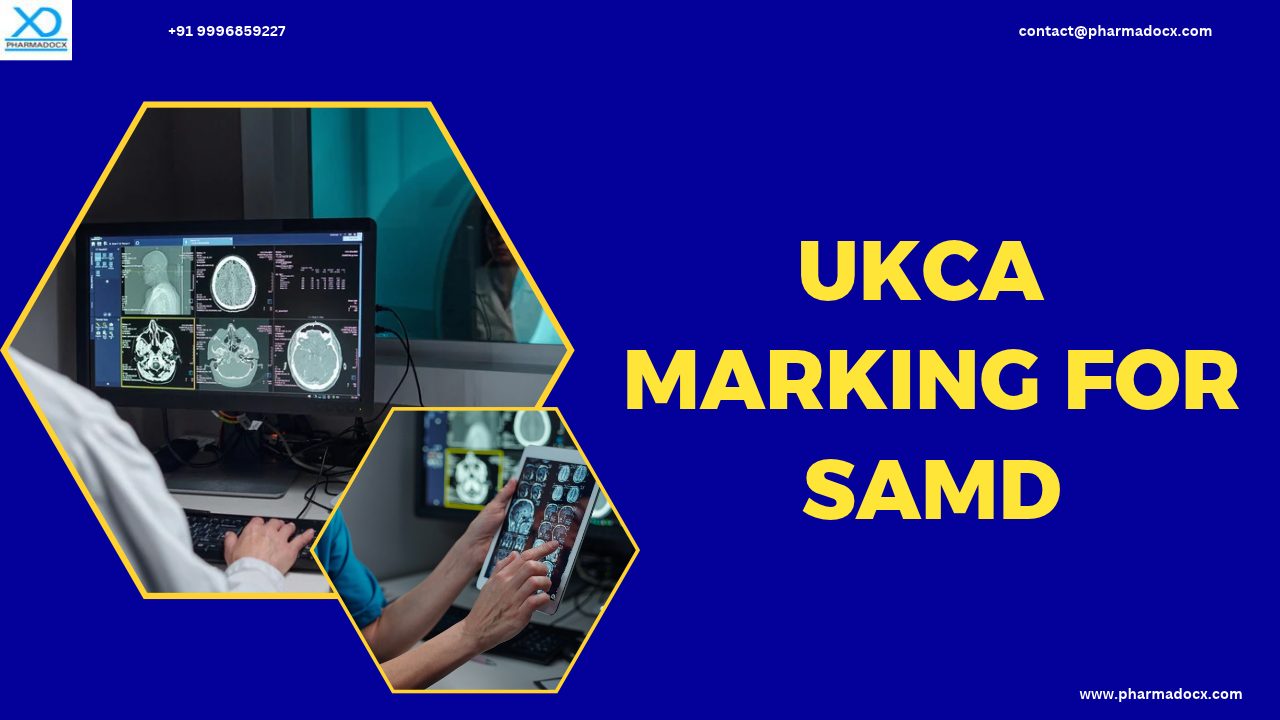
UKCA marking process for Software as a Medical Device (SaMD) requires manufacturers to follow UK MDR 2002 rules. The SaMD must undergo conformity assessment via a UK Approved Body. Additionally, it must be registered with the MHRA before placing the product on the Great Britain market. CE marking is still being temporarily accepted in UK. However, UKCA marking for SaMD is mandatory for long-term compliance.
What is SaMD under UKCA?
Under UKCA, Software as a Medical Device (SaMD) is defined as the software intended by the manufacturer to be used for one or more medical purposes, without being part of a hardware medical device. Thus, SaMD is a standalone software that diagnoses, prevents, monitors, or treats disease, injury, or disability. It is regulated as a medical device in its own right, not just an accessory. Apps, cloud-based tools, and AI-driven diagnostic platforms can all fall under SaMD. It must meet the UK Medical Devices Regulations 2002 (UK MDR 2002) essential requirements for safety, performance, and clinical benefit.
To be marketed in Great Britain, SaMD must undergo conformity assessment and bear the UKCA mark. CE marking is accepted until June 2028. However, UKCA is mandatory for long-term compliance. Registration with the MHRA is required before placing the SaMD in the market.
Requirements for UKCA marking for SaMD
- Classification under UK MDR 2002: SaMD must be classified according to the UK Medical Devices Regulations 2002, which mirror EU MDR rules but are enforced by the MHRA. The UKCA SaMD classification depends on the intended purpose, risk level, and potential impact on patient health. Notably, higher-risk classes (IIa, IIb, III) require stricter oversight and independent assessment.
- Conformity assessment: Manufacturers must undergo conformity assessment with a UK Approved Body for Class IIa and above devices. This process reviews technical documentation, clinical evidence, and compliance with ISO 13485 QMS. Notably, Class I devices may be self-certified if they are non-sterile and non-measuring.
- Technical documentation: A complete technical file must be prepared, covering software design, risk management, cybersecurity, and clinical evaluation. Documentation must demonstrate compliance with essential safety and performance requirements. The MHRA expects clear evidence of validation and verification across the software lifecycle.
- Quality management system (QMS): Manufacturers must implement a QMS aligned with ISO 13485. The system must cover design, development, production, and post-market activities. UK Approved Bodies audit the QMS to ensure consistent compliance and risk-based controls.
- UKCA marking and MHRA registration: Once conformity is achieved, the UKCA mark must be affixed before the SaMD is placed on the market. Manufacturers must register the device with the MHRA, providing classification, intended use, and conformity details.
- Post-market surveillance: Manufacturers must establish a robust post-market surveillance system to monitor device performance. This includes vigilance reporting, periodic safety updates, and corrective actions. From June 2025, enhanced surveillance obligations will apply, requiring proactive monitoring of SaMD in real-world use.
Class-wise requirements for UKCA SaMD marking
- Class I SaMD (low risk): Manufacturers can self‑certify compliance if the SaMD is Class I.They must prepare technical documentation showing intended use, risk analysis, and conformity with UK MDR 2002 essential requirements. Registration with the MHRA is mandatory before placing the software on the GB market.
- Class IIa SaMD (medium risk): Requires UK Approved Body involvement for conformity assessment. Technical documentation must include software lifecycle validation, cybersecurity controls, and clinical evaluation demonstrating safety and performance. A QMS compliant with ISO 13485 must be in place, covering design, development, and post‑market surveillance.
- Class IIb SaMD (higher risk): Full conformity assessment with a UK Approved Body is required. Manufacturers must provide robust clinical evidence, performance evaluation, and detailed risk management for the software’s impact on diagnosis or treatment. The QMS is audited comprehensively, thereby ensuring lifecycle management and vigilance systems are effective.
- Class III SaMD (highest risk): Extensive conformity assessment by a UK Approved Body is mandatory. Requires submission of clinical investigation data, strong post‑market surveillance plans, and detailed technical documentation. UKCA marking can only be affixed after rigorous review of QMS, clinical performance, and risk‑benefit justification.
UKCA marking process for SaMD
- Classify your SaMD: Determine the risk class (I, IIa, IIb, III) under UK MDR 2002.Most SaMD falls into Class IIa or higher due to its direct impact on patient safety. Classification defines the regulatory pathway and level of scrutiny. Misclassification can lead to rejection or penalties during audits. Always document the rationale for classification in your technical file.
- Appoint a UK responsible person: If you are based outside the UK, designate a UK Responsible Person (UKRP). The UKRP acts as your regulatory representative with the MHRA. They handle device registration, compliance communication, and vigilance reporting. Ensure the UKRP agreement is formalized and documented. Without a UKRP, non‑UK manufacturers cannot legally place SaMD on the GB market.
- Prepare technical documentation: Compile evidence of safety, performance, and clinical evaluation. Include software lifecycle validation, risk management, and cybersecurity measures. Documentation must align with UK MDR 2002 essential requirements. Maintain traceability of design inputs, outputs, and verification results. This file is the backbone of conformity assessment and must be audit‑ready.
- Undergo conformity assessment: Engage a UK Approved Body for Class IIa, IIb, and III SaMD. The Approved Body reviews your QMS, technical documentation, and clinical evidence. Class I SaMD may be self‑declared but only if truly low‑risk. The assessment ensures independent verification of compliance. Successful assessment results in certification needed for UKCA marking.
- Register with the MHRA: Submit device details, classification, and conformity certificates to the MHRA. Registration must be completed before placing SaMD on the GB market. The MHRA database ensures traceability and regulatory oversight. Keep registration records updated if device details change. Failure to register can result in enforcement action or market withdrawal.
- Issue UK Declaration of Conformity: Formally declare compliance with UK MDR 2002 requirements. The declaration must reference applicable standards and Approved Body certificates. Retain the declaration and supporting documents for audits. It serves as your legal statement of conformity. Regulators may request this document during inspections or investigations.
- Affix the UKCA mark: Place the UKCA mark visibly on packaging, documentation, or digital interface. The mark must be at least 5mm in height and proportionate. It signals compliance and allows lawful market access in Great Britain. Ensure the mark is not misleading or combined incorrectly with CE. Affixing the mark without proper conformity is a regulatory offence.
Pharmadocx Consultants: Your trusted support for easily securing the UKCA marking for SaMD
Therefore, the UKCA marking process for SaMD is a structured pathway designed to ensure that software intended for medical purposes meets the highest standards of safety, performance, and regulatory compliance in Great Britain. By correctly classifying the software, appointing a UK Responsible Person when required, preparing robust technical documentation, and undergoing conformity assessment, manufacturers establish a strong foundation for compliance. Registration with the MHRA, issuing a Declaration of Conformity, and affixing the UKCA mark are the final steps that legally enable market access. Beyond initial approval, ongoing post‑market surveillance and vigilance reporting are critical for maintaining patient safety and regulatory trust. Hence, these requirements form a lifecycle approach that not only secures compliance but also strengthens confidence in SaMD as a reliable tool in modern healthcare.
Drop an email at [email protected] or call/Whatsapp on 9996859227 to easily secure the UKCA marking for SaMD. We provide comprehensive UKCA mark service covering robust technical documentation and regulatory guidance.