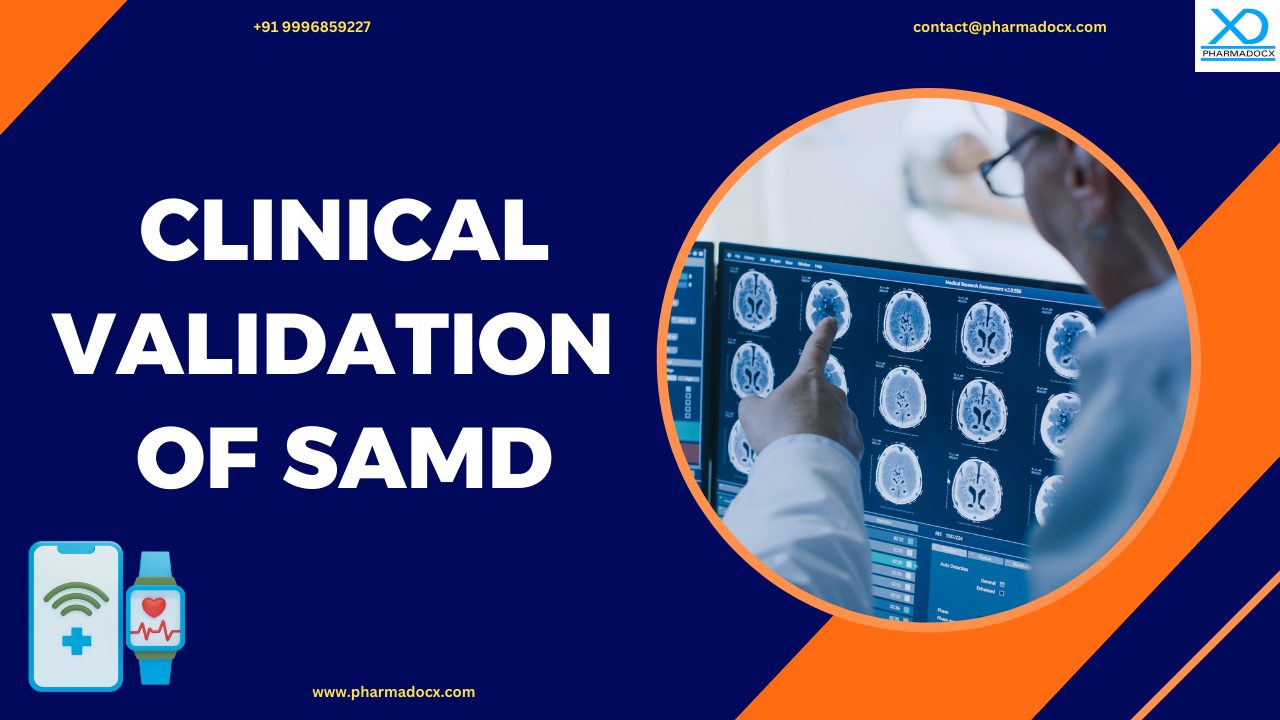

Software as a Medical Device (SaMD) is a software intended to be used for medical purposes without being part of a physical medical device. It can perform functions, such as diagnosing, preventing, monitoring, or treating diseases, by analyzing data and providing clinically relevant outputs. Unlike general wellness apps, SaMD must meet strict regulatory standards to ensure safety, effectiveness, and clinical validity. Regulators, such as the FDA, EU MDR, provide frameworks to evaluate and approve SaMD before it can be used in healthcare settings. Clinical validation of SaMD is the process of proving that the software delivers accurate, reliable, and clinically meaningful results for its intended medical purpose. It is based on real world clinical evidence. It ensures patient safety, effectiveness, and regulatory compliance.
What is clinical validation?
Clinical validation is the process of demonstrating, with real-world clinical evidence, that the device performs as intended in its target patient population and clinical setting. It goes beyond technical verification and analytical validation by proving that the device’s outputs are accurate, reliable, and clinically meaningful for healthcare decision-making.
Key elements of clinical validation
- Intended use confirmation shows that the device works safely and effectively for its claimed purpose (e.g., diagnosis, monitoring, therapy).
- Target population testing evidence must come from studies involving the actual patient groups the device is meant for.
- Clinical performance metrics validates sensitivity, specificity, predictive values, and usability in real-world practice.
- Regulatory bodies, such as FDA, EU MDR, CDSCO, and Health Canada, require clinical validation data in submissions for approval or clearance.
Why does clinical validation matter?
- For patients: Builds trust that the diagnosis and treatment outputs are evidence-based, reducing risk of misdiagnosis or ineffective treatment.
- For clinicians: Builds trust in device outputs for diagnosis/treatment.
- For hospitals: Prevents revenue loss from claim denials and ensures compliance.
- For regulators: Confirms that medical devices and diagnostics are safe, effective, and clinically relevant.
Clinical validation of SaMD
Clinical validation of SaMD is the process of demonstrating, with clinical evidence, that the software achieves its intended medical purpose safely and effectively in the target patient population. It goes beyond technical accuracy to prove that the SaMD’s outputs are clinically meaningful, reliable, and improve diagnosis, treatment, or patient outcomes in real-world settings. This involves showing valid clinical association, analytical performance, and clinical utility. Real world studies or real-world evidence is necessary. Clinical validation of SaMD is a critical requirement under global regulatory frameworks to ensure patient safety and trust in digital health technologies.
Thus, clinical validation demonstrates that the SaMD achieves its intended clinical purpose in the target patient population under real-world conditions. It goes beyond technical/analytical validation (which checks algorithms and performance) to confirm clinical utility that the software improves diagnosis, treatment, or patient outcomes.
Evidence required
- Clinical studies: Prospective or retrospective trials, observational studies, or real-world evidence are required to prove clinical validation of SaMD.
- Comparator benchmarks: Gold-standard diagnostic tools or clinician judgment are necessary.
- Population fit: Validation must reflect the intended patient group (age, disease severity, comorbidities).
- Endpoints: Outcomes, such as sensitivity, specificity, predictive value, or patient health improvements, are considered as endpoints.
3 core elements of clinical validation of SaMD
The following three core elements form the backbone of clinical validation of SaMD:
1. Clinical association: Clinical association demonstrates that the SaMD’s output is clinically relevant to the intended medical condition, disease, or physiological state. It ensures the software is built on sound medical evidence and its results matter in a healthcare context.
Example: A SaMD that detects diabetic retinopathy must show that its image analysis correlates with established diagnostic criteria for the disease.
2. Analytical performance: Analytical performance confirms the SaMD processes input data correctly, consistently, and accurately to generate its output. It ensures the algorithm or software logic is technically reliable and free from systematic errors.
Example: Testing whether an ECG analysis app consistently identifies arrhythmias with high sensitivity and specificity compared to a cardiologist’s interpretation.
3. Clinical utility: Clinical utility demonstrates that the SaMD provides areal-world clinical benefit. It improves decision-making, patient outcomes, or healthcare processes. It shows that the software is not just accurate, but also useful in practice.
Example: A SaMD that guides cancer treatment must prove that its recommendations lead to better patient outcomes compared to standard care.
Thus, the clinical validation process collectively functions as follows:
- Clinical association: Is the output medically meaningful?
- Analytical performance: Is the output technically accurate?
- Clinical utility: Does the output improve patient care?
Hence, the clinical validation process ensures the SaMD is safe, effective, and trusted in clinical practice.
Practical examples of clinical validation
We have provided the following examples highlighting how SaMD clinical validation is not just about proving the algorithm works but about showing real-world medical benefit.
AI-powered radiology SaMD
- Clinical association: The software is designed to detect lung nodules in chest CT scans, a clinically relevant marker for lung cancer.
- Analytical performance: Validation studies compare the algorithm’s detection accuracy against radiologists’ readings, showing high sensitivity and specificity.
- Clinical utility: A prospective clinical trial demonstrates that radiologists using the SaMD detect more early-stage nodules, leading to earlier interventions and improved patient outcomes.
Digital ECG analysis SaMD
- Clinical association: The SaMD interprets ECG signals to identify atrial fibrillation (AF), a condition linked to stroke risk.
- Analytical performance: Benchmarked against cardiologist interpretations, the software consistently identifies AF episodes with >95% accuracy.
- Clinical utility: Clinical validation in outpatient settings shows that patients monitored with the SaMD receive earlier diagnoses and timely anticoagulant therapy, thereby reducing stroke incidence compared to standard care.
Challenges and risks
- Dynamic algorithms: AI/ML-based SaMD may evolve, thereby requiring ongoing clinical validation of SaMD.
- Data quality: Bias in training datasets can undermine clinical relevance.
- Generalizability: Validation in one population may not apply globally.
- Regulatory scrutiny: Inadequate validation can lead to rejection of submissions or post-market recalls.
5 best practices for clinical validation of SaMD
- Align validation with intended use: Clearly define the clinical purpose, target population, and intended context of use before designing validation studies. Ensure evidence directly supports the claims made in regulatory submissions.
- Use risk-based evidence generation: The level of validation required will depend on the risk class of the SaMD. Higher-risk SaMD requires stronger, prospective clinical studies, while lower-risk may rely on retrospective or real-world data.
- Ensure representative patient populations: Validate in the actual patient groups where the SaMD will be used (age, disease severity, comorbidities, geography). Avoid bias by including diverse datasets to ensure generalizability across populations.
- Benchmark against clinical standards: Compare SaMD outputs against gold-standard diagnostics, clinician judgment, or established clinical endpoints. Use metrics like sensitivity, specificity, predictive values, and clinical outcome improvements to demonstrate validity.
- Maintain continuous validation: Treat validation as an ongoing process, especially for AI/ML-based SaMD that evolve over time. Implement post-market surveillance, real-world performance monitoring, and periodic re-validation to ensure sustained safety and effectiveness.
Clinical validation of SaMD ensures the SaMD is not only technically sound but also clinically meaningful and beneficial for patient care. By establishing valid clinical association, demonstrating robust analytical performance, and proving real-world clinical utility, developers and regulators can confirm that the SaMD delivers safe, effective, and reliable outcomes. This process safeguards patients, builds clinician confidence, and supports regulatory approval. Additionally, it also lays the foundation for ongoing monitoring and improvement as technologies evolve. Need help with ensuring regulatory compliance for your SaMD and launching it in a regulated market? Drop an email at [email protected] or call/Whatsapp on 9996859227 to hire our team of experts.