
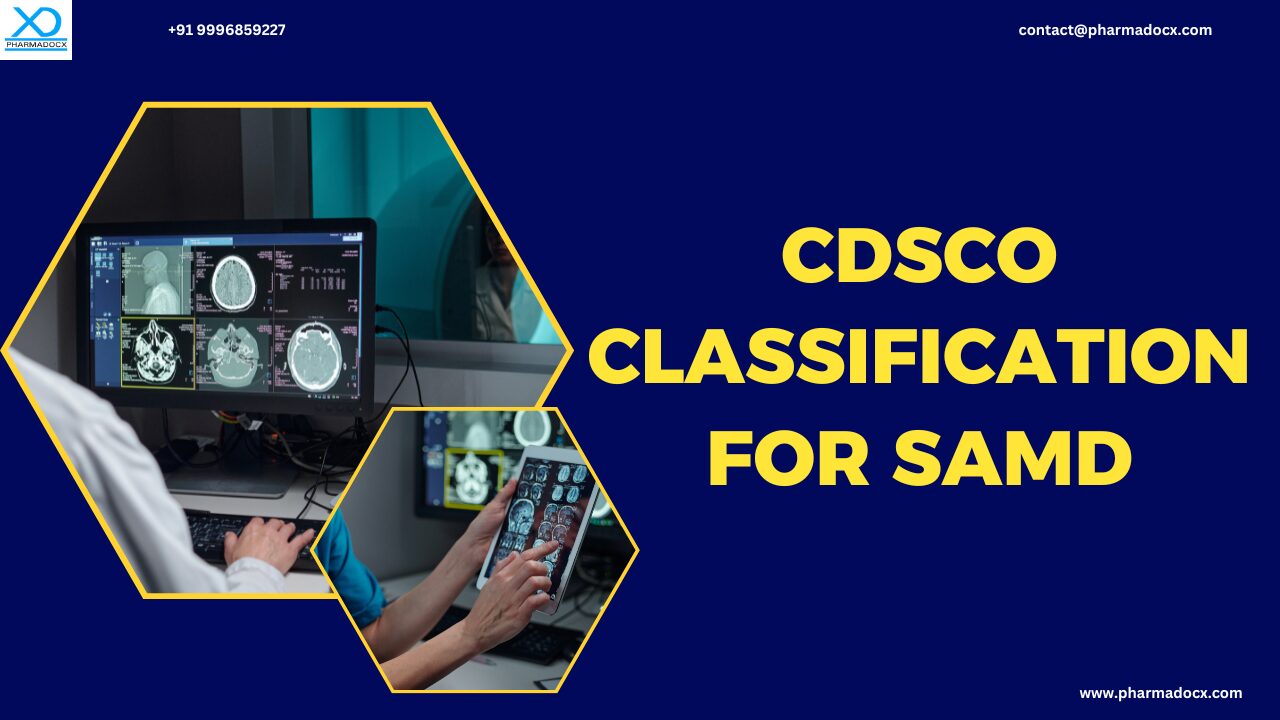
Currently, software is being used a medical device in the healthcare sector. These Software as a Medical Device (SaMDs) are used to diagnose diseases as well as decide the course of treatment. Hence, it is crucial to verify that the software performs as intended to minimize malfunctions that could harm patients. Moreover, the ability of the software to safeguard patient information and maintain privacy needs to be verified. Central Drugs Standard Control Organization (CDSCO) stringently regulates all SaMDs in India. Therefore, securing the CDSCO license for SaMD is a mandatory requirement for marketing your product in India. The CDSCO license required will depend on the CDSCO SaMD class. Hence, in this blog, we have prepared a detailed guide on CDSCO classification for SaMD.
What is SaMD?
Software as a Medical Device (SaMD) refers to standalone software that is intended to be used for medical purposes without being part of a physical medical device. It is recognized globally by regulators, such as the FDA, as a distinct category of medical device software, with its own compliance and validation requirements. SaMD is central to digital health innovation, enabling AI-driven diagnostics, remote monitoring, and personalized medicine. For patients, SaMD expands access to care, especially in India where mobile health solutions are rapidly growing. Unlike embedded software (SiMD), SaMD runs independently on general-purpose platforms (PCs, smartphones, cloud systems) but still qualifies as a medical device because of its intended use. SaMD has a vital role in lowering barriers to healthcare access.
Applications of SaMD
- Diagnosis: SaMD can analyze clinical data, such as medical images, lab results, or patient records, to identify potential diseases or conditions. It often uses algorithms or AI models to detect abnormalities faster than traditional methods. Hence, SaMD supports clinicians by improving accuracy and reducing diagnostic delays.
- Monitoring: SaMD can continuously track patient health metrics, such as heart rate, glucose levels, or respiratory patterns, often through connected sensors. It provides real-time alerts or reports to patients and healthcare providers. This enables proactive intervention and better management of chronic or high-risk conditions.
- Treatment support: SaMD can guide or deliver therapeutic interventions, such as digital therapeutics for mental health or rehabilitation programs. It may provide personalized treatment plans based on patient data and clinical guidelines. Hence, it enhances patient engagement and ensures consistency in therapy delivery.
- Clinical decision support: SaMD can process complex datasets to recommend treatment options, drug dosages, or care pathways. Moreover, it assists healthcare professionals in making evidence-based decisions by reducing uncertainty. Thus, it is critical for optimizing patient outcomes and minimizing medical errors.
To launch a SaMD manufacturing or import business in India, you need to have a CDSCO license for SaMD. The first step to procuring the CDSCO SaMD license is to understand the CDSCO classification for SaMD. This blog will dive deep into the CDSCO SaMD classification system.
CDSCO classification for SaMD
To apply for a CDSCO license for SaMD, you need to understand the CDSCO classification for SaMD. CDSCO has classified medical devices into four classes based on the associated risk level. This classification system has been developed to simplify the CDSCO medical device license application process. The CDSCO medical device class will determine the CDSCO license required and the application process. To register a SaMD in India, CDSCO has developed a similar risk-based classification system. The four CDSCO risk-based classes are as follows:
- Class A: Class A medical devices are low risk devices
- Class B: Class B medical devices are low-to-moderate risk devices
- Class C: Class C medical devices are moderate-to-high risk devices
- Class D: Class D medical devices are high risk devices.
CDSCO classification for SaMD: CDSCO SaMD class-wise examples
CDSCO SaMD Class A
The Class A SaMD does not directly interfere with patient data. It is a software that retrospectively analyses pre-recorded clinical data of patients. Examples:
- Ataxiagraph with interpretive software
- Continuous glucose monitor retrospective data analysis software
CDSCO SaMD Class B
The Class B SaMD generates real time patient information based on patient’s parameters. Examples:
- Multivariate Vital Signs Index Software
- Electrocardiograph Software for home use
- Photoplethysmograph Analysis Software for home use
- Diagnostic Software, K- Nearest Neighbor Algorithm, Autoimmune Disease
- Colon Computed Tomography System, Computer Aided Detection Software
- Lung Computed Tomography System, Computer- Aided Detection Software
- Chest X-Ray Computer Aided Detection Software
- Radiological Computer Assisted Detection/diagnosis Software For Fracture
- Insulin Pump Secondary Display Software
- X-Ray Angiographic Imaging-Based Coronary Vascular Simulation Software Device
- Automated Radiological Image Processing Software
- Image Acquisition and/or Optimization Guided By Artificial Intelligence
- Software for public thoracic and abdominal health screening diagnostic X- ray system
- Software for visual evoked response stimulator
- Software for auditory evoked response stimulator
- Software for pulmonary exercise stress monitoring system
- Software for ECG recorder with real-time analysis
- Software for film-recorded digital radiography
- Software for dye dilution cardiac output calculator
- Analyzing software for hemodynamics or cardiac function
- Supporting software for root canal treatment
- Chairside dental CAD/CAM unit
- Software for using with mammography- combined diagnostic X- ray system
- Software for urodynamic measurement system
- Software for vestibular function caloric stimulator
- Supporting software for external fixators treatment plan
- Diagnostic supporting software for diabetes
CDSCO SaMD Class C
The Class C SaMD can be used to diagnose diseases and analyse patient’s physiological and physical activity. Examples:
- Angiographic Coronary Vascular Physiologic Simulation Software
- Software For Visualization Of Vascular Anatomy And Intravascular Devices
- Orthodontic Software
- Dental Abutment Design Software For Dental Laboratory
- Neuropsychiatric Interpretative Electroencephalograph Assessment Aid
- Normalizing Quantitative Electroencephalograph Software
- Index- Generating Electroencephalograph Software
- Source Localization Software For Electroencephalograph or Magnetoencephalograph
- Automatic Event Detection Software For Polysomnograph With Electroencephalograph
- Automatic Event Detection Software For Full-Montage Electroencephalograph
- Supporting software for differential diagnosis with endoscopic imaging
- Ventilator, software
- Software for peritoneal dialysis treatment
- Software for radiation planning
- Software for radiotherapy QAQC planning
- Software for ophthalmic surgery treatment planning
- Software for active implanted device control
- Information collating software for radiotherapy
- Software for gene variants analysis (for cancer genome profiling)
- Brain Injury Adjunctive Interpretive Oculomotor Assessment Aid
- Diabetic Retinopathy Detection Device
- Computer- Assisted Diagnostic Software For Lesions Suspicious For Cancer
- Burn Resuscitation Decision Support Software
- Software, Similarity Score Algorithm, Tissue Of Origin For Malignant Tumor Types
- Device, Fertility Diagnostic, Contraceptive, Software Application
CDSCO SaMD Class D
CDSCO has not yet classified any software as high risk.
We have provided an overview of the CDSCO classification for SaMD. You can use our free tool to check which class your SaMD belongs to.
CDSCO license for SaMD
Different classes of SaMD require different CDSCO medical device licenses. We have already detailed the different CDSCO SaMD classes. The CDSCO SaMD class will determine the license type and application process.
CDSCO license for manufacturing SaMD in India
- To manufacture Class A and Class B Software as Medical Device (SaMD) in India, CDSCO MD 5 license must be secured from the state licensing authority.
- To manufacture Class C and Class D Software as Medical Device (SaMD) in India, CDSCO MD 9 license must be secured from the central licensing authority.
CDSCO license for importing SaMD into India
To import Software as Medical Device (SaMD) into India, CDSCO MD 15 has to be secured from the central licensing authority.
In this blog, we have provided a detailed overview of the CDSCO classification for SaMD. For any queries regarding the classification system feel to drop an email at [email protected] or call/Whatsapp on 9996859227. Additionally, we will help you easily secure the CDSCO license for SaMD. We provide license application, document preparation, and CDSCO query response support.