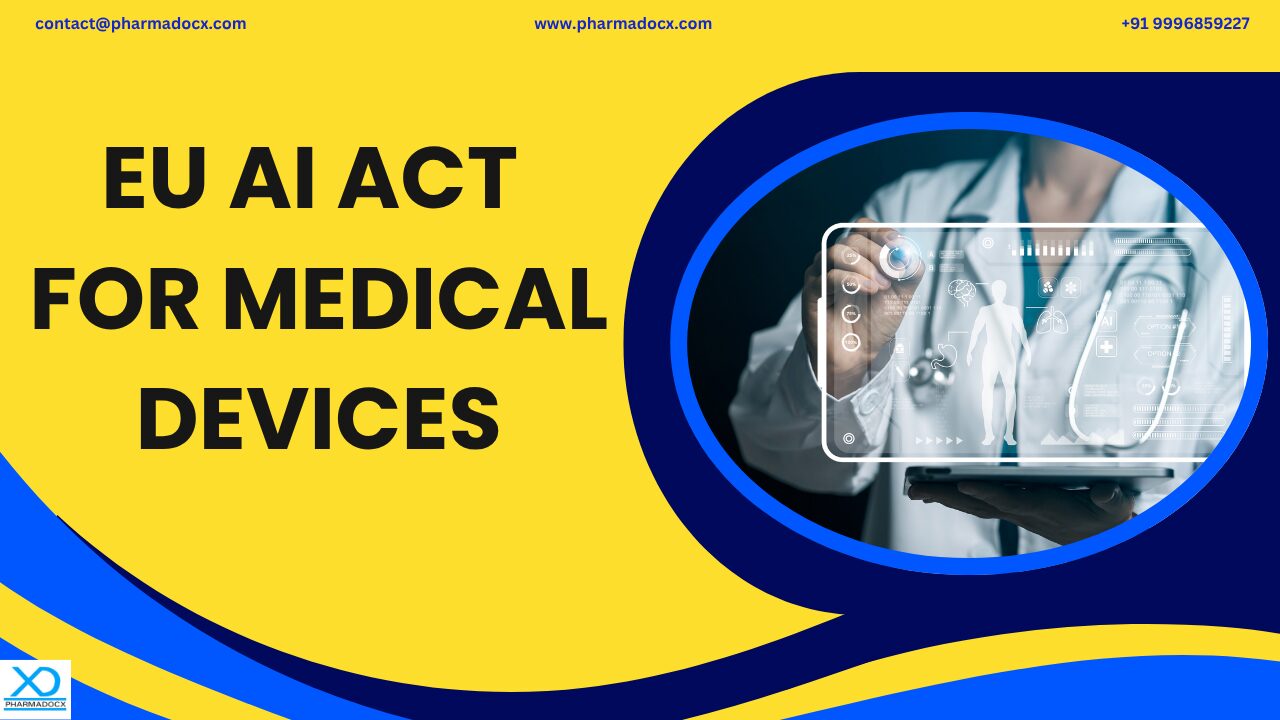
The EU AI Act introduces a new compliance layer for AI-enabled medical devices in Europe. It requires manufacturers to meet both EU MDR/IVDR and AI Act obligations. High-risk AI medical devices must now address AI-specific requirements, such as data governance, risk management, human oversight, transparency, and post-market monitoring. Additionally, these devices have to comply with traditional device safety and performance standards. Thus, manufacturers are required to begin preparations to comply with EU AI Act for medical devices. They will have to classify AI components, extend ISO 13485-compliant QMS to cover AI-specific procedures, and update surveillance plans. These steps are necessary as notified bodies are already raising AI-related questions during audits. Hence, compliance would mean double documentation, increased regulatory workload, and the need for early integration of AI governance. This will ensure smooth CE marking and EU market access.
What is the EU AI Act for medical devices?
The EU AI Act is Europe’s first comprehensive legal framework for artificial intelligence. For medical devices, it creates a dual compliance framework: manufacturers must meet both MDR/IVDR requirements and AI-specific obligations. AI-enabled medical devices are automatically classified as high-risk systems, thereby triggering strict rules on data governance, transparency, human oversight, risk management, and post-market monitoring.
What the EU AI Act means for medical devices?
- Scope: EU AI Act for medical devices applies to AI-powered medical devices (diagnostic imaging software, SaMD with ML, surgical planning tools, patient monitoring systems). On the other hand, it does not apply to non-AI devices. Only MDR/IVDR is applicable to non-AI devices.
- High-risk classification: Any AI system that is a medical device or a safety component of one is automatically considered high-risk. This includes diagnostic imaging AI, SaMD with machine learning, patient monitoring tools, and decision-support systems.
- Dual regulation: Dual regulation under the EU AI Act means that AI-enabled medical devices must comply with two separate but overlapping frameworks. First, the EU MDR/IVDR ensures device safety, clinical performance, and risk management through traditional medical device conformity assessments. Second, the EU AI Act imposes AI-specific obligations, such as data governance, transparency, human oversight, and continuous monitoring of algorithmic performance. This dual regulation will require manufacturers to maintain parallel technical documentation. One set will be required for MDR/IVDR and another for AI Act compliance. This will create additional regulatory workload. Notably, notified bodies will evaluate both aspects during audits. This implies manufacturers must integrate AI governance into their quality management systems to avoid delays in CE marking and EU market access.
5 Key obligations under EU AI Act for medical devices (Beyond EU MDR)
- Data governance: Manufacturers must ensure that training, validation, and testing datasets are of high quality, representative, and free from bias. This means documenting how data was collected, cleaned, and validated to avoid discriminatory or inaccurate outputs. Strong data governance reduces risks of unreliable AI predictions and strengthens clinical trust in the device.
- Risk management: AI-specific risks, such as data drift, model degradation, and bias, must be integrated into the device’s ISO 14971 risk management framework. Manufacturers need to identify, evaluate, and mitigate these risks throughout the lifecycle of the AI system. Continuous risk assessment ensures that evolving AI models remain safe and effective in real-world use.
- Human oversight: The EU AI Act for medical devices requires that clinicians or users can review, question, and override AI-generated outputs. This prevents blind reliance on algorithms and ensures that medical decisions remain under human control. Clear instructions and interfaces must be provided so users understand when and how to intervene.
- Transparency: Users must be informed when results are generated by AI, including the system’s limitations and intended use. Documentation should explain how the AI works in plain language, avoiding technical jargon that could confuse healthcare professionals. Transparency builds trust and ensures responsible adoption of AI in clinical workflows.
- Post-market monitoring: Manufacturers must track AI performance continuously after market entry and not just device safety incidents. This involves monitoring for model drift, unexpected outputs, and real-world effectiveness across diverse patient populations. Post-market AI surveillance ensures ongoing compliance and protects patients as algorithms evolve over time.
Practical impact on manufacturers
- Double documentation burden: Companies must maintain parallel technical files: one for MDR/IVDR compliance and another for AI Act obligations. This increases workload and requires cross-functional collaboration between regulatory, technical, and quality teams.
- Audit pressure: Notified Bodies are already probing AI-related aspects during MDR audits. Hence, manufacturers cannot wait to prepare. Early integration of AI governance into QMS is essential to avoid audit findings and delays in CE marking.
- QMS expansion: ISO 13485 systems must be extended with AI-specific SOPs covering data governance, bias control, human oversight, and continuous monitoring. Without this, manufacturers risk gaps that could block certification.
- Market access risks: Non-compliance can lead to fines, suspension of CE marking, or outright denial of EU market entry. This makes proactive compliance a commercial necessity and not just a regulatory checkbox.
- Strategic timing: Manufacturers who start now will be better positioned to handle audits under EU AI Act for medical devices. This will reduce last-minute compliance costs and maintain uninterrupted EU market access.
Risks and challenges
Risks and challenges manufacturers face under the EU AI Act for medical devices:
- Audit readiness pressure: Notified Bodies are already asking AI-related questions during MDR audits. Companies that delay preparation risk non-conformities and certification delays.
- Documentation overload: Dual regulation means maintaining separate technical files for MDR/IVDR and AI Act compliance. This increases complexity and requires more resources for regulatory teams.
- QMS gaps: ISO 13485 alone does not cover AI-specific obligations, such as bias control or continuous monitoring. Without extending QMS, manufacturers risk audit findings and compliance failures.
- Market access risks: Non-compliance can lead to fines, suspension of CE marking, or denial of EU market entry. This makes compliance with EU AI Act for medical devices a commercial survival issue.
Recommendations for manufacturers
- Start early: Manufacturers should begin compliance preparation now. Early action reduces last-minute costs and ensures smoother audits.
- Integrate AI governance into QMS: Extend ISO 13485 systems with AI-specific SOPs covering data governance, bias control, human oversight, and continuous monitoring. This ensures readiness for dual conformity assessments.
- Conduct gap analysis: Compare existing MDR/IVDR technical files with AI Act requirements to identify missing documentation. This helps prioritize updates and resource allocation.
- Train teams: Educate regulatory, technical, and quality staff on AI Act obligations. Building internal competence strengthens audit resilience.
- Engage notified bodies early: Proactively discuss AI compliance during MDR audits to align expectations and avoid surprises. This builds trust and demonstrates preparedness.
- Monitor regulatory updates: Track evolving guidance from the European Commission. Staying updated ensures timely adjustments to compliance strategies.
- Strategic planning: Treat AI Act compliance as part of long-term market access strategy. Align product development, documentation, and surveillance systems with both EU MDR/IVDR and EU AI Act requirements.
Therefore, EU AI Act introduces a new compliance layer for AI-enabled medical devices in Europe. On one hand, they must continue to meet the stringent requirements of MDR/IVDR for safety, performance, and clinical validation. On the other, they must now comply with AI-specific obligations around data governance, transparency, human oversight, and continuous monitoring. This dual regulatory pathway means parallel documentation, expanded QMS procedures, and heightened audit scrutiny. Notably, all of these significantly increase regulatory workload. For companies, the challenge is not just regulatory, it is strategic. Failure to integrate compliance with EU AI Act for medical devices early could jeopardize CE marking and EU market access. Drop an email at [email protected] or call/Whatsapp on 9996859227 for assistance with EU MDR compliance and CE marking certification.