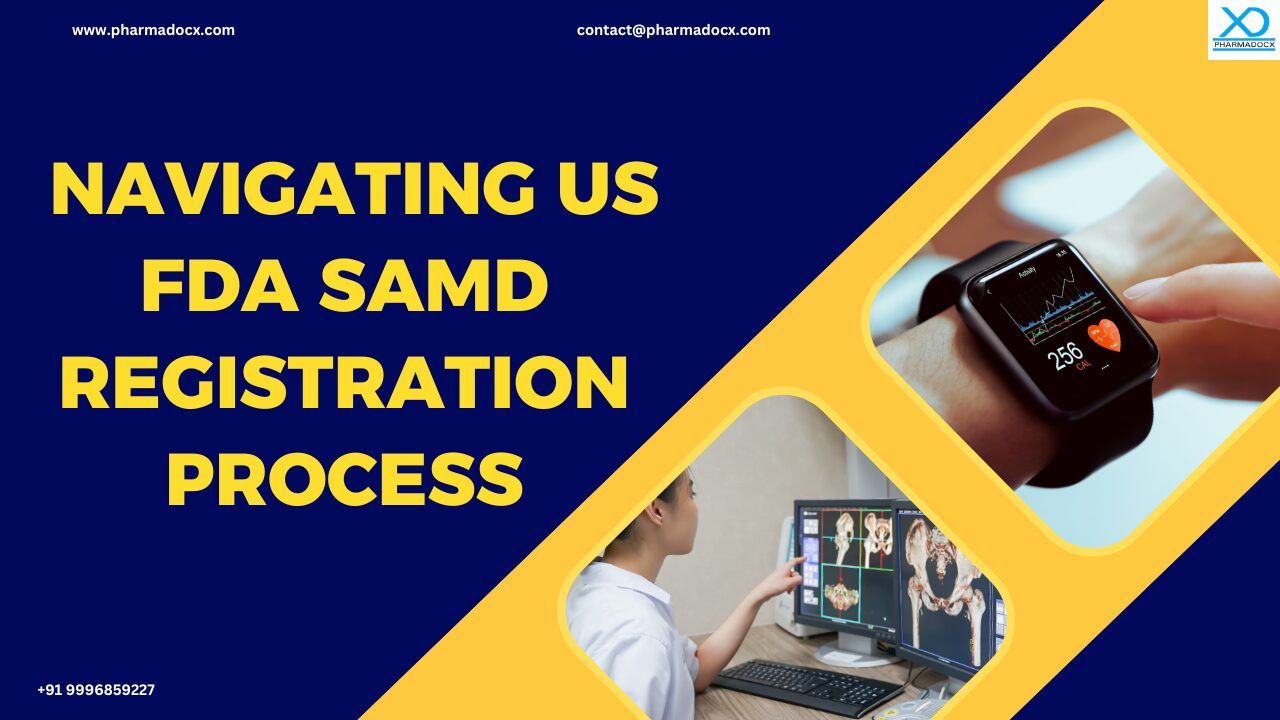
FDA requires SaMD registration to ensure that standalone medical-purpose software is safe, effective, and legally marketable in the United States. Registration is not just a formality. It establishes credibility, aligns product claims with regulatory expectations, and provides a pathway for market authorization. In this blog, we have prepared a detailed guide to help you easily navigate the US FDA SaMD registration process.
What is the US FDA definition for SaMD?
According to the US FDA, Software as a Medical Device (SaMD) is defined as a software intended to be used for one or more medical purposes. It should perform these purposes without being part of a hardware medical device. Thus, SaMD is a standalone software with a medical purpose not embedded in or essential to the functioning of a physical medical device. US FDA SaMD registration is mandatory to launch your product in the US.
Examples: Diagnostic apps analyzing medical images (e.g., MRI scans), Computer-Aided Detection (CAD) software for cancer screening, Treatment planning software that provides input for radiation therapy devices.
Thus, FDA recognizes SaMD as standalone medical-purpose software, distinct from device-embedded software. It regulates SaMD under a risk-based framework emphasizing safety and effectiveness.
What is the need for US FDA SaMD registration?
- Legal market authorization: US FDA SaMD registration is mandatory before the software can be marketed or sold in the United States. Without registration, the product is considered unauthorized and may face enforcement actions, such as recalls or penalties. This ensures that only validated and approved medical software reaches patients and healthcare providers.
- Patient safety and risk management: Registration requires manufacturers to demonstrate that the software is safe, effective, and clinically validated. It ensures that risks, such as inaccurate diagnoses, cybersecurity vulnerabilities, or data misinterpretation, are addressed before release. This protects patients from harm and builds trust in digital health solutions.
- Regulatory oversight and classification: FDA assigns the SaMD to Class I, II, or III based on its intended use and risk profile. This classification determines the level of regulatory control, ranging from general safety requirements to rigorous premarket approval. Moreover, it ensures proportional oversight aligned with the potential impact on patient health.
- Credibility and market acceptance: US FDA SaMD registration signals compliance with recognized standards, which enhances credibility among clinicians, hospitals, and insurers. Healthcare providers are more likely to adopt and integrate registered SaMD into clinical workflows. This credibility also strengthens competitive positioning in the global digital health market.
- Lifecycle compliance and post-market surveillance: Registration establishes obligations for ongoing monitoring, adverse event reporting, and quality system adherence. It ensures that manufacturers remain accountable for software updates, cybersecurity patches, and performance tracking. This lifecycle approach maintains safety and effectiveness even after the product is launched.
US FDA SaMD classification system
The US FDA classifies SaMD using a risk-based framework. The FDA SaMD classification system ensures proportional regulation. It balances innovation with patient safety by categorizing SaMD into four risk levels (I–IV) based on its role in healthcare decisions and the severity of the condition. Higher risk categories require more stringent evidence, validation, and regulatory review than lower risk categories. To help you navigate the US FDA SaMD registration process, we have explained the US FDA SaMD classes in details.
US FDA SaMD classes
- Class I (lowest risk): SaMD provides supportive information for non-serious conditions. Provides supportive information but does not directly drive or determine treatment decisions. Class I SaMDs are often exempt from premarket review. However, basic quality and safety controls apply. Examples: Apps tracking lifestyle factors (diet, exercise) for general wellness, Software offering reminders for routine medication in non-serious conditions.
- Class II (moderate risk): SaMD that either drives clinical management for non-serious conditions or informs management for serious/critical conditions. Influences healthcare decisions but errors would not likely result in immediate life-threatening harm. Typically requires 510(k) clearance or De Novo pathway depending on novelty. Examples: Dermatology apps analyzing skin lesions for possible referral, Software suggesting insulin dose adjustments for stable diabetes patients.
- Class III (high risk): SaMD that drives clinical management for serious conditions or treats/diagnoses non-serious conditions. Directly influences treatment pathways where incorrect outputs could cause significant harm. Requires stronger clinical evidence, usability validation, and cybersecurity safeguards. Examples: Software guiding chemotherapy dosing schedules, Diagnostic tools for moderate cardiac arrhythmias.
- Class IV (highest risk): SaMD that treats or diagnoses serious or critical conditions. Outputs are vital to avoid death or serious deterioration; errors could be catastrophic. Requires Premarket Approval (PMA) with extensive clinical trials, risk management, and post-market surveillance. Examples: AI software diagnosing stroke from CT/MRI scans, Software determining radiation therapy treatment plans for cancer.
What are the US FDA SaMD regulatory pathways?
- 510(k) premarket notification: The 510(k) pathway is used when a SaMD has a predicate device. A predicate device is an already cleared product with similar intended use and technological characteristics. Manufacturers must demonstrate substantial equivalence by showing that the new SaMD is as safe and effective as the predicate. This pathway is faster and less burdensome. However, this pathway requires careful alignment of claims and technical documentation with the predicate.
- De novo classification: The De Novo pathway applies to novel SaMD products that have no predicate device but are considered low-to-moderate risk. It allows manufacturers to establish a new device classification and special controls tailored to the innovation. This pathway is critical for emerging technologies, such as AI-driven diagnostics, as it creates a regulatory foundation for future similar devices.
- Premarket approval (PMA): PMA is reserved for high-risk Class III and above SaMD where errors could result in serious harm or death. It requires extensive clinical evidence, validation studies, and a rigorous review of design, manufacturing, and post-market surveillance plans. This pathway is the most demanding but ensures that life-critical software meets the highest standards of safety and effectiveness.
US FDA SaMD registration process
- Define intended use: The first step is to clearly define the medical purpose of the SaMD, including whether it is intended for diagnosis, treatment, or monitoring. This definition sets the foundation for how the FDA will evaluate the product’s claims and risk profile. A precise intended use statement avoids misclassification and regulatory delays.
- Confirm device classification: Based on the intended use and risk to patients, the SaMD must be classified as Class I, II, or III. This classification determines the level of regulatory control and evidence required for approval. Misclassification can lead to compliance issues. Hence, careful risk assessment is essential.
- Select submission pathway: Manufacturers must choose the appropriate FDA pathway: 510(k) if a predicate device exists, De Novo if the product is novel but low‑to‑moderate risk, or PMA for high‑risk Class III or above devices. Notably, each pathway has distinct requirements for evidence and review timelines. Selecting the right pathway ensures smoother regulatory clearance.
- Prepare technical documentation: Comprehensive documentation must be compiled, including clinical evaluation, cybersecurity safeguards, usability testing, and quality system compliance. This evidence demonstrates that the SaMD is safe, effective, and reliable under real‑world conditions. Well‑structured documentation reduces FDA queries and accelerates review.
- Submit to FDA: The application is formally filed with the FDA, often preceded by pre‑submission meetings to clarify expectations. During review, the FDA may request additional data or clarifications. Timely responses and transparent communication help avoid delays in clearance.
- Maintain compliance post‑market: After approval, manufacturers must implement post‑market surveillance to monitor performance and adverse events. Continuous compliance ensures patient safety and sustains regulatory trust throughout the product lifecycle.
We have curated this guide to help you easily navigate US FDA SaMD registration process. For assistance with securing US FDA SaMD approval, email at [email protected] or call/Whatsapp on 9996859227.