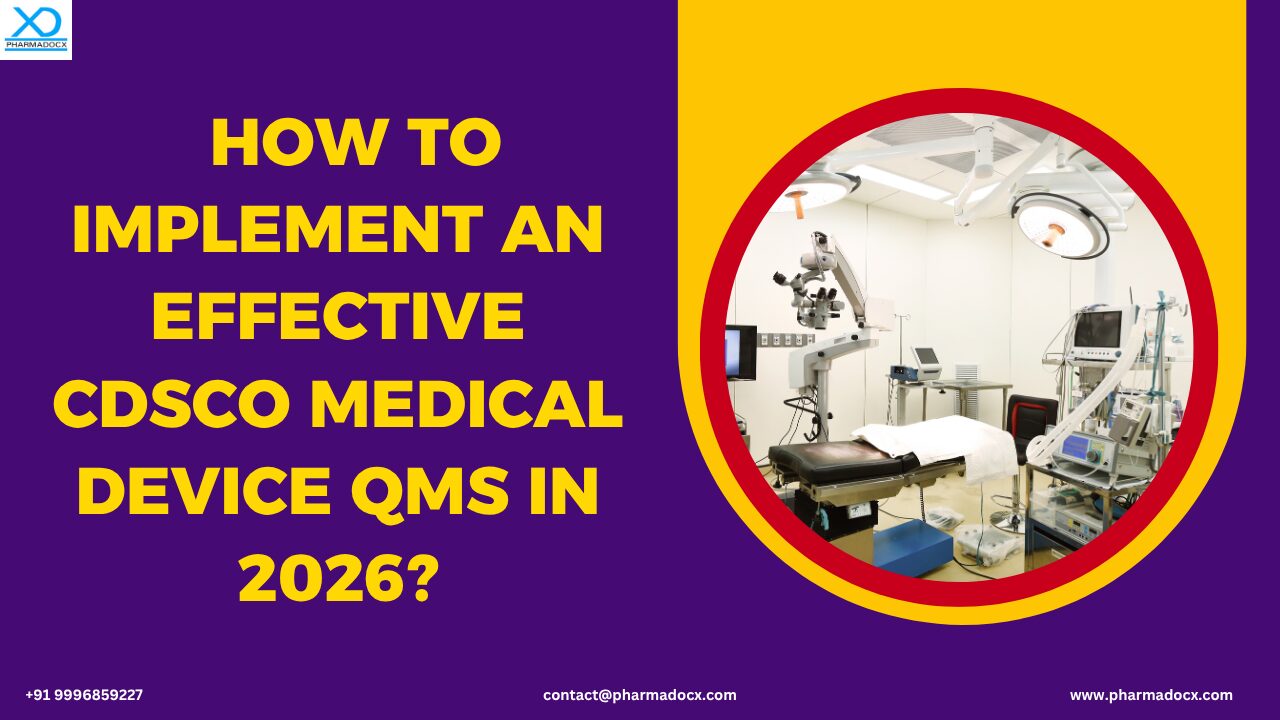
CDSCO medical device QMS is a strategic framework that ensures patient safety, operational discipline, and market access. Preparing one effectively means going beyond documentation. Manufacturers should treat the QMS as a living system. It should be continuously updated with CDSCO’s evolving guidance and reinforced through internal audits and staff training. We have curated this detailed guide to help you prepare an effective CDSCO medical device QMS in 2026.
What is medical device QMS?
A medical device QMS (Quality Management System) is a structured framework of policies, processes, and procedures that ensures medical devices are consistently designed, manufactured, and delivered to meet regulatory requirements and patient safety standards. A documented system that governs quality across the device lifecycle from design and development to production, distribution, installation, servicing, and post-market surveillance.
The globally recognized benchmark for medical device QMS is ISO 13485:2016. The international standard is specifically tailored for medical devices. It focuses on risk management, regulatory compliance, and continued improvement. Compliance with this standard is mandatory or strongly recommended in most regions, including India under CDSCO, the U.S. FDA, and the EU MDR.
We have listed some of the key components of a medical device QMS.
- Design controls: Structured processes for design validation, verification, and change management.
- Documented procedures: SOPs for design, manufacturing, testing, labeling, and distribution.
- Risk management: Integration of ISO 14971 principles to identify, evaluate, and mitigate risks.
- Supplier management: Qualification, audits, and monitoring of suppliers to ensure component quality.
- Production and process controls: Validation of manufacturing processes, equipment calibration, and environmental monitoring.
- Complaint handling and CAPA: Systems for corrective and preventive actions based on feedback and non-conformities.
- Post-market surveillance: Vigilance reporting, recalls, and monitoring of device performance in the field.
Benefits of an effective medical device QMS
- Risk reduction: Systematic identification and mitigation of patient safety risks.
- Operational efficiency: Streamlined processes, reduced waste, and improved productivity.
- Regulatory compliance: Enables market access in regulated medical device markets, such as India, U.S., EU, and other regions.
- Market trust: Builds credibility with regulators, customers, and healthcare providers.
- Global trade opportunity: Facilitates exports by meeting harmonized international standards.
What is CDSCO medical device QMS?
A CDSCO medical device QMS refers to the quality management system framework mandated by India’s Central Drugs Standard Control Organization (CDSCO) under the Medical Device Rules (MDR) 2017. It requires manufacturers and importers of medical devices to establish, document, and maintain a QMS that aligns with ISO 13485:2016.
Key features of CDSCO medical device QMS
- ISO 13485 alignment: CDSCO mandates compliance with ISO 13485 for CDSCO medical device licensing and audits.
- Lifecycle coverage: CDSCO medical device QMS must span design, development, manufacturing, distribution, installation, servicing, and post-market surveillance.
- Risk-based approach: Integration of ISO 14971 risk management principles to ensure patient safety.
- Documentation and traceability: Device master file (DMF), plant master file (PMF), technical file, SOPs, and CAPA records must be properly maintained. Additionally, traceability should be ensured for these documents.
- Supplier governance: Qualification, audits, and monitoring of suppliers to ensure raw material/component quality.
- Post-market vigilance: Systems should be in place for adverse event reporting, recalls, and corrective actions.
Properties of an effective CDSCO medical device QMS
An effective CDSCO medical device QMS meets the baseline requirement of ISO 13485:2016. Additionally, it also demonstrates operational discipline, risk-based thinking, and audit resilience.
- Contents: The CDSCO medical device QMS should extend across design, development, manufacturing, distribution, installation, servicing, and post-market surveillance. It should be fully harmonized with ISO 13485:2016, thereby ensuring international compatibility. Moreover, every process, record, and change should be traceable to ensure accountability.
- Compliance: The medical device QMS should incorporate ISO 14971 risk management principles for patient safety. It should be explicitly aligned with CDSCO MDR 2017 requirements. The file should be structured to withstand CDSCO inspections, with mock audits and CAPA systems in place.
- Operational: Strong supplier qualification along with audit scorecards and corrective action tracking are required as part of supplies governance. Manufacturing processes, cleanroom controls, and calibration should be validated and documented. Staff competence records should be maintained, with regular refresher training on regulatory updates.
- Post-market surveillance: Robust adverse event vigilance system for timely reporting to CDSCO.Effective corrective and preventive action systems linked to customer feedback.Capability to submit dossiers and QMS evidence via CDSCO’s online portal.
How to implement an effective CDSCO medical device QMS?
1. Build a cross‑functional implementation team
Form a dedicated team that includes representatives from quality, regulatory, manufacturing, supply chain, and IT. This team should map existing processes against CDSCO and ISO 13485 requirements. Gaps identified must be prioritized and assigned to responsible representatives with clear timelines. Cross‑functional collaboration prevents siloed compliance and ensures holistic coverage. The team should also coordinate training programs to build competence across departments. By involving diverse stakeholders, the CDSCO medical device QMS becomes resilient and adaptable to real‑world challenges.
2. Operationalize through SOP deployment
Translate regulatory and ISO requirements into practical SOPs that staff can follow daily. Conduct workshops to train employees on how to apply SOPs in real scenarios, not just read them. Monitor adherence through spot checks and process audits. Revise SOPs based on feedback and regulatory updates to keep them current. This operationalization ensures the CDSCO medical device QMS is embedded in workflows rather than sitting idle in manuals.
3. Develop a phased rollout plan
Implementation of the CDSCO medical device QMS should be staged rather than attempted in one sweep. Begin with high‑risk areas, such as design controls, supplier governance, and complaint handling. Once critical processes are stabilized, expand to supporting functions, like training, calibration, and documentation. Each phase must include internal audits and corrective actions before moving forward. This phased approach reduces disruption and allows lessons learned to be applied progressively. It also demonstrates to CDSCO auditors that the organization is methodical and disciplined in its compliance journey.
4. Embed risk management in every process
Integrate ISO 14971 risk management principles into design, supplier, and post‑market activities. Require risk assessments at every stage, from raw material sourcing to device complaints. Use risk registers and mitigation plans that are reviewed monthly by the QMS team. Train staff to identify risks proactively rather than reactively. Link CAPA systems directly to risk findings so that corrective actions are prioritized by severity. Embedding risk management ensures the QMS is dynamic and patient‑safety driven.
5. Integrate digital tools for compliance
Adopt electronic document management systems and CDSCO’s online portal for submissions. Additionally, automate version control, audit trails, and CAPA tracking to reduce manual errors. Moreover, use dashboards to monitor compliance KPIs, such as audit closure rates and supplier performance. Integrate supplier qualification data into the system for real‑time visibility. Ensure cybersecurity measures are in place to protect sensitive regulatory files. Digital infrastructure makes the QMS scalable, transparent, and inspection‑ready.
6. Conduct continuous internal audits and mock inspections
Regular internal audits simulate CDSCO inspections and test the robustness of the CDSCO medical device QMS. Findings must be documented, corrective actions tracked, and closure verified within defined timelines. Mock inspections help staff gain confidence and reduce anxiety during real audits. They also highlight systemic weaknesses that may not surface in routine operations. Continuous auditing ensures the QMS evolves with regulatory updates and operational changes. This cycle of review and improvement is the hallmark of an effective and resilient QMS.
Therefore, a CDSCO medical device QMS is not just a regulatory requirement but vital for patient safety, operational discipline, and market access. Preparing one effectively means going beyond documentation. It requires leadership commitment, regulatory mapping, risk integration, and digital infrastructure. The QMS should continuously be updated with CDSCO’s evolving guidance and reinforced through internal audits and staff training. For successful implementation, a phased and collaborative approach is required. Email at [email protected] or call/Whatsapp on 9996859227 for support with robust and effective QMS implementation.