
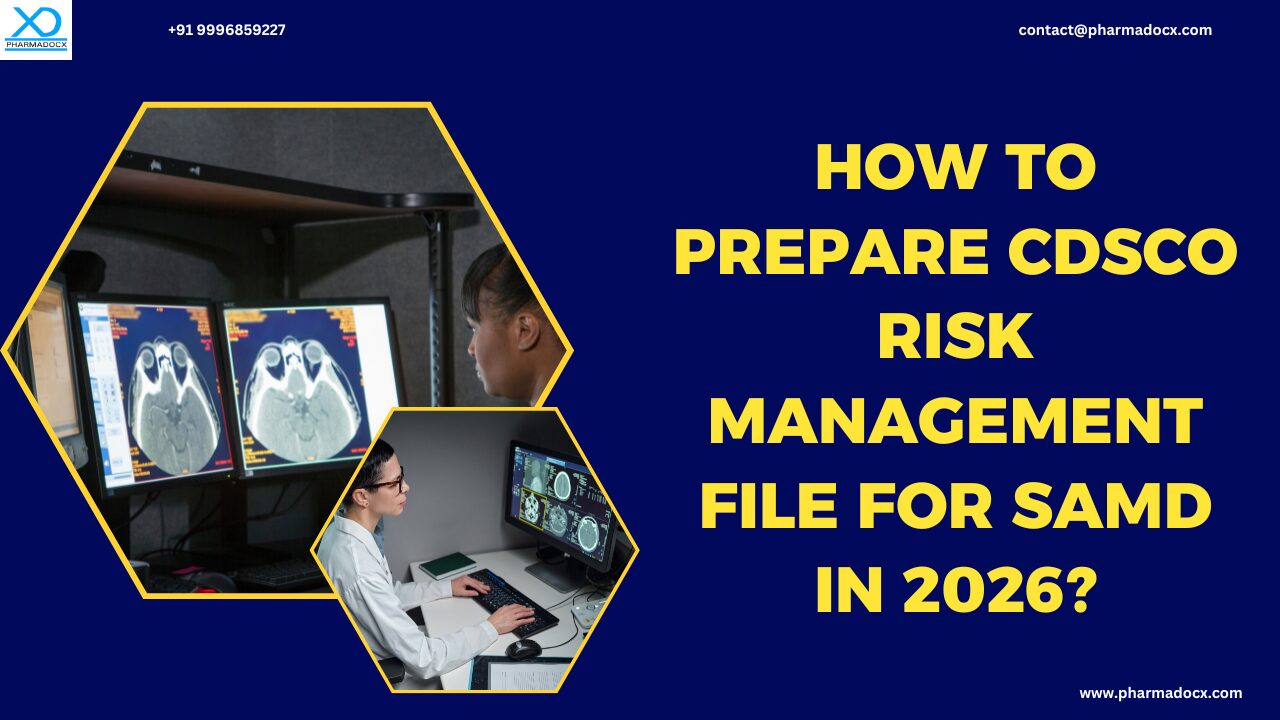
CDSCO risk management file for SaMD is a structured documentation covering hazards, risk evaluation, controls, verification, and lifecycle oversight. It aligns with ISO 14971 and IEC 62304. Moreover, CDSCO SaMD risk management file also focuses on cybersecurity, AI algorithm change protocols, and post‑market surveillance requirements. The risk management file demonstrates how patient safety risks are identified, assessed, and controlled throughout the SaMD lifecycle. We have prepared a detailed guide to help you easily prepare CDSCO risk management file for SaMD in 2026.
What is the purpose of CDSCO risk management file for SaMD?
CDSCO SaMD risk management file is used to demonstrate the SaMD is safe for clinical use in India. The CDSCO risk management file for SaMD acts as evidence that risk management is not a one-time activity but a continuous one. CDSCO requires this file to align with ISO 14971 principles, adapted for software-specific hazards. It ensures regulators see a proactive approach to risk-based thinking in medical device software. The main purpose of the risk management file is to show how patient safety risks are identified, assessed, and controlled throughout the SaMD lifecycle.
Scope and applicability of CDSCO SaMD risk management file
The CDSCO SaMD risk management file must clearly define the scope of risk management activities for the SaMD. It should specify whether the software is standalone, embedded, or part of a connected ecosystem. Applicability extends to cybersecurity, data integrity, and interoperability risks. CDSCO expects clarity on whether risks apply to patients, users, or healthcare systems.
Core components of CDSCO risk management file for SaMD
1. Device description and intended use
The CDSCO SaMD risk management file must begin with a detailed description of the SaMD, including its medical purpose, scope, and classification under India’s Medical Device Rules (MDR 2017). It should explain how the software is intended to be used, who the target users are, and in what clinical environment it will operate. The description must also clarify whether the SaMD is standalone, embedded, or part of a connected ecosystem. This section establishes the foundation for understanding the risk profile of the device. Regulators rely on this clarity to assess whether the software qualifies as a medical device under CDSCO’s framework.
2. Risk management plan
The CDSCO risk management file for SaMD must contain a structured plan that outlines how risks will be identified, analyzed, controlled, and monitored throughout the lifecycle of the SaMD. This plan should reference ISO 14971 principles and adapt them to the unique challenges of software. It must define responsibilities, team roles, and the phases of the lifecycle covered, from design to post‑market surveillance. The plan should also explain how risk management activities integrate with the company’s Quality Management System (QMS).
3. Hazard identification
The file must document all potential hazards associated with the SaMD, including functional, technical, clinical, and cybersecurity risks. Cybersecurity threats, such as unauthorized access or malware, must also be considered. Each hazard must be listed, even if later judged negligible, to demonstrate thoroughness.
4. Risk analysis and classification
The CDSCO SaMD risk management file must explain how each identified hazard is analyzed in terms of severity, probability, and detectability. Risks should be classified into categories such as minor, moderate, or critical, with justification for each classification. For SaMD, severity often relates to patient harm caused by incorrect or delayed outputs. Probability must consider both technical failure rates and human factors. This structured classification helps prioritize which risks require immediate and robust mitigation.
5. Risk control measures
The file must describe the measures taken to control or reduce risks to acceptable levels. These may include technical solutions, such as validation testing, redundancy, error alerts, and restricted access. Cybersecurity controls, such as encryption and penetration testing, should also be documented. For AI‑based SaMD, algorithm change protocols must be included to manage evolving risks. Regulators expect clear justification for why each control is effective and proportionate.
6. Verification of risk controls
The CDSCO risk management file for SaMD must provide evidence that risk control measures have been tested and verified. Verification activities may include software validation, simulation, and clinical scenario testing. Each risk must be traceable to its corresponding verification outcome. Documentation should include test reports, logs, and validation records.
7. Residual risk evaluation
The file must evaluate risks that remain after controls have been applied. Manufacturers must justify why these residual risks are clinically acceptable, often through benefit‑risk analysis. Any residual risks must be communicated to users via labeling, instructions, or warnings. Transparency in this evaluation builds trust with regulators and end‑users. In the file, CDSCO expects a clear rationale for why residual risks do not compromise patient safety.
8. Post‑market surveillance and vigilance
The CDSCO SaMD risk management file must outline procedures for monitoring risks once the SaMD is in use. This includes tracking adverse events, software bugs, and cybersecurity incidents. Corrective and preventive actions (CAPA) must be documented, along with timelines for reporting serious incidents to CDSCO. Field safety corrective actions, such as patches or recalls, should also be described.
9. Integration with quality management system (QMS)
The file must demonstrate how risk management activities are integrated into the company’s QMS. It should align with ISO 13485 and IEC 62304 standards for medical software. Risk management must connect to SOPs, audits, and CAPA processes to ensure consistency. Documentation should also show how risks are managed across suppliers and subcontractors.
10. Documentation and traceability
The CDSCO risk management file for SaMD must provide structured documentation that links each risk to its identification, assessment, control, and verification. A traceability matrix is often used to show these connections clearly. Supporting documents, such as system architecture, software requirements specifications, and test records, must be included. Compliance with relevant BIS and ISO standards should be referenced. Strong documentation and traceability reduce audit findings and accelerate CDSCO approval timelines.
How to prepare CDSCO risk management file for SaMD in 2026?
We have provided a step-by-step guide to help you prepare the CDSCO risk management file for SaMD. This guide ensures the file is comprehensive, audit‑ready, and aligned with CDSCO’s expectations for SaMD’s regulatory compliance.
Step 1: Define scope and objectives
Begin by clearly describing the SaMD, its intended medical use, and classification under India’s Medical Device Rules (MDR 2017). This sets the boundaries for risk management activities and ensures regulators understand the device’s clinical context. A well‑defined scope prevents gaps in hazard identification and aligns the file with CDSCO expectations.
Step 2: Develop a risk management plan
Prepare a structured plan that outlines responsibilities, lifecycle phases, and methodologies for risk assessment. The plan should reference ISO 14971 and IEC 62304, adapted specifically for software risks. This plan should be properly detailed in the CDSCO SaMD risk management file.
Step 3: Identify and analyze hazards
Systematically list all potential hazards, including functional errors, cybersecurity threats, and clinical misinterpretations, in the file. Comprehensive hazard analysis in the file reassures CDSCO that risks have been thoroughly explored.
Step 4: Implement and verify risk controls
Document the technical and procedural measures, such as validation testing, error alerts, encryption, and SOPs, taken to reduce risks. Verification must show that these controls are effective, supported by test reports and validation records. Traceability between risks and controls is essential to prove practical enforcement. Hence, incorporate traceability between risks and controls in the file.
Step 5: Cover post‑market vigilance
Notably, the CDSCO risk management file for SaMD should outline procedures for monitoring adverse events, software bugs, and cybersecurity incidents once the SaMD is in use. Hence, keep this in mind while preparing the file.
In this blog, we have provided a detailed guide to help you prepare CDSCO risk management file for SaMD. For any assistance with securing CDSCO license for SaMD, drop an email at [email protected] or call/Whatsapp on 9996859227.